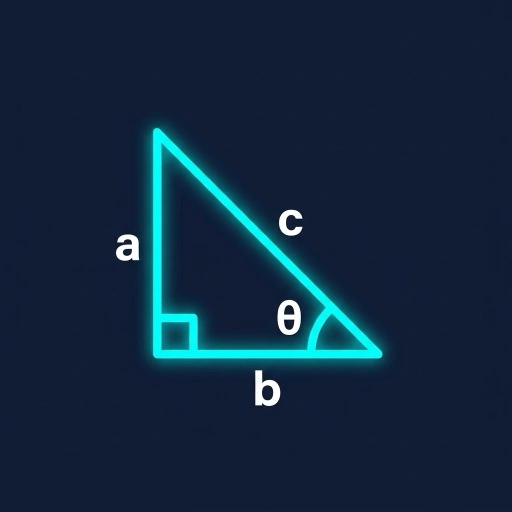
30-60-90 Triangle Calculator
A 30-60-90 triangle is a special right triangle with acute angles measuring $30^\circ$ and $60^\circ$ and a right angle of $90^\circ$. Its side lengths strictly adhere to the fundamental ratio $1 : \sqrt{3} : 2$.
Use this 30-60-90 triangle calculator to solve the short leg, long leg, hypotenuse, area, and perimeter instantly from any known side length. Get both exact radical forms with $\sqrt{3}$ and clean decimal approximations step-by-step.
30-60-90 Triangle Calculator
Select your input mode to calculate missing sides, exact radical expressions (√3), area, perimeter, and step-by-step mathematical proofs.
Calculation Results
Complete geometric solution & step-by-step breakdown
Step-by-Step Formulas & Solution Steps
Detailed Breakdown
What Can the 30-60-90 Triangle Calculator Calculate?
Our 30-60-90 Triangle Calculator evaluates all geometric and trigonometric properties simultaneously from any single known side, area, or perimeter measurement.
Because the three interior angles ($30^\circ, 60^\circ, 90^\circ$) fix the geometry of the triangle, entering any single dimension allows our solver to unlock all remaining values using the exact $1 : \sqrt{3} : 2$ ratio:
| Geometric Dimension | Notation | Exact Radical Formula | Description |
|---|---|---|---|
| Short Leg | $x$ (or $a$) | $x = \frac{c}{2} = \frac{b}{\sqrt{3}}$ | Side opposite the $30^\circ$ angle. Smallest side length. |
| Long Leg | $b$ | $b = x\sqrt{3} = \frac{c\sqrt{3}}{2}$ | Side opposite the $60^\circ$ angle. Adjacent to $30^\circ$. |
| Hypotenuse | $c$ | $c = 2x = \frac{2b}{\sqrt{3}}$ | Side opposite the $90^\circ$ right angle. Longest side. |
| Area | $A$ | $A = \frac{x^2\sqrt{3}}{2}$ | Enclosed 2D surface space inside the 30-60-90 boundary. |
| Perimeter | $P$ | $P = x(3 + \sqrt{3})$ | Total distance around all three outer edges. |
What Is a 30-60-90 Triangle?
A fundamental special right triangle with fixed interior angles of $30^\circ$, $60^\circ$, and $90^\circ$.
A 30-60-90 triangle is a specialized right triangle whose internal angles measure exactly $30^\circ$, $60^\circ$, and $90^\circ$. The $90^\circ$ angle forms the right angle corner, while $30^\circ$ and $60^\circ$ are complementary acute angles ($30^\circ + 60^\circ = 90^\circ$).
In Euclidean geometry, a 30-60-90 triangle is categorized as a special right triangle because the trigonometric functions ($\sin, \cos, \tan$) of its acute angles evaluate to exact radical fractions involving $\sqrt{3}$. The side opposite the $30^\circ$ angle is always the shortest leg, the side opposite the $60^\circ$ angle is the long leg, and the side opposite the $90^\circ$ angle is the hypotenuse.
📐 Key 30-60-90 Properties
- Acute Angle Complementarity: $30^\circ + 60^\circ = 90^\circ$.
- Short Leg Halving: Short leg $x$ is always exactly half the length of hypotenuse $c$ ($x = c/2$).
- Long Leg Scale: Long leg $b$ equals short leg $x$ multiplied by $\sqrt{3}$ ($b = x\sqrt{3}$).
30-60-90 Triangle Ratio
The canonical side length ratio governing all 30-60-90 triangles: $1 : \sqrt{3} : 2$.
The fundamental side length ratio of every 30-60-90 triangle is:
Mapping each ratio term directly to its corresponding side length gives:
- Short Leg ($x$): $1x$ (opposite $30^\circ$)
- Long Leg ($b$): $x\sqrt{3} \approx 1.73205x$ (opposite $60^\circ$)
- Hypotenuse ($c$): $2x$ (opposite $90^\circ$)
Multiplying all three ratio terms by any positive scale factor ($x > 0$) generates another similar 30-60-90 triangle. Here are common scaled examples:
| Scale Factor ($x$) | Short Leg ($x$) | Long Leg ($x\sqrt{3}$) | Hypotenuse ($2x$) | Exact Ratio |
|---|---|---|---|---|
| $x = 1$ | $1$ | $\sqrt{3} \approx 1.7321$ | $2$ | $1 : \sqrt{3} : 2$ |
| $x = 2$ | $2$ | $2\sqrt{3} \approx 3.4641$ | $4$ | $2 : 2\sqrt{3} : 4$ |
| $x = 5$ | $5$ | $5\sqrt{3} \approx 8.6603$ | $10$ | $5 : 5\sqrt{3} : 10$ |
| $x = 10$ | $10$ | $10\sqrt{3} \approx 17.3205$ | $20$ | $10 : 10\sqrt{3} : 20$ |
30-60-90 Triangle Formulas
Algebraic equations for converting between sides, hypotenuse, area, and perimeter.
Short Leg Formula
Calculates short leg $x$ opposite $30^\circ$ from hypotenuse $c$ or long leg $b$.
Long Leg Formula
Calculates long leg $b$ opposite $60^\circ$ from short leg $x$ or hypotenuse $c$.
Hypotenuse Formula
Calculates hypotenuse $c$ opposite $90^\circ$ from short leg $x$ or long leg $b$.
Area Formula
Calculates 2D area $A$ directly from short leg length $x$.
Perimeter Formula
Sums all three sides ($x + x\sqrt{3} + 2x$) into a simplified expression.
How to Find 30-60-90 Triangle Dimensions
Detailed step-by-step methods for solving missing hypotenuse, legs, area, and perimeter.
1. How to Find the Hypotenuse ($c$)
When Short Leg ($x$) is known: Double the short leg value ($c = 2x$).
Example: If $x = 7\text{ cm} \implies c = 2 \times 7 = 14\text{ cm}$.
When Long Leg ($b$) is known: Multiply long leg by $\frac{2}{\sqrt{3}}$ ($c = \frac{2b\sqrt{3}}{3}$).
Example: If $b = 12\text{ cm} \implies c = \frac{24\sqrt{3}}{3} = 8\sqrt{3} \approx 13.8564\text{ cm}$.
2. How to Find the Short Leg ($x$)
When Hypotenuse ($c$) is known: Halve the hypotenuse value ($x = c/2$).
Example: If $c = 20\text{ m} \implies x = 20/2 = 10\text{ m}$.
When Long Leg ($b$) is known: Divide long leg by $\sqrt{3}$ ($x = b/\sqrt{3}$).
Example: If $b = 15\text{ in} \implies x = \frac{15}{\sqrt{3}} = 5\sqrt{3} \approx 8.6603\text{ in}$.
3. How to Find Area ($A$) and Perimeter ($P$)
Area: $$A = \frac{1}{2} \times \text{base} \times \text{height} = \frac{1}{2} \times x \times x\sqrt{3} = \frac{x^2\sqrt{3}}{2}$$
Perimeter: $$P = a + b + c = x + x\sqrt{3} + 2x = x(3 + \sqrt{3})$$
Why Does the 1:√3:2 Ratio Work?
Mathematical proofs via Pythagorean theorem and equilateral triangle bisection.
The $1 : \sqrt{3} : 2$ ratio is mathematically derived using the Pythagorean theorem ($a^2 + b^2 = c^2$).
Let short leg $= x$ and hypotenuse $= 2x$. Solving for long leg $b$:
$$(2x)^2 = x^2 + b^2$$ $$4x^2 = x^2 + b^2 \implies b^2 = 3x^2 \implies b = \sqrt{3x^2} = x\sqrt{3}$$Writing all three sides as a ratio: $x : x\sqrt{3} : 2x$. Dividing each term by $x$ yields the exact canonical ratio $1 : \sqrt{3} : 2$.
🔺 Equilateral Triangle Derivation
- Start with an equilateral triangle of side length $2$ (all interior angles equal $60^\circ$).
- Draw an altitude line from the top vertex perpendicular to the bottom base.
- The altitude bisects the top $60^\circ$ angle into two $30^\circ$ angles and splits the base of length $2$ into two equal halves of length $1$.
- This produces two identical 30-60-90 right triangles with hypotenuse $2$, short leg $1$, and altitude $\sqrt{3}$.
30-60-90 Triangle and SOHCAHTOA
Exact trigonometric function values for $30^\circ$ and $60^\circ$.
| Angle ($\theta$) | $\sin(\theta) = \frac{\text{Opp}}{\text{Hyp}}$ | $\cos(\theta) = \frac{\text{Adj}}{\text{Hyp}}$ | $\tan(\theta) = \frac{\text{Opp}}{\text{Adj}}$ |
|---|---|---|---|
| $30^\circ$ | $\sin 30^\circ = \frac{1}{2} = 0.5$ | $\cos 30^\circ = \frac{\sqrt{3}}{2} \approx 0.8660$ | $\tan 30^\circ = \frac{1}{\sqrt{3}} \approx 0.5774$ |
| $60^\circ$ | $\sin 60^\circ = \frac{\sqrt{3}}{2} \approx 0.8660$ | $\cos 60^\circ = \frac{1}{2} = 0.5$ | $\tan 60^\circ = \sqrt{3} \approx 1.7321$ |
Learn more about right-triangle trigonometry with our SOHCAHTOA Calculator.
30-60-90 Triangle Worked Examples
Step-by-step solved math problems for various known inputs.
Example 1: Short Leg = 1
Given: Short leg $x = 1$
- Long leg: $b = 1 \times \sqrt{3} = \sqrt{3} \approx 1.7321$
- Hypotenuse: $c = 2 \times 1 = 2$
- Area: $A = \frac{1^2\sqrt{3}}{2} = \frac{\sqrt{3}}{2} \approx 0.8660$
- Perimeter: $P = 1(3 + \sqrt{3}) = 3 + \sqrt{3} \approx 4.7321$
Example 2: Short Leg = 5
Given: Short leg $x = 5$
- Long leg: $b = 5\sqrt{3} \approx 8.6603$
- Hypotenuse: $c = 2 \times 5 = 10$
- Area: $A = \frac{5^2\sqrt{3}}{2} = \frac{25\sqrt{3}}{2} \approx 21.6506$
- Perimeter: $P = 5(3 + \sqrt{3}) = 15 + 5\sqrt{3} \approx 23.6603$
Example 3: Hypotenuse = 20
Given: Hypotenuse $c = 20$
- Short leg: $x = \frac{20}{2} = 10$
- Long leg: $b = 10\sqrt{3} \approx 17.3205$
- Area: $A = \frac{10^2\sqrt{3}}{2} = 50\sqrt{3} \approx 86.6025$
- Perimeter: $P = 10(3 + \sqrt{3}) = 30 + 10\sqrt{3} \approx 47.3205$
Example 4: Long Leg = 15
Given: Long leg $b = 15$
- Short leg: $x = \frac{15}{\sqrt{3}} = 5\sqrt{3} \approx 8.6603$
- Hypotenuse: $c = 2 \times 5\sqrt{3} = 10\sqrt{3} \approx 17.3205$
- Area: $A = \frac{(5\sqrt{3})^2\sqrt{3}}{2} = \frac{75\sqrt{3}}{2} \approx 64.9519$
- Perimeter: $P = 5\sqrt{3}(3 + \sqrt{3}) = 15\sqrt{3} + 15 \approx 40.9808$
30-60-90 Triangle Comparisons
Comparing 30-60-90 triangles to 45-45-90 triangles, general right triangles, and equilateral triangles.
| Property | 30-60-90 Triangle | 45-45-90 Triangle |
|---|---|---|
| Angles | $30^\circ, 60^\circ, 90^\circ$ | $45^\circ, 45^\circ, 90^\circ$ |
| Side Ratio | $1 : \sqrt{3} : 2$ | $1 : 1 : \sqrt{2}$ |
| Equal Legs? | No (Unequal legs: $x$ and $x\sqrt{3}$) | Yes (Isosceles: $a = b$) |
| Hypotenuse Formula | $c = 2x$ | $c = a\sqrt{2}$ |
| Derived From | Equilateral triangle divided in half | Square cut along diagonal |
Compare with our 45-45-90 Triangle Calculator.
💡 30-60-90 vs General Right Triangles
Every 30-60-90 triangle is a right triangle, but not every right triangle is a 30-60-90 triangle. General right triangles can have any acute angle values (e.g. $20^\circ$ and $70^\circ$, or $36.87^\circ$ and $53.13^\circ$ in a 3-4-5 triangle). The $1:\sqrt{3}:2$ ratio applies strictly to 30-60-90 triangles.
Real-World Applications & Coordinate Geometry
Practical engineering uses and Cartesian coordinate plane applications.
Practical Real-World Fields:
- Architecture & Roofing: Designing $30^\circ$ and $60^\circ$ roof pitches, triangular trusses, and gables.
- Drafting & Engineering: Set squares and 30-60-90 drafting tools used for technical isometric drawing.
- Construction & Carpentry: Cutting isometric braces, hexagonal paving tiles, and structural supports.
Coordinate Geometry & Distance Formula:
On a Cartesian coordinate plane, a 30-60-90 triangle appears when finding points on the unit circle at $30^\circ$ ($\frac{\pi}{6}$) or $60^\circ$ ($\frac{\pi}{3}$). Coordinates of a point at $30^\circ$ on a circle of radius $r$ are $(\frac{r\sqrt{3}}{2}, \frac{r}{2})$.
30-60-90 Formula Quick Reference
At-a-glance cheat sheet for 30-60-90 special right triangles.
| Property / Dimension | Symbol | Exact Formula | Key Relationship / Value |
|---|---|---|---|
| Interior Angles | $\alpha, \beta, \gamma$ | $30^\circ + 60^\circ + 90^\circ = 180^\circ$ | Fixed ratio $1 : 2 : 3$ ($\text{Sum} = 180^\circ$) |
| Side Ratio | $a : b : c$ | $x : x\sqrt{3} : 2x$ | $1 : \sqrt{3} : 2$ (Short : Long : Hypotenuse) |
| Short Leg | $x$ (opp $30^\circ$) | $x = \frac{c}{2} = \frac{b}{\sqrt{3}}$ | Exactly half of hypotenuse $c$ |
| Long Leg | $b$ (opp $60^\circ$) | $b = x\sqrt{3} = \frac{c\sqrt{3}}{2}$ | Short leg times $\sqrt{3} \approx 1.73205$ |
| Hypotenuse | $c$ (opp $90^\circ$) | $c = 2x = \frac{2b}{\sqrt{3}}$ | Double the short leg $x$ |
| Area | $A$ | $A = \frac{1}{2}ab = \frac{x^2\sqrt{3}}{2}$ | Enclosed surface area ($\approx 0.8660 x^2$) |
| Perimeter | $P$ | $P = x + b + c = x(3 + \sqrt{3})$ | Sum of all 3 sides ($\approx 4.73205 x$) |
| Altitude to $c$ | $h_c$ | $h_c = \frac{ab}{c} = \frac{x\sqrt{3}}{2}$ | Perpendicular distance from $C$ to $c$ |
| Trig Values ($30^\circ$) | $\sin, \cos, \tan$ | $\sin 30^\circ = \frac{1}{2}, \quad \cos 30^\circ = \frac{\sqrt{3}}{2}, \quad \tan 30^\circ = \frac{1}{\sqrt{3}}$ | Exact radical trig ratios for $30^\circ$ |
| Trig Values ($60^\circ$) | $\sin, \cos, \tan$ | $\sin 60^\circ = \frac{\sqrt{3}}{2}, \quad \cos 60^\circ = \frac{1}{2}, \quad \tan 60^\circ = \sqrt{3}$ | Exact radical trig ratios for $60^\circ$ |
Related Right Triangle Calculators
Explore our suite of specialized right triangle geometry solvers.
Frequently Asked Questions
Answers to common questions about 30-60-90 right triangles.
Q1
What is a 30-60-90 triangle?
A 30-60-90 triangle is a special right triangle with interior angles measuring 30°, 60°, and 90°. Its three side lengths follow the fixed ratio $1 : \sqrt{3} : 2$.
Q2
What is the 30-60-90 triangle ratio?
The side length ratio is $1 : \sqrt{3} : 2$, representing $\text{Short Leg} : \text{Long Leg} : \text{Hypotenuse}$. If short leg is $x$, long leg is $x\sqrt{3}$ and hypotenuse is $2x$.
Q3
What is the formula for a 30-60-90 triangle?
The core formulas are: Hypotenuse $c = 2x$, Long Leg $b = x\sqrt{3}$, Short Leg $x = \frac{c}{2}$ or $x = \frac{b}{\sqrt{3}}$, Area $A = \frac{x^2\sqrt{3}}{2}$, and Perimeter $P = x(3 + \sqrt{3})$.
Q4
What is the shortest side of a 30-60-90 triangle?
The short leg ($x$) is always opposite the 30° angle. It is exactly half the length of the hypotenuse ($x = \frac{c}{2}$).
Q5
How do you find the long leg?
Multiply the short leg length $x$ by $\sqrt{3}$ ($b = x\sqrt{3}$), or multiply hypotenuse $c$ by $\frac{\sqrt{3}}{2}$ ($b = \frac{c\sqrt{3}}{2}$).
Q6
How do you find the hypotenuse?
Double the short leg length $x$ ($c = 2x$), or multiply long leg $b$ by $\frac{2}{\sqrt{3}}$ ($c = \frac{2b}{\sqrt{3}}$).
Q7
Why is the ratio 1:√3:2?
Bisecting an equilateral triangle of side length 2 with an altitude creates two 30-60-90 triangles. The base becomes 1, the hypotenuse is 2, and by the Pythagorean theorem, the altitude equals $\sqrt{2^2 - 1^2} = \sqrt{3}$.
Q8
What is √3 in a 30-60-90 triangle?
Square root of 3 ($\sqrt{3} \approx 1.73205$) is the scaling factor connecting the short leg to the long leg ($b = x\sqrt{3}$).
Q9
How do you find the area?
Using $\text{Area} = \frac{1}{2} \times \text{base} \times \text{height}$, substitute short leg $x$ and long leg $x\sqrt{3}$ to get $\text{Area} = \frac{x^2\sqrt{3}}{2}$.
Q10
How do you find the perimeter?
Add all three side lengths: $P = x + x\sqrt{3} + 2x = x(3 + \sqrt{3})$.
Q11
Can I find the short leg from the hypotenuse?
Yes. Divide hypotenuse $c$ by 2: Short Leg $x = \frac{c}{2}$.
Q12
Can I find the long leg from the hypotenuse?
Yes. Multiply hypotenuse $c$ by $\frac{\sqrt{3}}{2}$: Long Leg $b = \frac{c\sqrt{3}}{2}$.
Q13
Is every right triangle a 30-60-90 triangle?
No. A right triangle is only a 30-60-90 triangle if its acute interior angles measure exactly 30° and 60°.
Q14
What is the difference between 30-60-90 and 45-45-90?
A 30-60-90 triangle has angles 30°-60°-90° with side ratio $1 : \sqrt{3} : 2$ and unequal legs. A 45-45-90 triangle has angles 45°-45°-90° with side ratio $1 : 1 : \sqrt{2}$ and equal legs.
Q15
Why does an equilateral triangle create a 30-60-90 triangle?
An altitude drawn in an equilateral triangle bisects a 60° vertex angle into two 30° angles and meets the base at 90°, producing two congruent 30-60-90 right triangles.
Q16
Can the calculator show exact radical answers?
Yes. The calculator displays exact radical expressions (e.g., $5\sqrt{3}$) alongside high-precision decimal approximations.
Q17
Can the calculator calculate area and perimeter?
Yes. The calculator solves short leg, long leg, hypotenuse, area, perimeter, and altitude to hypotenuse simultaneously.
Q18
When should I use the 30-60-90 ratio?
Use the $1 : \sqrt{3} : 2$ ratio whenever a right triangle has acute angles measuring 30° and 60°, or when bisecting an equilateral triangle.