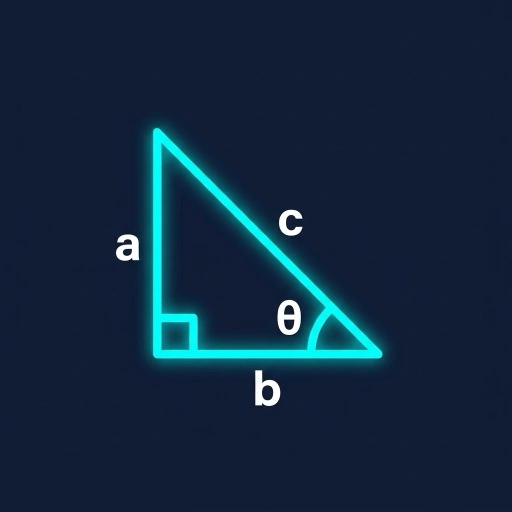
Right Triangle Formulas Reference
This comprehensive reference sheet provides quick, accurate formulas for solving and analyzing right triangles. Whether you need side lengths, acute angles, area, perimeter, altitude, or trigonometric ratios, find every essential right triangle equation below.
Formulas are logically organized by side relations, Pythagorean theorem, missing leg calculations, SOHCAHTOA trigonometry, area and perimeter, altitude to the hypotenuse, special 45-45-90 and 30-60-90 triangles, and angle unit conversions.
Standard Right Triangle Notation ($a = \text{leg}$, $b = \text{leg}$, $c = \text{hypotenuse}$, $C = 90^\circ$, $\theta = \text{angle}$)
Right Triangle Formula Reference
A quick-scan table detailing the core equations, mathematical expressions, and specific geometric purposes for right triangles.
| Formula | Equation | Purpose |
|---|---|---|
| Pythagorean Theorem | $a^2 + b^2 = c^2$ | Relates the lengths of two legs ($a, b$) to the hypotenuse ($c$). |
| Hypotenuse | $c = \sqrt{a^2 + b^2}$ | Calculates hypotenuse length from both perpendicular legs. |
| Missing Leg (a) | $a = \sqrt{c^2 - b^2}$ | Calculates leg $a$ when hypotenuse $c$ and leg $b$ are known. |
| Missing Leg (b) | $b = \sqrt{c^2 - a^2}$ | Calculates leg $b$ when hypotenuse $c$ and leg $a$ are known. |
| Area | $A = \frac{1}{2}bh = \frac{1}{2}ab$ | Determines enclosed surface area using perpendicular base and height. |
| Perimeter | $P = a + b + c$ | Calculates total distance around all three outer triangle edges. |
| Sine Ratio | $\sin\theta = \frac{\text{Opposite}}{\text{Hypotenuse}}$ | Relates reference angle $\theta$ to opposite leg and hypotenuse. |
| Cosine Ratio | $\cos\theta = \frac{\text{Adjacent}}{\text{Hypotenuse}}$ | Relates reference angle $\theta$ to adjacent leg and hypotenuse. |
| Tangent Ratio | $\tan\theta = \frac{\text{Opposite}}{\text{Adjacent}}$ | Relates reference angle $\theta$ to opposite leg and adjacent leg. |
| Altitude to Hypotenuse | $h = \frac{ab}{c}$ | Calculates perpendicular line segment from 90° vertex to hypotenuse. |
What Formulas Are Used for a Right Triangle?
Right triangles are defined by having exactly one 90-degree right angle. Because of this unique geometric constraint, mathematical calculations fall into distinct formula categories depending on which parameters are known:
- Side-Length Formulas: Fundamental algebraic relations based on side measurements ($a, b, c$).
- Hypotenuse Formulas: Explicit equations for calculating the longest side opposite the right angle.
- Missing-Leg Formulas: Subtractive square-root equations to solve for unknown legs.
- Angle Formulas: Complementary relationships for interior acute angles ($A + B = 90^\circ$).
- Trigonometric Formulas: SOHCAHTOA ratios ($\sin, \cos, \tan$) and inverse functions ($\arcsin, \arccos, \arctan$).
- Area Formulas: Measurements of interior 2D surface space ($A = \frac{1}{2}ab$).
- Perimeter Formulas: Summation of boundary side lengths ($P = a + b + c$).
- Altitude Formulas: Height calculations relative to the hypotenuse ($h = \frac{ab}{c}$).
- Special Right-Triangle Formulas: Fixed ratio shortcuts for 45-45-90 and 30-60-90 triangles.
Right Triangle Side Formulas
The sides of a right triangle consist of two legs ($a$ and $b$) that form the 90° right angle, and the hypotenuse ($c$) positioned opposite the right angle. All side-length calculations derive from the fundamental Pythagorean relationship:
Pythagorean Relation
Base equation relating leg lengths $a, b$ and hypotenuse $c$.
Hypotenuse Equation
Solves for hypotenuse length from both legs.
Leg a Equation
Solves for leg $a$ using hypotenuse $c$ and leg $b$.
Leg b Equation
Solves for leg $b$ using hypotenuse $c$ and leg $a$.
Variable notation: $a$ represents the first leg, $b$ represents the second leg, and $c$ represents the hypotenuse.
To calculate unknown side lengths interactively, visit our Right Triangle Side Calculator.
Pythagorean Theorem Formula
The primary Pythagorean theorem equation states that in any right-angled triangle, the area of a square constructed on the hypotenuse is equal to the sum of the areas of squares constructed on the two legs:
Here, $a$ and $b$ represent the legs adjacent to the 90° corner, while $c$ is the hypotenuse located directly opposite the right angle. This formula applies exclusively to right triangles.
Rearranging the theorem allows direct calculation of any single missing side:
- Hypotenuse form: $c = \sqrt{a^2 + b^2}$
- First leg form: $a = \sqrt{c^2 - b^2}$
- Second leg form: $b = \sqrt{c^2 - a^2}$
To compute values or explore proofs, see our Pythagorean Theorem Calculator and dedicated Pythagorean Theorem Guide.
Hypotenuse Formulas
The hypotenuse ($c$) is always the longest side in a right triangle. When both leg lengths ($a$ and $b$) are known, the hypotenuse formula is:
Equivalent squared form: $c^2 = a^2 + b^2$.
Quick Calculation Example:
For step-by-step hypotenuse calculations, use the specialized Right Triangle Hypotenuse Calculator.
Missing Leg Formulas
Calculating a missing leg requires knowing the hypotenuse ($c$) and one leg length. The missing-leg formulas are derived by isolating the unknown leg in the Pythagorean theorem:
Formula for Leg a
Requires hypotenuse $c$ and leg $b$.
Formula for Leg b
Requires hypotenuse $c$ and leg $a$.
Because hypotenuse $c$ is always larger than any leg, $c^2$ will always exceed the squared leg value, ensuring a real positive result under the square root. Solve missing leg problems directly with our Right Triangle Side Calculator.
Right Triangle Angle Formulas
The sum of all interior angles in any Euclidean triangle is always $180^\circ$. Because a right triangle possesses one fixed $90^\circ$ right angle, the remaining two acute interior angles ($A$ and $B$) must total $90^\circ$:
Rearranged equation to solve for one acute angle when the other is known:
This establishes that the two acute angles in a right triangle are always complementary. Solve angle measurements using our Right Triangle Angle Calculator.
SOHCAHTOA Formulas
Trigonometric ratios connect an acute interior angle ($\theta$) to the relative side lengths of a right triangle. SOHCAHTOA is the mnemonic used to remember the three primary definitions:
Sine (SOH)
Ratio of opposite leg to hypotenuse.
Cosine (CAH)
Ratio of adjacent leg to hypotenuse.
Tangent (TOA)
Ratio of opposite leg to adjacent leg.
Inverse Trigonometric Formulas (Finding Angles):
- $\theta = \sin^{-1}\left(\frac{\text{Opposite}}{\text{Hypotenuse}}\right) = \arcsin\left(\frac{O}{H}\right)$
- $\theta = \cos^{-1}\left(\frac{\text{Adjacent}}{\text{Hypotenuse}}\right) = \arccos\left(\frac{A}{H}\right)$
- $\theta = \tan^{-1}\left(\frac{\text{Opposite}}{\text{Adjacent}}\right) = \arctan\left(\frac{O}{A}\right)$
Practice or solve trig equations using the dedicated SOHCAHTOA Calculator.
Right Triangle Trigonometric Rearrangement Formulas
When an acute angle ($\theta$) and one side length are known, SOHCAHTOA formulas can be algebraically rearranged to calculate any unknown side:
| Trig Function | To Find Opposite (O) | To Find Adjacent (A) | To Find Hypotenuse (H) |
|---|---|---|---|
| Sine Ratio | $\text{Opposite} = \text{Hypotenuse} \times \sin\theta$ | - | $\text{Hypotenuse} = \frac{\text{Opposite}}{\sin\theta}$ |
| Cosine Ratio | - | $\text{Adjacent} = \text{Hypotenuse} \times \cos\theta$ | $\text{Hypotenuse} = \frac{\text{Adjacent}}{\cos\theta}$ |
| Tangent Ratio | $\text{Opposite} = \text{Adjacent} \times \tan\theta$ | $\text{Adjacent} = \frac{\text{Opposite}}{\tan\theta}$ | - |
Right Triangle Area Formula
The general formula for the area of any triangle is $A = \frac{1}{2}bh$. Because the two legs ($a$ and $b$) of a right triangle are strictly perpendicular to each other, one leg acts as the base ($b$) and the other leg serves as the height ($h$):
Quick Calculation Example:
To compute area from various input combinations, use our Right Triangle Area Calculator.
Right Triangle Perimeter Formula
The perimeter ($P$) represents the total boundary length surrounding the triangle. It is calculated by summing the lengths of all three sides:
Quick Calculation Example:
For interactive perimeter calculations, visit our Right Triangle Perimeter Calculator.
Right Triangle Altitude Formula
The altitude ($h$) to the hypotenuse is the perpendicular line segment drawn from the $90^\circ$ right-angle vertex to the opposite hypotenuse ($c$). Using equal area representations ($A = \frac{1}{2}ab = \frac{1}{2}ch$), the formula for altitude is:
Variables: $a$ and $b$ are the leg lengths, $c$ is the hypotenuse, and $h$ is the perpendicular altitude dropped onto the hypotenuse.
Solve altitude problems using our dedicated Right Triangle Altitude Calculator.
Right Triangle Base and Height Relationships
Starting from the fundamental area equation $A = \frac{1}{2}bh$, the base ($b$) or perpendicular height ($h$) can be isolated when the area and the other dimension are known:
To Find Base (b)
Solves for base using total area $A$ and perpendicular height $h$.
To Find Height (h)
Solves for height using total area $A$ and base $b$.
These rearranged relations allow quick recovery of missing perpendicular side dimensions from known surface area.
Right Triangle Special Angle Formulas
Certain acute angle measurements yield exact mathematical values for trigonometric ratios. The reference table below details exact radical values for standard special angles:
| Angle ($\theta$) | Radians | Sine ($\sin\theta$) | Cosine ($\cos\theta$) | Tangent ($\tan\theta$) |
|---|---|---|---|---|
| 30° | $\pi/6$ | $\frac{1}{2}$ | $\frac{\sqrt{3}}{2}$ | $\frac{1}{\sqrt{3}} = \frac{\sqrt{3}}{3}$ |
| 45° | $\pi/4$ | $\frac{\sqrt{2}}{2}$ | $\frac{\sqrt{2}}{2}$ | $1$ |
| 60° | $\pi/3$ | $\frac{\sqrt{3}}{2}$ | $\frac{1}{2}$ | $\sqrt{3}$ |
45-45-90 Triangle Formulas
A 45-45-90 triangle is an isosceles right triangle. Because both acute angles equal $45^\circ$, the two legs are of equal length ($a = b = x$). Its side lengths conform to the exact ratio:
Specific equations for a 45-45-90 triangle with leg length $x$:
- Leg length: $a = b = x$
- Hypotenuse: $c = x\sqrt{2}$
- Rearranged leg equation: $x = \frac{c}{\sqrt{2}} = \frac{c\sqrt{2}}{2}$
For exact calculations, see our 45-45-90 Triangle Calculator.
30-60-90 Triangle Formulas
A 30-60-90 triangle is a scalene right triangle produced by dividing an equilateral triangle in half. Its side lengths conform to the exact ratio:
Specific equations where $x$ represents the short leg opposite the $30^\circ$ angle:
- Short leg ($a$): $x$
- Long leg ($b$): $x\sqrt{3}$
- Hypotenuse ($c$): $2x$
Rearranged formulas starting from hypotenuse $c$:
- Short leg: $\text{short leg} = \frac{c}{2}$
- Long leg: $\text{long leg} = \frac{c\sqrt{3}}{2}$
For step-by-step solutions, use our 30-60-90 Triangle Calculator.
Right Triangle Formula Variables and Symbols
To avoid confusion when reading mathematical references, the table below outlines the standard variables and symbols used across all right triangle formulas:
| Symbol | Meaning | Description |
|---|---|---|
| a | First Leg | Perpendicular side forming the right angle (often height). |
| b | Second Leg | Perpendicular side forming the right angle (often base). |
| c | Hypotenuse | Longest side length, positioned opposite the 90° right angle. |
| A | Area / Angle A | Total enclosed 2D surface area (or label for vertex angle A). |
| P | Perimeter | Total distance around all three outer edges ($a + b + c$). |
| h | Altitude / Height | Perpendicular segment drawn from 90° corner to hypotenuse. |
| θ (alpha/beta) | Reference Angle | Selected acute interior angle measured in degrees or radians. |
| sin | Sine Ratio | Trigonometric function: $\text{Opposite} / \text{Hypotenuse}$. |
| cos | Cosine Ratio | Trigonometric function: $\text{Adjacent} / \text{Hypotenuse}$. |
| tan | Tangent Ratio | Trigonometric function: $\text{Opposite} / \text{Adjacent}$. |
Degrees and Radians
Right triangle angles are measured either in degrees ($^\circ$) or radians ($\text{rad}$). Standard angular conversion formulas are:
Degrees to Radians
Radians to Degrees
Common Right Triangle Equivalents:
- $30^\circ = \frac{\pi}{6}\text{ rad}$
- $45^\circ = \frac{\pi}{4}\text{ rad}$
- $60^\circ = \frac{\pi}{3}\text{ rad}$
- $90^\circ = \frac{\pi}{2}\text{ rad}$
Right Triangle Formula Examples
Practical demonstrations showing how to select and apply the correct right triangle formula for specific problem types.
Example 1 — Finding the Hypotenuse
Example 2 — Finding Triangle Area
Example 3 — Finding Perimeter
Example 4 — Finding an Acute Angle
How to Choose the Correct Right Triangle Formula
Choosing the right formula depends on identifying what information is given and which value you need to determine:
| Known Information | Recommended Formula | Target Result |
|---|---|---|
| Two leg lengths ($a, b$) | $c = \sqrt{a^2 + b^2}$ | Hypotenuse ($c$) |
| Hypotenuse ($c$) + one leg ($b$) | $a = \sqrt{c^2 - b^2}$ | Missing leg ($a$) |
| Opposite side + hypotenuse | $\sin\theta = \text{O}/\text{H} \implies \theta = \sin^{-1}(\text{O}/\text{H})$ | Acute Angle ($\theta$) |
| Adjacent side + hypotenuse | $\cos\theta = \text{A}/\text{H} \implies \theta = \cos^{-1}(\text{A}/\text{H})$ | Acute Angle ($\theta$) |
| Opposite side + adjacent side | $\tan\theta = \text{O}/\text{A} \implies \theta = \tan^{-1}(\text{O}/\text{A})$ | Acute Angle ($\theta$) |
| Base ($b$) + perpendicular height ($h$) | $A = \frac{1}{2}bh$ | Enclosed Area ($A$) |
| All three side lengths ($a, b, c$) | $P = a + b + c$ | Perimeter ($P$) |
Right Triangle Formula Quick Reference Sheet
A compact, all-in-one cheat sheet summarizing essential right triangle mathematical equations for students, engineers, and educators.
Side Relationship
Hypotenuse
Missing Leg
Area
Perimeter
Sine Ratio
Cosine Ratio
Tangent Ratio
Altitude to Hypotenuse
Angle Relationship
45-45-90 Ratio
30-60-90 Ratio
Common Right Triangle Formula Mistakes
Avoid these frequent conceptual and mathematical errors when solving right triangles:
- Using the hypotenuse as a leg: Always place the hypotenuse alone on the right side of $a^2 + b^2 = c^2$.
- Forgetting $c$ is opposite the 90° angle: The hypotenuse $c$ is strictly guaranteed to be opposite the right angle.
- Applying Pythagorean theorem to non-right triangles: $a^2 + b^2 = c^2$ holds strictly when one angle equals $90^\circ$.
- Mixing up opposite and adjacent sides: "Opposite" and "adjacent" depend entirely on which acute reference angle $\theta$ is selected.
- Forgetting the $\frac{1}{2}$ in the area formula: Triangle area is half of base times height ($A = \frac{1}{2}ab$).
- Confusing area and perimeter formulas: Area measures 2D surface space ($A = \frac{1}{2}ab$), whereas perimeter measures boundary length ($P = a + b + c$).
- Using degrees when a calculator expects radians: Ensure your calculator mode matches your input angle units.
- Using the wrong special-triangle ratio: Remember $1:1:\sqrt{2}$ applies to 45-45-90, whereas $1:\sqrt{3}:2$ applies to 30-60-90.
- Applying 30-60-90 formulas to general right triangles: $1:\sqrt{3}:2$ requires exact angles of 30° and 60°.
- Applying 45-45-90 formulas to non-isosceles right triangles: $1:1:\sqrt{2}$ requires both legs to be equal.
Right Triangle Formula Applicability
Verify that your geometric figure meets the required mathematical conditions before applying a formula:
| Formula | Applies When |
|---|---|
| Pythagorean Theorem ($a^2 + b^2 = c^2$) | The triangle contains exactly one 90° right angle. |
| SOHCAHTOA Ratios | Performing right-triangle trigonometry with acute angles. |
| Area ($A = \frac{1}{2}bh$) | Base and perpendicular height are known. |
| Ratio $1 : 1 : \sqrt{2}$ | The triangle is an isosceles right triangle (45-45-90). |
| Ratio $1 : \sqrt{3} : 2$ | The triangle is a 30-60-90 right triangle. |
| Altitude ($h = ab/c$) | Altitude is drawn from the 90° vertex perpendicular to hypotenuse. |
Related Right Triangle Calculators
Use our specialized interactive online solvers to verify calculations or get instant step-by-step solutions:
Frequently Asked Questions
Common questions regarding right triangle formulas, equations, and applications.
Q1
What is the main formula for a right triangle?
The main formula for a right triangle is the Pythagorean theorem: $a^2 + b^2 = c^2$, where $a$ and $b$ are the perpendicular legs and $c$ is the hypotenuse.
Q2
What is the Pythagorean theorem formula for a right triangle?
The Pythagorean theorem formula is $a^2 + b^2 = c^2$. It states that the square of the hypotenuse equals the sum of the squares of the other two legs.
Q3
How do you calculate the hypotenuse?
Calculate the hypotenuse using $c = \sqrt{a^2 + b^2}$. Take the square root of the sum of the squared leg lengths.
Q4
How do you calculate a missing leg?
To find a missing leg when hypotenuse $c$ and leg $b$ are known, use $a = \sqrt{c^2 - b^2}$. Similarly, $b = \sqrt{c^2 - a^2}$.
Q5
What is the area formula for a right triangle?
The area of a right triangle is calculated as $\text{Area} = \frac{1}{2}bh = \frac{1}{2}ab$, where $a$ and $b$ are the two perpendicular leg lengths.
Q6
What is the perimeter formula for a right triangle?
The perimeter formula is $P = a + b + c$, which adds all three side lengths together.
Q7
What are the SOHCAHTOA formulas?
SOHCAHTOA formulas are $\sin\theta = \text{opposite}/\text{hypotenuse}$, $\cos\theta = \text{adjacent}/\text{hypotenuse}$, and $\tan\theta = \text{opposite}/\text{adjacent}$.
Q8
What is the formula for the altitude to the hypotenuse?
The altitude ($h$) drawn from the 90° right-angle vertex to the hypotenuse $c$ is calculated using $h = ab/c$.
Q9
What is the 45-45-90 triangle ratio?
The side ratio for a 45-45-90 isosceles right triangle is $1 : 1 : \sqrt{2}$. If the leg is $x$, the hypotenuse is $x\sqrt{2}$.
Q10
What is the 30-60-90 triangle ratio?
The side ratio for a 30-60-90 right triangle is $1 : \sqrt{3} : 2$ ($\text{short leg} : \text{long leg} : \text{hypotenuse}$).
Q11
What do a, b, and c represent in a right triangle?
$a$ and $b$ represent the two perpendicular legs that form the 90-degree right angle, while $c$ represents the hypotenuse opposite the right angle.
Q12
When should I use sine, cosine, or tangent?
Use sine when dealing with opposite side and hypotenuse, cosine for adjacent side and hypotenuse, and tangent for opposite and adjacent sides.
Q13
What is the relationship between the two acute angles?
The two acute angles ($A$ and $B$) in any right triangle are complementary, meaning they always add up to 90 degrees ($A + B = 90^\circ$).
Q14
Can right triangle formulas be used for every triangle?
No. Pythagorean theorem and SOHCAHTOA apply strictly to right triangles containing a 90-degree angle. Oblique triangles require the Law of Sines or Law of Cosines.
Q15
What is the difference between the Pythagorean theorem and SOHCAHTOA?
The Pythagorean theorem relates three side lengths without angles, whereas SOHCAHTOA connects acute angles to side length ratios.