SOHCAHTOA Calculator
Use this interactive SOHCAHTOA calculator to find missing sides and acute angles in any right triangle using sine, cosine, and tangent.
Remember the fundamental trigonometric ratios easily with the SOHCAHTOA mnemonic: SOH ($\sin\theta = \text{Opposite}/\text{Hypotenuse}$), CAH ($\cos\theta = \text{Adjacent}/\text{Hypotenuse}$), and TOA ($\tan\theta = \text{Opposite}/\text{Adjacent}$). Get instant step-by-step mathematical proofs.
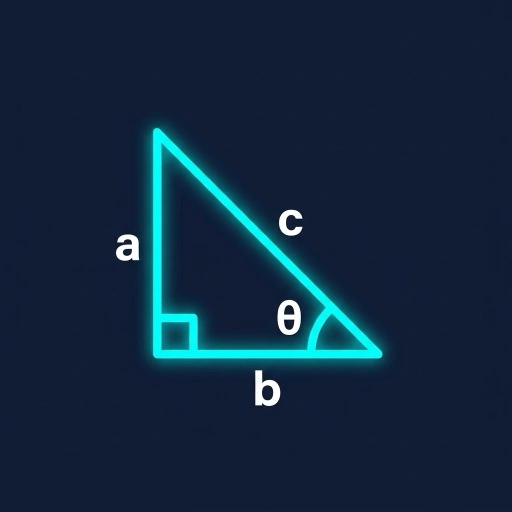
Standard SOHCAHTOA Right Triangle ($\text{Opposite} = a$, $\text{Adjacent} = b$, $\text{Hypotenuse} = c$, Reference Angle $\theta$, $90^\circ$)
SOHCAHTOA Calculator
Calculate missing sides or acute angles of a right triangle using SOH ($\sin$), CAH ($\cos$), and TOA ($\tan$). Select your known inputs below.
SOHCAHTOA Calculation Results
Complete geometric solution & trigonometric step-by-step breakdown
Step-by-Step SOHCAHTOA Solution
Detailed Breakdown
What Can This SOHCAHTOA Calculator Calculate?
Our online SOHCAHTOA calculator solves seven essential right-triangle trigonometric problems instantly:
What Is SOHCAHTOA?
SOHCAHTOA is a universally recognized memory aid (mnemonic) used in geometry and trigonometry to recall the definitions of the three primary trigonometric ratios for right-angled triangles: Sine, Cosine, and Tangent.
The acronym breaks down into three distinct formula groups:
SOHCAHTOA Mnemonic Breakdown
- SOH: Sine = Opposite / Hypotenuse ($\sin\theta = \frac{\text{Opposite}}{\text{Hypotenuse}}$)
- CAH: Cosine = Adjacent / Hypotenuse ($\cos\theta = \frac{\text{Adjacent}}{\text{Hypotenuse}}$)
- TOA: Tangent = Opposite / Adjacent ($\tan\theta = \frac{\text{Opposite}}{\text{Adjacent}}$)
In any right triangle, the labels "Opposite" and "Adjacent" are defined strictly relative to the selected reference angle ($\theta$). Changing which acute angle you are analyzing swaps the Opposite and Adjacent labels!
SOHCAHTOA Formula
The mathematical formulas governing SOHCAHTOA establish direct algebraic equations connecting side length ratios to acute angle measurements:
SOH — Sine
CAH — Cosine
TOA — Tangent
Where the variable symbols represent:
- $\theta$ (Theta): The reference acute angle (measured in degrees or radians, where $0^\circ < \theta < 90^\circ$).
- $O$ (Opposite): The leg length positioned directly across from reference angle $\theta$.
- $A$ (Adjacent): The leg length touching reference angle $\theta$ (excluding the hypotenuse).
- $H$ (Hypotenuse): The longest side length opposite the $90^\circ$ right angle.
SOHCAHTOA Triangle Diagram
The diagram below illustrates how all three SOHCAHTOA trigonometric ratios derive from a single right-angled triangle.
Diagram Key: $O$ = opposite leg, $A$ = adjacent leg, $H$ = hypotenuse, $\theta$ = reference angle, $90^\circ$ = fixed right angle.
Because all three trigonometric ratios ($\sin\theta, \cos\theta, \tan\theta$) share side measurements from the exact same right triangle, knowing any two values (such as one side and one acute angle, or any two side lengths) allows you to solve the entire triangle completely.
How to Identify Opposite, Adjacent, and Hypotenuse
Correctly identifying the three sides of a right triangle is the single most critical step when applying SOHCAHTOA. Follow these clear definitions:
Hypotenuse
The Hypotenuse is always the longest side of the right triangle. It is located directly across from the $90^\circ$ right angle. The hypotenuse never changes position regardless of which reference angle is chosen.
Opposite Side
The Opposite Side is the leg positioned directly across from your selected reference angle $\theta$. If you draw an arrow straight out from the vertex of angle $\theta$, it points directly at the opposite side.
Adjacent Side
The Adjacent Side is the leg that touches your reference angle $\theta$ to help form its corner, but is not the hypotenuse. "Adjacent" literally means "next to."
⚠️ Crucial Reference Angle Rule
Opposite and Adjacent are relative labels. If you switch your attention from Angle A to Angle B, the side that was Opposite to A becomes Adjacent to B, and the side that was Adjacent to A becomes Opposite to B!
How SOHCAHTOA Works
Solving any right triangle using SOHCAHTOA follows a logical 12-step systematic procedure:
- Identify the 90° Right Angle: Locate the square corner vertex to confirm it is a right triangle.
- Select the Reference Angle: Choose the acute angle ($\theta$) given in the problem or the angle you need to find.
- Identify the Hypotenuse: Locate the longest side opposite the $90^\circ$ angle.
- Identify the Opposite Side: Locate the leg directly across from reference angle $\theta$.
- Identify the Adjacent Side: Locate the remaining leg touching reference angle $\theta$.
- Identify Known Values: Write down your given numbers (e.g. $\theta = 30^\circ, H = 10$).
- Select Sine, Cosine, or Tangent: Choose SOH if you have/need Opposite & Hypotenuse, CAH for Adjacent & Hypotenuse, or TOA for Opposite & Adjacent.
- Write the Trigonometric Equation: State the formula with symbols (e.g., $\sin(\theta) = O / H$).
- Substitute Numerical Values: Replace the variable letters with your known numbers.
- Rearrange the Equation: Isolate the unknown variable algebraically.
- Calculate the Result: Perform the calculation using a scientific calculator or our online tool.
- Check & Round: Verify that the hypotenuse remains the longest side and round appropriately.
Sine Calculator — SOH
The Sine ratio compares the length of the opposite leg to the hypotenuse.
Sine (SOH) Fundamental Formula
Algebraic Rearrangements:
- To find Opposite: $$\text{Opposite} = \text{Hypotenuse} \times \sin(\theta)$$
- To find Hypotenuse: $$\text{Hypotenuse} = \frac{\text{Opposite}}{\sin(\theta)}$$
Worked Example:
Given a right triangle with reference angle $\theta = 30^\circ$ and hypotenuse $H = 10\text{ cm}$. Find the opposite side $O$.
Cosine Calculator — CAH
The Cosine ratio compares the length of the adjacent leg to the hypotenuse.
Cosine (CAH) Fundamental Formula
Algebraic Rearrangements:
- To find Adjacent: $$\text{Adjacent} = \text{Hypotenuse} \times \cos(\theta)$$
- To find Hypotenuse: $$\text{Hypotenuse} = \frac{\text{Adjacent}}{\cos(\theta)}$$
Worked Example:
Given a right triangle with reference angle $\theta = 60^\circ$ and hypotenuse $H = 20\text{ cm}$. Find the adjacent side $A$.
Tangent Calculator — TOA
The Tangent ratio compares the length of the opposite leg directly to the adjacent leg. Tangent does not involve the hypotenuse.
Tangent (TOA) Fundamental Formula
Algebraic Rearrangements:
- To find Opposite: $$\text{Opposite} = \text{Adjacent} \times \tan(\theta)$$
- To find Adjacent: $$\text{Adjacent} = \frac{\text{Opposite}}{\tan(\theta)}$$
Worked Example:
Given a right triangle with reference angle $\theta = 45^\circ$ and adjacent leg $A = 8\text{ m}$. Find the opposite leg $O$.
How to Find a Missing Side Using SOHCAHTOA
Depending on which side is unknown, select the corresponding formula:
Find the Opposite Side
If Hypotenuse $H = 12\text{ m}$ and $\theta = 35^\circ$:
Given: $H = 12$, $\theta = 35^\circ$
Formula: $O = H \times \sin(\theta)$
Substitution: $O = 12 \times \sin(35^\circ)$
Calculation: $O \approx 12 \times 0.573576 = 6.8829\text{ m}$
Answer: $O \approx 6.88\text{ m}$
Find the Adjacent Side
If Hypotenuse $H = 15\text{ cm}$ and $\theta = 50^\circ$:
Given: $H = 15$, $\theta = 50^\circ$
Formula: $A = H \times \cos(\theta)$
Substitution: $A = 15 \times \cos(50^\circ)$
Calculation: $A \approx 15 \times 0.642788 = 9.6418\text{ cm}$
Answer: $A \approx 9.64\text{ cm}$
Find the Hypotenuse
If Opposite $O = 9\text{ in}$ and $\theta = 28^\circ$:
Given: $O = 9$, $\theta = 28^\circ$
Formula: $H = \frac{O}{\sin(\theta)}$
Substitution: $H = \frac{9}{\sin(28^\circ)}$
Calculation: $H \approx \frac{9}{0.469472} = 19.1705\text{ in}$
Answer: $H \approx 19.17\text{ in}$
How to Find a Missing Angle Using SOHCAHTOA
When two side lengths are known but the acute angle $\theta$ is unknown, use inverse trigonometric functions ($\sin^{-1}$, $\cos^{-1}$, $\tan^{-1}$, also written as $\text{arcsin}$, $\text{arccos}$, $\text{arctan}$):
Inverse Sine
Inverse Cosine
Inverse Tangent
💡 Understanding $\sin^{-1}$ Notation
In trigonometry, $\sin^{-1}(x)$ means "the angle whose sine is $x$" (inverse sine), NOT $\frac{1}{\sin(x)}$ (which is cosecant, $\csc(x)$). Scientific programming environments use `Math.asin()`, `Math.acos()`, and `Math.atan()`.
SOHCAHTOA Worked Examples
Study 8 complete step-by-step worked examples covering every major right-triangle trig scenario:
When to Use Sine, Cosine, or Tangent
Use this reference matrix to quickly pick the right trigonometric ratio based on your known and required sides:
Always determine your reference angle $\theta$ first before selecting the ratio!
SOHCAHTOA and Right Triangles
SOHCAHTOA is built exclusively upon the unique geometric properties of right triangles ($90^\circ$ triangles). In every right triangle:
- The interior angles always sum to $180^\circ$. Because the right angle uses $90^\circ$, the two acute angles are complementary ($\theta + \beta = 90^\circ$).
- The side opposite the $90^\circ$ angle is guaranteed to be the longest side (Hypotenuse).
- The ratios between the side lengths depend strictly on the acute angles, creating constant trigonometric ratios.
Need to solve a general right triangle with both side and angle inputs? Visit our core Right Triangle Calculator.
SOHCAHTOA vs Pythagorean Theorem
Both SOHCAHTOA and the Pythagorean theorem are foundational tools for right triangles, but they serve different primary purposes:
For pure side-length calculations without angle requirements, use our dedicated Pythagorean Theorem Calculator.
SOHCAHTOA and Special Right Triangles
Special right triangles have constant interior angle measurements that produce exact, simple radical SOHCAHTOA ratios:
45-45-90 Isosceles Right Triangle
Side length ratio is $1 : 1 : \sqrt{2}$.
- $\sin(45^\circ) = \frac{1}{\sqrt{2}} = \frac{\sqrt{2}}{2} \approx 0.7071$
- $\cos(45^\circ) = \frac{1}{\sqrt{2}} = \frac{\sqrt{2}}{2} \approx 0.7071$
- $\tan(45^\circ) = \frac{1}{1} = 1.0$
Explore our specialized 45-45-90 Triangle Calculator.
30-60-90 Right Triangle
Side length ratio is $1 : \sqrt{3} : 2$.
- $\sin(30^\circ) = \frac{1}{2} = 0.5$, $\cos(30^\circ) = \frac{\sqrt{3}}{2} \approx 0.8660$, $\tan(30^\circ) = \frac{1}{\sqrt{3}} = \frac{\sqrt{3}}{3} \approx 0.5774$
- $\sin(60^\circ) = \frac{\sqrt{3}}{2} \approx 0.8660$, $\cos(60^\circ) = \frac{1}{2} = 0.5$, $\tan(60^\circ) = \sqrt{3} \approx 1.7321$
Explore our specialized 30-60-90 Triangle Calculator.
SOHCAHTOA and Pythagorean Triples
Pythagorean triples are sets of three whole integers $(a, b, c)$ that satisfy $a^2 + b^2 = c^2$. Evaluating SOHCAHTOA for integer triples yields exact rational fractions:
3-4-5 Right Triangle
For the reference angle opposite leg 3:
- $\sin\theta = \frac{\text{Opposite}}{\text{Hypotenuse}} = \frac{3}{5} = 0.6$
- $\cos\theta = \frac{\text{Adjacent}}{\text{Hypotenuse}} = \frac{4}{5} = 0.8$
- $\tan\theta = \frac{\text{Opposite}}{\text{Adjacent}} = \frac{3}{4} = 0.75$
- Angle $\theta = \sin^{-1}(0.6) \approx 36.87^\circ$.
Other famous integer triples include (5, 12, 13), (8, 15, 17), and (7, 24, 25).
Real-World Applications of SOHCAHTOA
SOHCAHTOA is heavily utilized in practical STEM fields and trade disciplines:
Ladder and Wall Example
A classic trigonometry problem asks: "A $10\text{ ft}$ ladder rests against a wall, making a $60^\circ$ angle with the ground. How high up the wall does the ladder reach?"
Problem Solution Breakdown
- Ladder length (Hypotenuse): $H = 10\text{ ft}$
- Ground angle (Reference Angle): $\theta = 60^\circ$
- Vertical wall height (Opposite): $O = \text{unknown}$
- Select Ratio: Sine (SOH) because we have $H$ and need $O$.
- Equation: $\sin(60^\circ) = \frac{\text{height}}{10}$
- Calculation: $\text{height} = 10 \times \sin(60^\circ) = 10 \times \frac{\sqrt{3}}{2} \approx 8.66\text{ ft}$
The ladder reaches approximately 8.66 ft up the wall.
Angle of Elevation and Depression
Real-world trigonometry problems often involve angles measured from horizontal line-of-sight reference axes:
Angle of Elevation
The angle measured upward from a horizontal reference line to an elevated object (e.g., looking up at the top of a lighthouse).
Angle of Depression
The angle measured downward from a horizontal reference line to an object below (e.g., an observer at the top of a cliff looking down at a boat).
Because alternate interior angles are equal across parallel horizontal lines, the angle of elevation from point A to point B equals the angle of depression from point B to point A!
SOHCAHTOA Formula Rearrangement
Keep this master reference table of algebraic rearrangements handy when solving for any specific unknown variable:
SOHCAHTOA Calculator Units
Our calculator supports seven linear length units: millimeters (mm), centimeters (cm), meters (m), kilometers (km), inches (in), feet (ft), and yards (yd).
Because SOHCAHTOA ratios compare relative side lengths ($\frac{\text{length}}{\text{length}}$), unit dimensions cancel out in the trigonometric ratio! However, all input side lengths must be expressed in the same unit before computing.
Degrees vs Radians in Trigonometry
Angles can be measured in two common units:
- Degrees (°): Full circle = $360^\circ$, Right angle = $90^\circ$. Standard for geometry and practical measurements.
- Radians (rad): Full circle = $2\pi\text{ rad}$, Right angle = $\frac{\pi}{2}\text{ rad}$. Standard in calculus and advanced mathematics.
Conversion formulas:
Our calculator allows seamless toggling between degree and radian modes.
Exact vs Decimal Trigonometric Results
Trigonometric calculations produce two representation forms:
- Exact Radical Expressions: Values expressed with exact square roots (e.g. $\sin(60^\circ) = \frac{\sqrt{3}}{2}$ or $c = 5\sqrt{2}$).
- Decimal Approximations: Floating-point numbers rounded to specific decimal places (e.g. $\sin(60^\circ) \approx 0.866025$).
Our solver displays exact simplified radical tags alongside 6-decimal rounded values.
Common SOHCAHTOA Mistakes
Avoid these 12 frequent pitfalls when solving right-triangle trig problems:
- Wrong Reference Angle: Confusing which angle $\theta$ is being evaluated.
- Confusing Opposite & Adjacent: Mixing up the legs relative to angle $\theta$.
- Treating Hypotenuse as Adjacent: Forgetting that hypotenuse is never called adjacent.
- Choosing Wrong Ratio: Using Sine when Tangent is required.
- Forgetting Inverse Trig: Trying to use regular $\sin$ instead of $\sin^{-1}$ to find an angle.
- Wrong Calculator Angle Mode: Having your calculator set to Radians when inputs are in Degrees.
- Rounding Too Early: Rounding intermediate decimal values before the final step.
- Invalid Side Combinations: Entering Opposite > Hypotenuse (which is impossible).
- Mixing Units: Combining meters and inches without converting.
- Using SOHCAHTOA on Non-Right Triangles: Applying basic trig ratios to triangles without a $90^\circ$ angle.
- Misunderstanding $\sin^{-1}$: Treating $\sin^{-1}(x)$ as $\frac{1}{\sin(x)}$.
- Entering Invalid Values: Inputting negative side lengths or zero angles.
When Can SOHCAHTOA Be Used?
Basic SOHCAHTOA ratios apply only to right-angled triangles ($90^\circ$ triangles).
If a triangle does not contain a $90^\circ$ angle (an oblique triangle), SOHCAHTOA cannot be used directly. Instead, you must apply oblique triangle formulas:
- Law of Sines: $\frac{a}{\sin A} = \frac{b}{\sin B} = \frac{c}{\sin C}$
- Law of Cosines: $c^2 = a^2 + b^2 - 2ab\cos C$
How to Solve a Right Triangle Using SOHCAHTOA
Summary of the complete 10-step right-triangle solution workflow:
- Identify the $90^\circ$ right angle.
- Select your reference angle $\theta$.
- Label Opposite (O), Adjacent (A), and Hypotenuse (H).
- Write down your known measurements.
- Select the correct ratio (SOH, CAH, or TOA).
- Formulate the equation.
- Rearrange to isolate the unknown.
- Calculate the numeric result.
- Check that Hypotenuse remains the longest side.
- Round to desired precision.
SOHCAHTOA Quick Reference
SOHCAHTOA Summary Box
- SOH: $\sin\theta = \frac{\text{Opposite}}{\text{Hypotenuse}} \quad \implies \quad O = H \sin\theta, \quad H = \frac{O}{\sin\theta}$
- CAH: $\cos\theta = \frac{\text{Adjacent}}{\text{Hypotenuse}} \quad \implies \quad A = H \cos\theta, \quad H = \frac{A}{\cos\theta}$
- TOA: $\tan\theta = \frac{\text{Opposite}}{\text{Adjacent}} \quad \implies \quad O = A \tan\theta, \quad A = \frac{O}{\tan\theta}$
- Inverse Functions: $\theta = \sin^{-1}(O/H) = \cos^{-1}(A/H) = \tan^{-1}(O/A)$
Related Right Triangle Calculators
Explore our complete cluster of specialized right-triangle geometric calculators:
Frequently Asked Questions
Find fast answers to 20 common questions about SOHCAHTOA and right-triangle trigonometry:
Q1
What is a SOHCAHTOA calculator?
A SOHCAHTOA calculator is an interactive geometric tool that solves missing side lengths and acute angles in right triangles using the fundamental trigonometric ratios: sine, cosine, and tangent.
Q2
What does SOHCAHTOA stand for?
SOHCAHTOA is a mnemonic acronym for remembering right-triangle trig ratios: SOH stands for Sine = Opposite / Hypotenuse, CAH stands for Cosine = Adjacent / Hypotenuse, and TOA stands for Tangent = Opposite / Adjacent.
Q3
What is the SOH formula?
The SOH formula is $\sin(\theta) = \frac{\text{Opposite}}{\text{Hypotenuse}}$. Rearranging gives $\text{Opposite} = \text{Hypotenuse} \times \sin(\theta)$ or $\text{Hypotenuse} = \frac{\text{Opposite}}{\sin(\theta)}$.
Q4
What is the CAH formula?
The CAH formula is $\cos(\theta) = \frac{\text{Adjacent}}{\text{Hypotenuse}}$. Rearranging gives $\text{Adjacent} = \text{Hypotenuse} \times \cos(\theta)$ or $\text{Hypotenuse} = \frac{\text{Adjacent}}{\cos(\theta)}$.
Q5
What is the TOA formula?
The TOA formula is $\tan(\theta) = \frac{\text{Opposite}}{\text{Adjacent}}$. Rearranging gives $\text{Opposite} = \text{Adjacent} \times \tan(\theta)$ or $\text{Adjacent} = \frac{\text{Opposite}}{\tan(\theta)}$.
Q6
How do I know whether to use sine, cosine, or tangent?
Identify which two sides are involved relative to your reference angle $\theta$: use Sine for Opposite and Hypotenuse, Cosine for Adjacent and Hypotenuse, and Tangent for Opposite and Adjacent.
Q7
What is the opposite side?
The opposite side is the leg positioned directly across from the chosen reference angle $\theta$ in a right-angled triangle.
Q8
What is the adjacent side?
The adjacent side is the leg that touches the reference angle $\theta$ and forms one of its rays, excluding the hypotenuse.
Q9
Which side is the hypotenuse?
The hypotenuse is the longest side of a right triangle, situated directly opposite the $90^\circ$ right angle.
Q10
How do I find a missing side?
Select the SOH, CAH, or TOA ratio connecting your known acute angle and known side to the unknown side, substitute the values, and solve the linear equation.
Q11
How do I find a missing angle?
Calculate the ratio of two known sides, then take the inverse trigonometric function: $\theta = \sin^{-1}(\text{Opp}/\text{Hyp})$, $\theta = \cos^{-1}(\text{Adj}/\text{Hyp})$, or $\theta = \tan^{-1}(\text{Opp}/\text{Adj})$.
Q12
What is inverse sine?
Inverse sine ($\sin^{-1}$ or $\text{arcsin}$) is the inverse function of sine that inputs a ratio ($\text{Opposite}/\text{Hypotenuse}$) and returns the corresponding acute angle $\theta$.
Q13
What is inverse cosine?
Inverse cosine ($\cos^{-1}$ or $\text{arccos}$) is the inverse function of cosine that inputs a ratio ($\text{Adjacent}/\text{Hypotenuse}$) and returns the corresponding acute angle $\theta$.
Q14
What is inverse tangent?
Inverse tangent ($\tan^{-1}$ or $\text{arctan}$) is the inverse function of tangent that inputs a ratio ($\text{Opposite}/\text{Adjacent}$) and returns the corresponding acute angle $\theta$.
Q15
Can SOHCAHTOA be used for every triangle?
No. Basic SOHCAHTOA ratios apply only to right-angled triangles (triangles with a $90^\circ$ angle). Oblique triangles require the Law of Sines or Law of Cosines.
Q16
Should I use degrees or radians?
Standard school geometry and engineering problems use degrees (°), while advanced calculus uses radians. Our calculator allows toggling between degrees and radians.
Q17
What is the difference between SOHCAHTOA and Pythagorean theorem?
The Pythagorean theorem ($a^2 + b^2 = c^2$) connects side lengths ($a, b, c$), whereas SOHCAHTOA trigonometric ratios connect side lengths to acute angles.
Q18
Can SOHCAHTOA calculate building height?
Yes. Measuring the angle of elevation $\theta$ from a known horizontal baseline distance (Adjacent) lets you compute building height (Opposite) using $\text{height} = \text{distance} \times \tan(\theta)$.
Q19
How do I solve a ladder problem?
Model the ladder as the hypotenuse, ground distance as adjacent, vertical height as opposite, and ground angle as $\theta$, then apply $\sin(\theta) = \text{height} / \text{ladder}$.
Q20
Why can two trig calculators show slightly different results?
Differences usually arise from floating-point rounding precision or using degree mode versus radian mode.