Right Triangle Worked Examples
Master right triangle geometry and trigonometry through clear, step-by-step solved problems. Learn how to compute missing hypotenuse lengths, perpendicular legs, acute angles, area, perimeter, and real-world word problems.
Each worked example guides you from given values to final answer using explicit formula substitutions, arithmetic steps, and answer verification techniques.
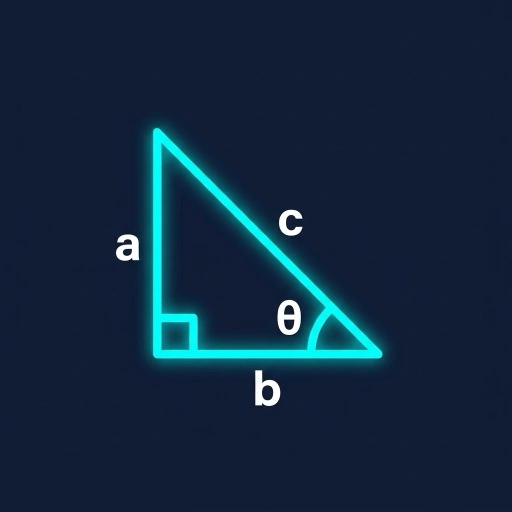
Right Triangle Model ($a = \text{leg}$, $b = \text{leg}$, $c = \text{hypotenuse}$, $C = 90^\circ$)
Right Triangle Worked Examples Overview
To solve any right triangle problem consistently, follow this standard 8-step problem-solving workflow:
- Identify the Right Angle: Confirm the presence of the $90^\circ$ corner and identify the side directly opposite it as the hypotenuse ($c$).
- Identify Known Quantities: Note all given side lengths ($a, b, c$) and acute angles ($\theta, \alpha, \beta$).
- Determine the Unknown Quantity: Define precisely what value needs to be solved (e.g., hypotenuse $c$, leg $b$, angle $\theta$, area, or perimeter).
- Select the Appropriate Formula: Choose the Pythagorean theorem ($a^2 + b^2 = c^2$), a trigonometric ratio ($\sin, \cos, \tan$), or a geometric area/perimeter equation based on your knowns.
- Substitute Known Values: Replace the formula variables with your exact numerical values.
- Perform Calculations: Evaluate the arithmetic steps, square roots, or trigonometric functions cleanly.
- Round Appropriately: Maintain precision during calculation and round the final answer to the required decimal places.
- Check and Verify the Result: Verify that the hypotenuse is the longest side and that $a^2 + b^2 = c^2$ or acute angles sum to $90^\circ$.
Example 1: Find the Hypotenuse From Two Legs
Problem: A right triangle has legs of $6\text{ units}$ and $8\text{ units}$. Find the hypotenuse $c$.
Example 2: Find a Missing Leg
Problem: A right triangle has a hypotenuse of $13\text{ units}$ and one leg of $5\text{ units}$. Find the missing leg $b$.
Example 3: Find an Unknown Angle
Problem: A right triangle has an opposite leg of $6\text{ units}$ and an adjacent leg of $8\text{ units}$. Find angle $\theta$.
Example 4: Find a Missing Side Using Sine
Problem: A right triangle has a hypotenuse of $10\text{ units}$ and an acute angle of $30^\circ$. Find the opposite leg $O$.
Example 5: Find a Missing Side Using Cosine
Problem: A right triangle has a hypotenuse of $12\text{ units}$ and an acute angle of $40^\circ$. Find the adjacent leg $A$.
Example 6: Find the Area of a Right Triangle
Problem: A right triangle has a base of $9\text{ units}$ and a perpendicular height of $12\text{ units}$. Find the area.
Example 7: Find the Perimeter of a Right Triangle
Problem: A right triangle has side lengths of $a = 5\text{ units}$, $b = 12\text{ units}$, and hypotenuse $c = 13\text{ units}$. Find the perimeter.
Example 8: Ladder Against a Wall (Real-World Problem)
Problem: A ladder reaches $8\text{ ft}$ up a vertical wall while its base is placed $6\text{ ft}$ away from the wall. Find the length of the ladder.
Example 9: Angle of Elevation Worked Example
Problem: An observer stands $50\text{ ft}$ from the base of a building. The angle of elevation to the top of the building is $35^\circ$. Find the height of the building.
Example 10: A Two-Step Right Triangle Problem
Problem: A right triangle has a hypotenuse of $14\text{ cm}$ and an acute angle of $42^\circ$. First calculate the missing opposite leg, then determine the total area of the triangle.
Example 11: Pythagorean Triple Worked Example
Problem: Verify that $3, 4, 5$ forms a primitive Pythagorean triple.
Example 12: Do Three Sides Form a Right Triangle?
Problem: Determine whether side lengths $7$, $24$, and $25$ form a right-angled triangle.
Exact Answer vs Decimal Answer
In right triangle calculations, solutions can be expressed in either exact radical form or rounded decimal form depending on your application.
Consider a right triangle with legs $a = 5$ and $b = 7$:
$$c = \sqrt{5^2 + 7^2} = \sqrt{25 + 49} = \sqrt{74}$$
Exact Answer: $c = \sqrt{74}$ (preserves perfect mathematical accuracy without rounding error)
Decimal Answer: $c \approx 8.6023$ (rounded to 4 decimal places for practical physical measurement)
Best Practice: Always keep exact values or high precision throughout intermediate calculation steps. Round only at the final step to prevent compounding rounding errors.
Worked Examples With Measurement Units
Applying correct physical units is essential when solving real-world geometry problems:
- Linear Dimensions (Sides, Hypotenuse, Perimeter): Measured in linear units such as centimeters ($\text{cm}$), meters ($\text{m}$), feet ($\text{ft}$), or inches ($\text{in}$).
- Area Dimensions: Always expressed in square units such as $\text{cm}^2$, $\text{m}^2$, $\text{ft}^2$, or $\text{sq in}$.
- Angular Dimensions: Measured in degrees ($\text{deg}$ or $^\circ$) or radians ($\text{rad}$).
Unit Consistency Rule: Before starting any calculation, ensure all input side lengths are converted to the same unit of measure.
How to Choose the Correct Method for a Right Triangle Problem
Use this quick decision matrix to select the appropriate mathematical method based on your known values:
| Given Information | Target Unknown | Optimal Method / Formula |
|---|---|---|
| Two perpendicular legs ($a, b$) | Hypotenuse ($c$) | Pythagorean Theorem: $c = \sqrt{a^2 + b^2}$ |
| Hypotenuse ($c$) & one leg ($a$) | Missing leg ($b$) | Pythagorean Theorem: $b = \sqrt{c^2 - a^2}$ |
| Opposite ($O$) & Adjacent ($A$) | Acute Angle ($\theta$) | Inverse Tangent: $\theta = \tan^{-1}(O/A)$ |
| Opposite ($O$) & Hypotenuse ($H$) | Acute Angle ($\theta$) | Inverse Sine: $\theta = \sin^{-1}(O/H)$ |
| Adjacent ($A$) & Hypotenuse ($H$) | Acute Angle ($\theta$) | Inverse Cosine: $\theta = \cos^{-1}(A/H)$ |
| Angle ($\theta$) & Hypotenuse ($H$) | Opposite leg ($O$) | Sine Ratio: $O = H \times \sin(\theta)$ |
| Angle ($\theta$) & Hypotenuse ($H$) | Adjacent leg ($A$) | Cosine Ratio: $A = H \times \cos(\theta)$ |
| Angle ($\theta$) & Adjacent leg ($A$) | Opposite leg ($O$) | Tangent Ratio: $O = A \times \tan(\theta)$ |
| Base ($b$) & Height ($h$) | Area | Area Formula: $\text{Area} = \frac{1}{2}bh$ |
| Three sides ($a, b, c$) | Perimeter | Perimeter Formula: $P = a + b + c$ |
Common Mistakes When Solving Right Triangle Problems
- Selecting the wrong hypotenuse: Assuming leg $a$ or $b$ is the hypotenuse. Correction: The hypotenuse is ALWAYS the longest side directly opposite the $90^\circ$ angle.
- Using the wrong trigonometric ratio: Confusing Sine, Cosine, and Tangent. Correction: Remember SOHCAHTOA relative to your chosen angle.
- Forgetting to square values: Adding $a + b$ instead of $a^2 + b^2$. Correction: Always square side lengths before adding or subtracting.
- Forgetting the square root: Leaving $c^2 = 100$ as the final answer. Correction: Remember to take $\sqrt{100} = 10$.
- Misidentifying Opposite vs. Adjacent: Swapping legs relative to angle $\theta$. Correction: Opposite faces the angle; Adjacent touches the angle.
- Calculator in Radian Mode: Getting unexpected negative trig values. Correction: Ensure your calculator mode is set to Degrees ($^\circ$).
- Rounding too early: Truncating intermediate decimals before final multiplication. Correction: Keep full precision until the last step.
- Mixing units: Combining feet with inches. Correction: Convert all dimensions to a common unit before calculating.
- Forgetting square units for area: Writing area as meters instead of $\text{m}^2$. Correction: Express area in square units.
- Failing to verify results: Accepting impossible side lengths. Correction: Plug values back into $a^2 + b^2 = c^2$.
- Using impossible side lengths: Trying to calculate a triangle where a leg is longer than the hypotenuse.
- Confusing exact and decimal answers: Misinterpreting radical results during tests.
How to Check a Right Triangle Answer
Always perform these five quick checks to confirm your calculations:
- Hypotenuse Check: Verify that calculated hypotenuse $c$ is strictly larger than both legs $a$ and $b$ ($c > a$ and $c > b$).
- Pythagorean Check: Substitute calculated sides back into $a^2 + b^2 = c^2$. The left side must equal the right side.
- Angle Sum Check: Verify that acute angles sum to exactly $90^\circ$ ($\alpha + \beta = 90^\circ$).
- Trig Ratio Verification: Re-calculate $\frac{\text{Opposite}}{\text{Hypotenuse}}$ and check if it equals $\sin(\theta)$.
- Unit Consistency Check: Ensure linear quantities have linear units and area has square units.
Right Triangle Worked Examples by Problem Type
Right Triangle Worked Examples Quick Reference
| Example | Given Information | Target Unknown | Method / Formula | Final Answer |
|---|---|---|---|---|
| Example 1 | $a=6, b=8$ | Hypotenuse $c$ | $c = \sqrt{a^2 + b^2}$ | $c = 10\text{ units}$ |
| Example 2 | $c=13, a=5$ | Leg $b$ | $b = \sqrt{c^2 - a^2}$ | $b = 12\text{ units}$ |
| Example 3 | $\text{Opp}=6, \text{Adj}=8$ | Angle $\theta$ | $\theta = \tan^{-1}(O/A)$ | $\theta \approx 36.87^\circ$ |
| Example 4 | $H=10, \theta=30^\circ$ | Opposite $O$ | $O = H \cdot \sin(30^\circ)$ | $O = 5\text{ units}$ |
| Example 5 | $H=12, \theta=40^\circ$ | Adjacent $A$ | $A = H \cdot \cos(40^\circ)$ | $A \approx 9.19\text{ units}$ |
| Example 6 | $b=9, h=12$ | Area | $\text{Area} = \frac{1}{2}bh$ | $\text{Area} = 54\text{ sq units}$ |
| Example 7 | $a=5, b=12, c=13$ | Perimeter $P$ | $P = a + b + c$ | $P = 30\text{ units}$ |
| Example 8 | $h=8\text{ ft}, d=6\text{ ft}$ | Ladder Length | $c = \sqrt{h^2 + d^2}$ | $c = 10\text{ ft}$ |
| Example 9 | $A=50\text{ ft}, \theta=35^\circ$ | Height | $O = A \cdot \tan(35^\circ)$ | $O \approx 35.01\text{ ft}$ |
| Example 10 | $c=14\text{ cm}, \theta=42^\circ$ | Side $a$ & Area | Trig & Area Formula | $a \approx 9.37\text{ cm}, \text{Area} \approx 48.73\text{ cm}^2$ |
| Example 11 | $3, 4, 5$ | Triple Check | $a^2 + b^2 = c^2$ | Valid Triple ($25 = 25$) |
| Example 12 | $7, 24, 25$ | Right Triangle Verification | $7^2 + 24^2 = 25^2$ | Valid Right Triangle ($625 = 625$) |
Related Right Triangle Calculators and Resources
Explore our suite of specialized interactive solvers and educational references:
Frequently Asked Questions
Common questions regarding right triangle worked examples, solved problems, and calculation methods.
Q1
What is a right triangle worked example?
A right triangle worked example is a fully solved geometry problem that details every calculation step—from identifying given parameters to substituting values into formulas and checking the final result.
Q2
How do you solve a right triangle step by step?
First identify the $90^\circ$ right angle and list all known values. Determine the unknown parameter, select the correct formula (Pythagorean theorem or trig ratio), substitute the known values, compute the arithmetic, round appropriately, and verify using $a^2 + b^2 = c^2$.
Q3
How do you find the missing side of a right triangle?
If two side lengths are known, use the Pythagorean theorem ($c = \sqrt{a^2 + b^2}$ or $b = \sqrt{c^2 - a^2}$). If one side and one acute angle are known, apply a trigonometric ratio such as $\sin, \cos,$ or $\tan$.
Q4
How do you find the hypotenuse in a worked example?
Square both perpendicular leg lengths, sum them together, and take the square root of the sum: $c = \sqrt{a^2 + b^2}$.
Q5
How do you find a missing leg?
Subtract the square of the known leg from the square of the hypotenuse, then take the square root: $b = \sqrt{c^2 - a^2}$.
Q6
How do you find a missing angle?
Use an inverse trigonometric function with two known side lengths, such as $\theta = \tan^{-1}(\text{Opposite}/\text{Adjacent})$ or $\theta = \sin^{-1}(\text{Opposite}/\text{Hypotenuse})$.
Q7
How do you know whether to use sine, cosine, or tangent?
Use the SOHCAHTOA rule relative to your angle: Sine for Opposite and Hypotenuse; Cosine for Adjacent and Hypotenuse; Tangent for Opposite and Adjacent.
Q8
How do you check a right triangle answer?
Plug calculated sides back into $a^2 + b^2 = c^2$ to ensure equality, and confirm that acute angles sum to $90^\circ$.
Q9
Can a right triangle problem require multiple calculations?
Yes. Complex problems often require solving for a missing side length first before evaluating secondary properties like area, perimeter, or altitude.
Q10
How do you solve real-world right triangle problems?
Model real-world physical situations (like ladders, shadows, or buildings) as a right triangle by mapping vertical height, horizontal ground distance, and line of sight to legs and hypotenuse.
Q11
How should right triangle answers be rounded?
Maintain exact values or maximum floating-point precision throughout intermediate calculation steps, and round only at the final step to 2 or 4 decimal places.
Q12
How do units affect right triangle calculations?
All side lengths must use identical linear units before evaluating formulas. Enclosed area will always be expressed in square units.