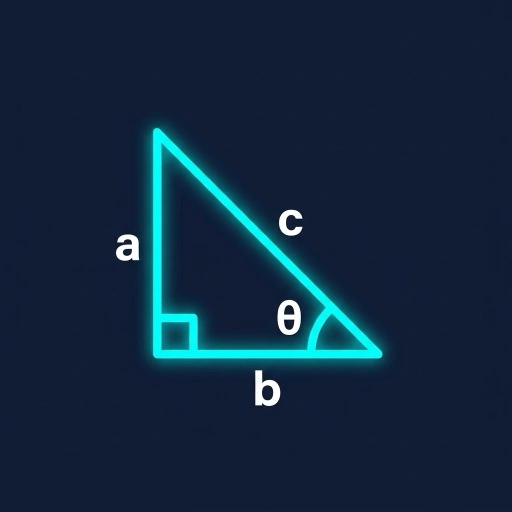
Right Triangle Hypotenuse Calculator
Calculate the exact length of the hypotenuse $c$ when the two perpendicular legs $a$ and $b$ are known using the right triangle hypotenuse formula $c = \sqrt{a^2 + b^2}$.
This tool computes exact radical simplified forms, accurate decimal values, and step-by-step substitutions instantly. Enter your two leg lengths below to find the hypotenuse of any right triangle.
Right Triangle Hypotenuse Geometry ($c = \sqrt{a^2 + b^2}$)
Calculate Right Triangle Hypotenuse c
Enter known perpendicular legs $a$ and $b$ to calculate hypotenuse $c$ with exact radical and decimal steps.
Calculation Results
Hypotenuse solution & step-by-step breakdown
Step-by-Step Formulas & Solution Steps
Detailed Breakdown
What Is the Hypotenuse of a Right Triangle?
Core definition and geometric characteristics of the hypotenuse side.
The hypotenuse of a right triangle is defined as the side opposite the $90^\circ$ right angle. It possesses several fundamental geometric characteristics:
- Longest Side: It is always strictly longer than either individual leg ($c > a$ and $c > b$).
- Opposite the Right Angle: It faces the perpendicular corner where leg $a$ and leg $b$ meet at a right angle.
- Connects Non-Right Vertices: It links the two acute angle vertices of the right triangle.
- Standard Notation: In mathematical literature and formulas, the hypotenuse length is conventionally represented by the variable $c$.
- Perpendicular Base Legs: The remaining two sides forming the $90^\circ$ corner are called legs ($a$ and $b$).
Hypotenuse Formula
Derivation and equation for finding hypotenuse c from perpendicular legs.
The primary mathematical formula used to calculate the hypotenuse of a right triangle when both leg lengths are known is:
Where:
- $c$ = length of the hypotenuse
- $a$ = length of the first perpendicular leg
- $b$ = length of the second perpendicular leg
This equation is derived directly by taking the principal square root of both sides of the standard Pythagorean relationship:
When both leg values $a$ and $b$ are known positive real numbers, squaring each leg, adding the squares together, and taking the square root yields the exact length of hypotenuse $c$. For a broader exploration of right-triangle side relationships, visit our Pythagorean theorem calculator.
How to Calculate the Hypotenuse
Step-by-step procedure and worked calculation example.
To calculate the hypotenuse of a right triangle from two known legs by hand, follow these seven step-by-step instructions:
- Identify the two leg lengths: Label the two perpendicular side lengths as $a$ and $b$.
- Confirm the right angle: Verify that the triangle contains a $90^\circ$ right angle between legs $a$ and $b$.
- Square the first leg: Multiply leg $a$ by itself to find $a^2$.
- Square the second leg: Multiply leg $b$ by itself to find $b^2$.
- Sum the squared values: Add $a^2$ and $b^2$ together ($a^2 + b^2$).
- Take the square root: Calculate the principal square root of the sum ($c = \sqrt{a^2 + b^2}$).
- Report with linear units: State the final hypotenuse length using the same linear measurement unit as the legs.
Step-by-Step Calculation Example:
Calculate the hypotenuse $c$ for a right triangle with legs $a = 3\text{ cm}$ and $b = 4\text{ cm}$.
$$\text{Step 1: } a = 3, \quad b = 4$$
$$\text{Step 2: } c = \sqrt{a^2 + b^2}$$
$$\text{Step 3: } c = \sqrt{3^2 + 4^2}$$
$$\text{Step 4: } c = \sqrt{9 + 16}$$
$$\text{Step 5: } c = \sqrt{25}$$
$$\text{Step 6: } c = 5\text{ cm}$$
Finding the Hypotenuse From Two Known Legs
How different leg measurements affect hypotenuse calculations.
Because the two legs of a right triangle meet at a fixed $90^\circ$ angle, knowing both leg lengths provides complete geometric information required to construct the triangle.
Depending on your measurement inputs, hypotenuse calculations behave as follows:
- Equal Legs (Isosceles Right Triangle): When $a = b$, the formula simplifies to $c = \sqrt{2a^2} = a\sqrt{2}$.
- Unequal Legs: When leg lengths differ, calculate $c = \sqrt{a^2 + b^2}$ using full precision.
- Integer Measurements: Legs given as whole integers may produce whole integer hypotenuse results (Pythagorean triples) or radical expressions.
- Decimal & Fractional Measurements: Leg inputs containing decimals or fractions follow identical squared operations ($c = \sqrt{a^2 + b^2}$).
- Compatible Units: Ensure both legs are measured in identical units before performing addition under the square root.
Hypotenuse Calculation Examples
Five comprehensive worked examples covering integer, radical, and decimal cases.
Example 1: Classic 3-4-5 Triangle
Inputs: $a = 3\text{ in}$, $b = 4\text{ in}$
Formula: $c = \sqrt{3^2 + 4^2}$
Intermediate: $c = \sqrt{9 + 16} = \sqrt{25}$
Result: $c = 5\text{ in}$
Example 2: 5-12-13 Integer Triple
Inputs: $a = 5\text{ cm}$, $b = 12\text{ cm}$
Formula: $c = \sqrt{5^2 + 12^2}$
Intermediate: $c = \sqrt{25 + 144} = \sqrt{169}$
Result: $c = 13\text{ cm}$
Example 3: 6-8-10 Scaled Triple
Inputs: $a = 6\text{ m}$, $b = 8\text{ m}$
Formula: $c = \sqrt{6^2 + 8^2}$
Intermediate: $c = \sqrt{36 + 64} = \sqrt{100}$
Result: $c = 10\text{ m}$
Example 4: Equal Legs (Exact Radical)
Inputs: $a = 5\text{ ft}$, $b = 5\text{ ft}$
Formula: $c = \sqrt{5^2 + 5^2} = \sqrt{50}$
Exact Radical: $c = 5\sqrt{2}\text{ ft}$
Decimal: $c \approx 7.0711\text{ ft}$
Example 5: Decimal Leg Inputs
Inputs: $a = 4.5\text{ mm}$, $b = 7.2\text{ mm}$
Formula: $c = \sqrt{4.5^2 + 7.2^2}$
Intermediate: $c = \sqrt{20.25 + 51.84} = \sqrt{72.09}$
Result: $c \approx 8.4906\text{ mm}$
Exact vs Decimal Hypotenuse Results
Understanding when to use simplified radicals versus floating-point decimal values.
When calculating the hypotenuse of a right triangle, results can be expressed in exact radical notation or rounded decimal format:
- Exact Radical Result: Unrounded mathematical form preserving full precision using square roots, such as $\sqrt{50}$.
- Simplified Radical Result: Factoring perfect squares from under the radical, simplifying $\sqrt{50}$ to $5\sqrt{2}$.
- Decimal Approximation: Converting the radical into a floating-point number, such as $7.0711$.
- Integer Results: Occur exclusively when the leg inputs form a Pythagorean triple (e.g. $3^2 + 4^2 = 25 \implies \sqrt{25} = 5$).
In practical applications like woodworking or engineering, decimal approximations rounded to 3 or 4 decimal places provide actionable real-world measurements, whereas academic geometry prefers exact simplified radicals.
Hypotenuse Length Constraints
Geometric inequalities governing right-triangle side lengths.
For any physically valid right triangle with positive leg lengths ($a > 0$ and $b > 0$), the calculated hypotenuse $c$ must satisfy two fundamental inequalities:
Furthermore, the triangle inequality theorem requires that the sum of any two side lengths must strictly exceed the third side length ($a + b > c$).
Example Check: If $a = 3$ and $b = 4$, then $c = 5$. Notice that $5 > 3$, $5 > 4$, and $3 + 4 = 7 > 5$. If a calculation yields a hypotenuse equal to or shorter than either leg, an error has occurred.
How to Verify a Calculated Hypotenuse
Checking calculation accuracy using algebraic substitution.
To verify whether a calculated hypotenuse value is mathematically correct, substitute all three side lengths back into the Pythagorean equation:
Verification Example:
Suppose $a = 5$, $b = 12$, and your calculated hypotenuse is $c = 13$.
$$\text{Substitute values: } 13^2 \stackrel{?}{=} 5^2 + 12^2$$
$$\text{Compute squares: } 169 \stackrel{?}{=} 25 + 144$$
$$\text{Sum legs: } 169 = 169 \quad \checkmark$$
Because both sides of the equation balance perfectly, the hypotenuse calculation of $13$ is verified as 100% accurate.
Hypotenuse Length and Units
Linear unit rules and handling mixed unit measurements.
The calculated hypotenuse inherits the exact same linear unit of measurement as the legs used in the calculation. Supported standard linear units include:
- Metric Units: Millimeters ($\text{mm}$), Centimeters ($\text{cm}$), Meters ($\text{m}$), Kilometers ($\text{km}$)
- Imperial Units: Inches ($\text{in}$), Feet ($\text{ft}$), Yards ($\text{yd}$)
Unit Compatibility Rule: Both leg inputs must be converted into the same unit before performing squaring or square root operations. Never add squared quantities from different units without converting first.
Mixed-Unit Example:
Calculate hypotenuse for $a = 3\text{ ft}$ and $b = 24\text{ in}$.
Step 1: Convert units: Convert $24\text{ in}$ to feet: $24\text{ in} = 2\text{ ft}$.
Step 2: Calculate hypotenuse: $c = \sqrt{3^2 + 2^2} = \sqrt{9 + 4} = \sqrt{13}\text{ ft} \approx 3.606\text{ ft}$.
Can You Find the Hypotenuse From Only One Leg?
Understanding minimal geometric information requirements.
No. Knowing the length of only one leg is not sufficient to calculate a unique hypotenuse. Infinitely many right triangles can be constructed sharing a single leg length.
To solve for the hypotenuse, you require at least one additional piece of geometric information:
- The length of the second leg ($b$) — use this hypotenuse calculator.
- One acute interior angle ($\theta$) — use our SOHCAHTOA calculator or angle calculator.
- The triangle's area or perimeter — use our right triangle side calculator.
Common Hypotenuse Calculation Mistakes
Pitfalls to avoid when calculating right-triangle hypotenuse side lengths.
- Using the formula on non-right triangles: Applying $c = \sqrt{a^2 + b^2}$ to triangles without a $90^\circ$ angle.
- Misidentifying legs and hypotenuse: Treating the hypotenuse as a leg input in the formula.
- Adding before squaring: Adding $a + b$ first and then squaring, i.e., $(a + b)^2 \neq a^2 + b^2$.
- Forgetting the square root: Leaving the answer as $c^2 = a^2 + b^2$ without taking the final square root $\sqrt{a^2 + b^2}$.
- Mixing measurement units: Adding inches squared to feet squared without unit normalization.
- Premature rounding: Rounding intermediate squared values prior to taking the square root.
- Entering negative or zero leg lengths: Inputting non-physical lengths ($a \le 0$ or $b \le 0$).
When Can You Use the Hypotenuse Formula?
Criteria for applying the right-triangle hypotenuse equation.
The hypotenuse formula $c = \sqrt{a^2 + b^2}$ can be applied when:
- The geometric figure is strictly a $90^\circ$ right triangle.
- Both perpendicular leg lengths ($a$ and $b$) are known positive real numbers.
- All inputs are measured in compatible linear units.
When NOT to use this specific calculator: Do not use this tool if your triangle is oblique (acute or obtuse), if you are solving for a missing leg given hypotenuse $c$, or if you need to calculate acute angles using trigonometric ratios.
Right Triangle Hypotenuse Calculator vs Other Calculators
Comparison table outlining specialized tool capabilities.
How to Use the Hypotenuse Calculator
Quick guide to calculating hypotenuse lengths online.
- Enter First Leg (a): Type the length of leg $a$ into the first field.
- Enter Second Leg (b): Type the length of leg $b$ into the second field.
- Select Unit: Choose your preferred linear measurement unit ($\text{cm}, \text{mm}, \text{m}, \text{in}, \text{ft}$, etc.).
- Click Calculate Hypotenuse: Press the primary calculation button to process inputs.
- Review Steps & Results: View the calculated hypotenuse, exact radical expression, decimal value, and step-by-step substitution steps.
Related Right Triangle Calculators
Explore our complete suite of geometry calculators.
Frequently Asked Questions
Common questions regarding hypotenuse calculations and right triangle geometry.
Q1
What is the hypotenuse of a right triangle?
The hypotenuse is the side located directly opposite the $90^\circ$ right angle in a right-angled triangle. It is always the longest side of the triangle.
Q2
How do you calculate the hypotenuse?
To calculate the hypotenuse ($c$) when two leg lengths ($a$ and $b$) are known, square both legs, sum the squared values together, and take the square root: $c = \sqrt{a^2 + b^2}$.
Q3
What is the formula for the hypotenuse?
The hypotenuse formula is $c = \sqrt{a^2 + b^2}$, derived directly from the Pythagorean theorem $c^2 = a^2 + b^2$, where $a$ and $b$ are the perpendicular legs.
Q4
How do I find the hypotenuse from two legs?
Identify the lengths of the two perpendicular legs, square both numbers, add the squares together, and find the principal square root of the result.
Q5
Is the hypotenuse always the longest side?
Yes. Because the $90^\circ$ right angle is the largest interior angle in any right triangle, the side opposite it (the hypotenuse) must strictly be the longest side.
Q6
Can I calculate the hypotenuse from one leg?
No. One leg length alone is not sufficient to determine a unique hypotenuse. You also need either the second leg length or an acute angle.
Q7
Can the calculator handle decimal leg lengths?
Yes. The calculator accepts positive decimal values, fractions, and integers for both leg inputs.
Q8
Can I use different measurement units?
Yes. Both leg inputs must use compatible linear units (e.g. mm, cm, m, km, in, ft, yd). If inputting mixed units, convert them to a uniform unit before calculating.
Q9
Why is the hypotenuse longer than the legs?
Geometric principles dictate that the side opposite the largest interior angle is the longest side. Since a right angle ($90^\circ$) is greater than both acute angles, the hypotenuse is always longer than both leg $a$ and leg $b$.
Q10
How do I verify my hypotenuse calculation?
Verify by squaring your calculated hypotenuse and checking if $c^2$ equals $a^2 + b^2$. If both sides of the equation match, the calculation is correct.
Q11
Can the hypotenuse be an integer?
Yes. When the leg lengths form a Pythagorean triple (such as 3, 4, 5 or 5, 12, 13), the hypotenuse resolves to an exact whole integer.
Q12
What is the hypotenuse of a 3-4-5 triangle?
In a right triangle with legs of 3 and 4 units, the hypotenuse is exactly 5 units long ($c = \sqrt{3^2 + 4^2} = \sqrt{9 + 16} = \sqrt{25} = 5$).
Q13
What happens if the triangle is not a right triangle?
The hypotenuse formula $c = \sqrt{a^2 + b^2}$ only applies to right triangles containing a $90^\circ$ angle. Non-right (oblique) triangles require the Law of Cosines.
Q14
Should I round the hypotenuse result?
Avoid rounding intermediate numbers during calculations. Display the exact radical form (such as $5\sqrt{2}$) alongside a rounded decimal approximation as required.
Q15
What is the difference between a hypotenuse calculator and a missing-side calculator?
A hypotenuse calculator specifically solves for hypotenuse $c$ given two legs, whereas a missing-side calculator can also solve for a missing leg given hypotenuse $c$ and another leg.