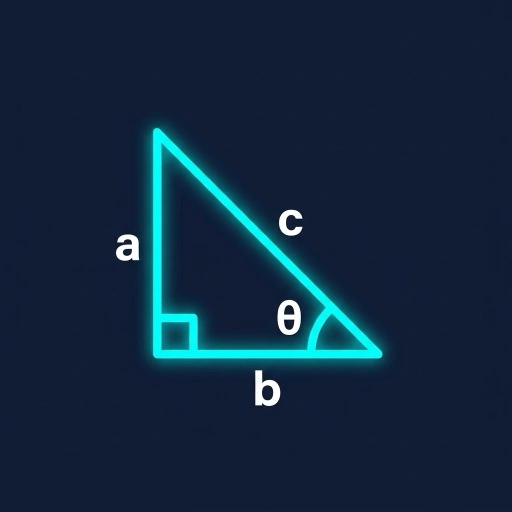
Right Triangle Area Calculator
Calculate the surface area of a right triangle from its perpendicular base and height, or directly from its two perpendicular leg lengths.
For any right-angled triangle, the two perpendicular legs meet at $90^\circ$ and serve directly as the base and height. Apply the fundamental formula $A = \frac{1}{2} \times b \times h$ to get exact answers, dynamic calculation steps, and instant square unit conversions.
Standard Right Triangle Area Diagram ($b = \text{base}$, $h = \text{height}$, $\text{Area} = \frac{1}{2}bh$)
Right Triangle Area Calculator
Enter the perpendicular base $b$ and height $h$ to calculate the enclosed surface area and step-by-step mathematical proofs.
Calculated Right Triangle Area
Triangle area solution & step-by-step breakdown
Step-by-Step Formulas & Solution Steps
Detailed Breakdown
What Is the Area of a Right Triangle?
The half-rectangle relationship of right-angled surface space.
The area of a right triangle represents the total amount of flat space contained within its three boundary edges: the base, the height, and the hypotenuse. Geometrically, any right-angled triangle can be viewed as exactly one-half of a rectangle that shares the same base length and height length.
Since the total area of a rectangle is equal to $\text{base} \times \text{height}$, slicing that rectangle diagonally along its diagonal creates two congruent right triangles. Consequently, the area of a right triangle is exactly half of the surrounding rectangle's area:
Right Triangle Area Formula
Primary mathematical equations for calculating right triangle surface space.
Standard Base & Height Formula
Variables: $b$ = base, $h$ = perpendicular height.
When used: General right triangle area calculation from base and vertical height.
Perpendicular Legs Formula
Variables: $a, b$ = perpendicular leg lengths.
When used: When both non-hypotenuse side lengths are known.
Because legs $a$ and $b$ meet at exactly $90^\circ$, no additional trigonometric angle calculations are necessary when both leg lengths are known. For more detailed proofs and geometric derivations, explore our comprehensive Right Triangle Formulas Guide.
How to Calculate the Area of a Right Triangle
Follow these 5 simple sequential steps to solve any right triangle area problem.
- Identify the base ($b$): Determine the linear measurement of one perpendicular leg.
- Identify the perpendicular height ($h$): Determine the linear measurement of the second perpendicular leg.
- Multiply base by height: Calculate the product $b \times h$.
- Divide by 2: Divide the resulting product by 2 to account for the triangular half-rectangle shape.
- Attach square units: Append the appropriate squared unit of measurement ($\text{cm}^2, \text{m}^2, \text{ft}^2$, etc.).
Walkthrough Calculation Example
Given a right triangle with base $b = 8\text{ cm}$ and height $h = 5\text{ cm}$:
Finding Area From the Two Legs
Direct leg substitution without needing the hypotenuse.
In right-triangle geometry, the term "legs" specifically refers to the two shorter sides ($a$ and $b$) that intersect to form the $90^\circ$ right angle. When a problem asks you to calculate right triangle area from two legs or find right triangle area from two sides, you do not need to calculate the hypotenuse first.
Example: Suppose a right triangle has perpendicular leg lengths $a = 6\text{ ft}$ and $b = 10\text{ ft}$:
Choosing the Base and Height
Commutativity rules and avoiding hypotenuse selection errors.
A common question students ask is: Which leg should be chosen as the base and which as the height?
Because multiplication is mathematically commutative ($a \times b = b \times a$), either perpendicular leg can be selected as the base, and the other perpendicular leg automatically becomes the height. Your choice of orientation does not alter the final calculated area.
Consider a right triangle with legs $a = 6$ and $b = 8$:
- Option 1 (Base = 6, Height = 8): $A = \frac{1}{2} \times 6 \times 8 = 24$
- Option 2 (Base = 8, Height = 6): $A = \frac{1}{2} \times 8 \times 6 = 24$
Right Triangle Area Calculation Examples
5 detailed worked examples under different input and unit conditions.
Example 1: Base and Perpendicular Height
Given: Base $b = 10\text{ cm}$, Height $h = 6\text{ cm}$
Formula: $A = \frac{1}{2} \times b \times h$
Substitution: $A = \frac{1}{2} \times 10 \times 6$
Calculation: $A = \frac{60}{2} = 30$
Final Answer: $30\text{ cm}^2$
Example 2: Two Perpendicular Legs
Given: Leg $a = 5\text{ m}$, Leg $b = 12\text{ m}$
Formula: $A = \frac{1}{2} \times a \times b$
Substitution: $A = \frac{1}{2} \times 5 \times 12$
Calculation: $A = \frac{60}{2} = 30$
Final Answer: $30\text{ m}^2$
Example 3: Isosceles Right Triangle
Given: Leg $a = 7\text{ in}$, Leg $b = 7\text{ in}$
Formula: $A = \frac{1}{2} \times a^2$
Substitution: $A = \frac{1}{2} \times 7 \times 7$
Calculation: $A = \frac{49}{2} = 24.5$
Final Answer: $24.5\text{ in}^2$
Example 4: Decimal Dimensions
Given: Base $b = 4.5\text{ ft}$, Height $h = 8.2\text{ ft}$
Formula: $A = \frac{1}{2} \times b \times h$
Substitution: $A = \frac{1}{2} \times 4.5 \times 8.2$
Calculation: $A = \frac{36.9}{2} = 18.45$
Final Answer: $18.45\text{ ft}^2$
Example 5: Millimeter Metric Calculation
Given: Base $b = 14\text{ mm}$, Height $h = 9\text{ mm}$
Formula: $A = \frac{1}{2} \times b \times h$
Substitution: $A = \frac{1}{2} \times 14 \times 9$
Calculation: $A = \frac{126}{2} = 63$
Final Answer: $63\text{ mm}^2$
Area Units and Square Units
Why two-dimensional surface space requires squared measurement units.
Linear measurement units (such as $\text{cm}$, $\text{m}$, or $\text{ft}$) describe one-dimensional distance around edges. Surface area describes two-dimensional region coverage. When you multiply two linear quantities together ($5\text{ cm} \times 4\text{ cm}$), the units themselves multiply ($ \text{cm} \times \text{cm} = \text{cm}^2$).
Converting Right Triangle Area Units
Using squared conversion factors for metric and imperial surface areas.
When converting right triangle areas between different measurement systems, linear conversion factors must be squared. For instance, while $1\text{ m} = 100\text{ cm}$, converting square meters to square centimeters requires squaring the conversion factor ($100^2 = 10,000$):
Common area unit conversion reference factors:
- $\text{cm}^2$ to $\text{m}^2$: Divide area by $10,000$
- $\text{m}^2$ to $\text{ft}^2$: Multiply area by $\approx 10.7639$ ($3.28084^2$)
- $\text{ft}^2$ to $\text{m}^2$: Multiply area by $\approx 0.092903$
- $\text{in}^2$ to $\text{ft}^2$: Divide area by $144$ ($12^2$)
Exact vs Decimal Area Results
Precision handling for integer, fractional, and decimal leg inputs.
Depending on input dimensions, right triangle area results can be exact integers, terminating decimals, or repeating decimals. For instance, multiplying fractional or decimal dimensions such as $b = 5.5$ and $h = 7.2$ yields an exact terminating decimal result:
Our calculator maintains floating-point precision internally and rounds only at the final presentation step to ensure zero intermediate rounding errors.
How to Verify a Right Triangle Area Calculation
Simple algebraic check using the double-area identity.
You can double-check any right triangle area calculation using the algebraic verification identity:
Verification Step: Multiply your calculated area $A$ by $2$, and verify that it equals the product of your base $b$ and height $h$.
$$2 \times 24 = 8 \times 6 \implies 48 = 48 \quad \checkmark \text{ (Verified)}$$
Can the Hypotenuse Be Used as the Base?
Understanding altitude to hypotenuse ($h_c$) vs perpendicular leg height.
Technically, any side of a triangle can serve as a base. However, if you choose the hypotenuse ($c$) as the base, the corresponding height is NOT either of the perpendicular legs. Instead, the height corresponds to the altitude to the hypotenuse ($h_c$)—the perpendicular segment drawn from the $90^\circ$ vertex directly to the hypotenuse:
Because calculating $h_c$ ($h_c = \frac{a \cdot b}{c}$) requires extra steps, using the two perpendicular legs ($A = \frac{1}{2}ab$) is much simpler and faster. To find missing hypotenuse lengths or altitudes, visit our specialized Right Triangle Hypotenuse Calculator and Right Triangle Altitude Calculator.
Common Right Triangle Area Calculation Mistakes
Avoid these 10 frequent pitfalls when solving right triangle surface space.
- Forgetting the $\frac{1}{2}$ factor: Calculating $b \times h$ gives the rectangle area, not the triangle area.
- Forgetting to divide by 2: Failing to perform the final division step.
- Using the hypotenuse as the height: Substituting side $c$ into $A = \frac{1}{2}bh$ instead of perpendicular leg $h$.
- Using non-perpendicular dimensions: Selecting two sides that do not form a $90^\circ$ right angle.
- Mixing measurement units: Multiplying base in meters by height in centimeters without converting first.
- Reporting area in linear units: Writing $\text{cm}$ instead of square units $\text{cm}^2$.
- Rounding intermediate values too early: Rounding leg values before completing multiplication and division.
- Entering negative dimensions: Entering non-physical negative side lengths.
- Entering zero dimensions: Attempting to calculate area with zero base or height.
- Using dimensions from different triangles: Mixing side lengths from separate geometric figures.
When Can You Use the Right Triangle Area Formula?
Prerequisites and physical constraints for formula validity.
The simplified area formula $A = \frac{1}{2}ab$ can be used directly whenever the following conditions are met:
- The triangle contains a true $90^\circ$ right angle.
- The two given dimensions represent the mutually perpendicular legs $a$ and $b$.
- Both dimensions are measured in compatible linear units.
- Both input values are strictly positive real numbers ($a > 0, b > 0$).
Right Triangle Area Calculator vs Other Calculators
Compare our specialized geometry tools to choose the exact solver for your problem.
How to Use the Right Triangle Area Calculator
Follow these quick steps to solve any right triangle area problem in seconds.
- Enter the Base ($b$): Type the horizontal leg length into the first input field.
- Enter the Perpendicular Height ($h$): Type the vertical leg length into the second input field.
- Select Measurement Unit: Choose your preferred length unit ($\text{cm}, \text{mm}, \text{m}, \text{in}, \text{ft}$, etc.).
- Click Calculate Area: Press the primary Calculate Area button to trigger calculation.
- Review Results: Examine the highlighted square unit area, formula substitution, and complete calculation steps.
Related Right Triangle Calculators
Explore our complete collection of specialized right-angle geometry tools.
Frequently Asked Questions
Common questions about right triangle area calculations, formulas, and geometry rules.
Q1
What is the formula for the area of a right triangle?
The fundamental formula is $\text{Area} = \frac{1}{2} \times \text{base} \times \text{height} = \frac{1}{2}bh$, or $\text{Area} = \frac{1}{2}ab$ using perpendicular leg lengths $a$ and $b$.
Q2
How do you calculate the area of a right triangle?
Identify the base and perpendicular height (or two perpendicular legs), multiply them together, divide the product by 2, and append square units ($\text{cm}^2, \text{m}^2$, etc.).
Q3
What are the base and height of a right triangle?
The base and height are the two perpendicular sides (legs $a$ and $b$) that meet at the $90^\circ$ right angle corner.
Q4
Can the two legs be used to calculate area?
Yes. Because the two legs of a right triangle meet at a $90^\circ$ angle, one leg serves directly as base and the other serves directly as perpendicular height.
Q5
Is the hypotenuse the height of a right triangle?
No. The hypotenuse is the longest side opposite the $90^\circ$ angle and is slanted relative to both legs. It cannot be used directly as the height.
Q6
Why do you divide by 2 when calculating triangle area?
A right triangle represents exactly half of a rectangle with dimensions $\text{base} \times \text{height}$. Dividing the rectangular product by 2 gives the triangle's area.
Q7
What units are used for right triangle area?
Area is always expressed in squared units such as $\text{mm}^2, \text{cm}^2, \text{m}^2, \text{km}^2, \text{in}^2, \text{ft}^2$, or $\text{yd}^2$.
Q8
Why is triangle area expressed in square units?
Area measures a 2D surface region. Multiplying two 1D linear length dimensions ($\text{length} \times \text{length}$) produces square units ($\text{unit}^2$).
Q9
Can I calculate area using decimal side lengths?
Yes. The area formula works for any positive real numbers, including terminating and non-terminating decimals.
Q10
Can either leg be the base?
Yes. Multiplication is commutative, so choosing leg $a$ as base and leg $b$ as height yields the exact same numerical result as swapping them.
Q11
What happens if the base and height are not perpendicular?
If two sides are not perpendicular, $\text{Area} = \frac{1}{2} \times \text{side1} \times \text{side2}$ produces an incorrect result. You must use the actual perpendicular height or sine formula $\frac{1}{2}ab\sin(C)$.
Q12
How do I verify my right triangle area calculation?
Verify by checking that $2 \times \text{Area} = \text{base} \times \text{height}$. If $2A = bh$, your calculation is algebraically correct.
Q13
Can the hypotenuse be used as the base?
Yes, but only if you know the perpendicular altitude ($h_c$) drawn directly to the hypotenuse, giving $\text{Area} = \frac{1}{2} \cdot c \cdot h_c$.
Q14
How is right triangle area different from perimeter?
Area measures enclosed 2D surface space in square units ($\text{cm}^2$), while perimeter measures 1D total boundary distance in linear units ($\text{cm}$).
Q15
What is the area of a 3-4-5 right triangle?
The perpendicular legs of a 3-4-5 right triangle are 3 and 4. The area is $\frac{1}{2} \times 3 \times 4 = 6\text{ square units}$.