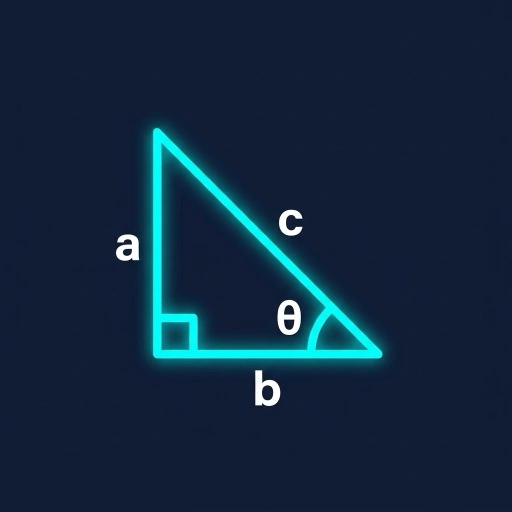
Right Triangle Ratios
Right triangle ratios compare the lengths of two side edges relative to a chosen acute reference angle in a right-angled triangle.
These fundamental proportional relationships define the primary trigonometric functions—sine ($\sin$), cosine ($\cos$), and tangent ($\tan$)—along with their reciprocal counterparts: cosecant ($\csc$), secant ($\sec$), and cotangent ($\cot$).
Right triangle sides labeled relative to reference angle $\theta$ ($C = 90^\circ$).
What Are Right Triangle Ratios?
A ratio is a mathematical relationship comparing the relative sizes of two numerical quantities by division. In Euclidean geometry, a right triangle ratio specifically compares the length of one side of a right-angled triangle to another side.
Because all right triangles contain one fixed $90^\circ$ right angle, the shape of the triangle is entirely determined by the size of its acute interior angles. No matter how large or small a right triangle is drawn, if its acute reference angle remains constant, the ratio between any two of its side lengths stays identical.
These invariant geometric proportions give rise to the core trigonometric functions: sine, cosine, and tangent. The value of a right triangle ratio depends strictly on which acute angle is chosen as the reference point:
- The hypotenuse is always fixed as the longest side directly opposite the $90^\circ$ corner.
- The opposite side is the leg positioned directly across from the selected reference angle.
- The adjacent side is the leg running alongside the selected reference angle that forms the corner with the hypotenuse.
The Three Primary Right Triangle Ratios
Core mathematical definitions comparing sides relative to acute angle $\theta$.
Opposite, Adjacent, and Hypotenuse
Understanding how the three sides of a right triangle are classified.
Hypotenuse
- Situated directly opposite the $90^\circ$ right angle.
- Always guaranteed to be the longest side in any right triangle.
- Never changes its name, regardless of which acute angle is chosen.
Opposite Side
- Located directly across from the chosen acute reference angle.
- Does not touch or form the vertex of the selected reference angle.
- Swaps roles with the adjacent side if the reference angle is changed.
Adjacent Side
- Positioned next to the chosen acute reference angle.
- Forms one ray of the reference angle's vertex alongside the hypotenuse.
- Is always one of the two perpendicular legs, never the hypotenuse.
Crucial Concept: The labels opposite and adjacent are not static physical properties of the legs. They are strictly relative designations that depend on which acute angle you pick as your reference angle.
The Reference Angle in Right Triangle Ratios
A reference angle (often denoted by Greek letters such as $\theta$ or $\phi$, or vertex letters like $A$ or $B$) is the acute angle chosen to analyze a right triangle.
Because every right triangle has two non-right acute angles that sum to $90^\circ$, choosing one specific angle as your focus establishes the frame of reference for all trigonometric calculations:
- Selecting an acute reference angle immediately identifies which leg is across from it (opposite) and which leg is beside it (adjacent).
- Changing the selected reference angle to the other acute vertex flips the designations of opposite and adjacent legs.
- The hypotenuse remains completely unaffected because it is permanently anchored across from the $90^\circ$ right angle corner.
Comparing reference angle $\theta$ (bottom-left) vs reference angle $\phi$ (top-right) in the same triangle.
How the Reference Angle Changes Right Triangle Ratios
Understanding complementary relationships between acute angles $\theta$ and $\phi$.
Consider a single right triangle with legs $a$ and $b$, hypotenuse $c$, and acute angles $\theta$ and $\phi$. Because the three interior angles of any triangle total $180^\circ$ and the right angle takes up $90^\circ$, the two acute angles are complementary:
When evaluating side ratios relative to $\theta$, leg $a$ is opposite and leg $b$ is adjacent. When evaluating ratios relative to $\phi$, leg $b$ becomes opposite and leg $a$ becomes adjacent. This produces the co-function identities:
Sine Ratio in a Right Triangle
The sine ratio measures the proportion of the opposite leg length relative to the hypotenuse length for a given acute reference angle $\theta$:
Key Properties of Sine
- Because the hypotenuse is always the longest side, the sine of any acute angle in a right triangle is strictly between 0 and 1 ($0 < \sin \theta < 1$).
- As angle $\theta$ grows larger toward $90^\circ$, the opposite leg expands and $\sin \theta$ approaches $1$.
- As angle $\theta$ shrinks toward $0^\circ$, the opposite leg shrinks and $\sin \theta$ approaches $0$.
Numerical Ratio Example
Suppose a right triangle has an opposite leg of 3 units and a hypotenuse of 5 units:
$$\sin \theta = \frac{3}{5} = 0.6$$Interpretation: The opposite leg measures exactly $60\%$ of the length of the hypotenuse.
Cosine Ratio in a Right Triangle
The cosine ratio measures the proportion of the adjacent leg length relative to the hypotenuse length for a given acute reference angle $\theta$:
Key Properties of Cosine
- Like sine, the cosine ratio for an acute angle in a right triangle always ranges strictly between 0 and 1 ($0 < \cos \theta < 1$).
- As angle $\theta$ increases toward $90^\circ$, the adjacent leg shrinks and $\cos \theta$ decreases toward $0$.
- As angle $\theta$ decreases toward $0^\circ$, the adjacent leg approaches the length of the hypotenuse and $\cos \theta$ increases toward $1$.
Numerical Ratio Example
Suppose a right triangle has an adjacent leg of 4 units and a hypotenuse of 5 units:
$$\cos \theta = \frac{4}{5} = 0.8$$Interpretation: The adjacent leg measures exactly $80\%$ of the length of the hypotenuse.
Tangent Ratio in a Right Triangle
The tangent ratio compares the length of the opposite leg directly to the length of the adjacent leg for a given acute reference angle $\theta$:
Key Properties of Tangent
- Unlike sine and cosine, the tangent ratio is not bounded by $1$. It can take any positive value ($\tan \theta > 0$).
- When opposite = adjacent (as in a $45^\circ$-$45^\circ$-$90^\circ$ triangle), $\tan(45^\circ) = 1$.
- When the opposite leg is longer than the adjacent leg, $\tan \theta > 1$. When the opposite leg is shorter, $\tan \theta < 1$.
- Mathematically, tangent is also equal to the ratio of sine to cosine: $\tan \theta = \frac{\sin \theta}{\cos \theta}$.
Numerical Ratio Example
Suppose a right triangle has an opposite leg of 3 units and an adjacent leg of 4 units:
$$\tan \theta = \frac{3}{4} = 0.75$$Interpretation: The opposite leg is $75\%$ as long as the adjacent leg.
SOHCAHTOA and Right Triangle Ratios
The classic memory aid for primary right triangle trigonometric ratios.
Need to solve interactive right triangle problems? Use our dedicated SOHCAHTOA Calculator.
Reciprocal Right Triangle Ratios
In addition to sine, cosine, and tangent, every right triangle has three reciprocal trigonometric ratios. A reciprocal ratio is created simply by swapping the numerator and denominator of a primary ratio.
Cosecant ($\csc$)
Reciprocal of Sine ($\sin$):
$$\csc \theta = \frac{\text{Hypotenuse}}{\text{Opposite}} = \frac{1}{\sin \theta}$$Secant ($\sec$)
Reciprocal of Cosine ($\cos$):
$$\sec \theta = \frac{\text{Hypotenuse}}{\text{Adjacent}} = \frac{1}{\cos \theta}$$Cotangent ($\cot$)
Reciprocal of Tangent ($\tan$):
$$\cot \theta = \frac{\text{Adjacent}}{\text{Opposite}} = \frac{1}{\tan \theta}$$Right Triangle Ratio Table
Complete 6-function trigonometric ratio reference matrix.
Calculating Right Triangle Ratios From Side Lengths
When all three side lengths of a right triangle are known, you can directly compute every trigonometric ratio for either acute angle without needing an angle measurement in degrees.
Consider a right triangle with side lengths $a = 3$, $b = 4$, and $c = 5$:
Ratios for Angle $\theta$ (Opposite = 3, Adjacent = 4)
- $$\sin \theta = \frac{3}{5} = 0.60$$
- $$\cos \theta = \frac{4}{5} = 0.80$$
- $$\tan \theta = \frac{3}{4} = 0.75$$
Ratios for Angle $\phi$ (Opposite = 4, Adjacent = 3)
- $$\sin \phi = \frac{4}{5} = 0.80$$
- $$\cos \phi = \frac{3}{5} = 0.60$$
- $$\tan \phi = \frac{4}{3} \approx 1.33$$
Right Triangle Ratios in a 3-4-5 Triangle
Worked example showing all 6 primary and reciprocal ratios for a 3-4-5 right triangle.
Primary Ratios
$$\sin \theta = \frac{3}{5} = 0.6$$
$$\cos \theta = \frac{4}{5} = 0.8$$
$$\tan \theta = \frac{3}{4} = 0.75$$
Reciprocal Ratios
$$\csc \theta = \frac{5}{3} \approx 1.667$$
$$\sec \theta = \frac{5}{4} = 1.25$$
$$\cot \theta = \frac{4}{3} \approx 1.333$$
Right Triangle Ratios in a 5-12-13 Triangle
Worked example showing all 6 primary and reciprocal ratios for a 5-12-13 right triangle.
Primary Ratios
$$\sin \theta = \frac{5}{13} \approx 0.3846$$
$$\cos \theta = \frac{12}{13} \approx 0.9231$$
$$\tan \theta = \frac{5}{12} \approx 0.4167$$
Reciprocal Ratios
$$\csc \theta = \frac{13}{5} = 2.6$$
$$\sec \theta = \frac{13}{12} \approx 1.0833$$
$$\cot \theta = \frac{12}{5} = 2.4$$
Right Triangle Ratios and Complementary Angles
Because the two acute angles in a right triangle always add up to $90^\circ$ ($\theta + \phi = 90^\circ$), their trigonometric ratios share powerful co-function identities:
Exact Ratios for Special Right Triangles
Standard exact radical values for $45^\circ$-$45^\circ$-$90^\circ$ and $30^\circ$-$60^\circ$-$90^\circ$ triangles.
45°-45°-90° Triangle Ratios
Side length ratio: $1 : 1 : \sqrt{2}$
- $$\sin(45^\circ) = \frac{\sqrt{2}}{2} \approx 0.7071$$
- $$\cos(45^\circ) = \frac{\sqrt{2}}{2} \approx 0.7071$$
- $$\tan(45^\circ) = 1$$
30°-60°-90° Triangle Ratios
Side length ratio: $1 : \sqrt{3} : 2$
- $$\sin(30^\circ) = \frac{1}{2}, \quad \cos(30^\circ) = \frac{\sqrt{3}}{2}, \quad \tan(30^\circ) = \frac{\sqrt{3}}{3}$$
- $$\sin(60^\circ) = \frac{\sqrt{3}}{2}, \quad \cos(60^\circ) = \frac{1}{2}, \quad \tan(60^\circ) = \sqrt{3}$$
How Right Triangle Ratios Change With Angle
As the acute reference angle $\theta$ changes from near $0^\circ$ up to near $90^\circ$, the trigonometric ratios move continuously through specific boundaries:
As $\theta$ Increases Toward $90^\circ$
- Sine ($\sin \theta$) increases from near $0$ toward $1$.
- Cosine ($\cos \theta$) decreases from near $1$ toward $0$.
- Tangent ($\tan \theta$) grows rapidly toward $+\infty$.
As $\theta$ Decreases Toward $0^\circ$
- Sine ($\sin \theta$) decreases toward $0$.
- Cosine ($\cos \theta$) increases toward $1$.
- Tangent ($\tan \theta$) decreases toward $0$.
Right Triangle Ratio Ranges
Valid numeric boundaries for acute angles ($0^\circ < \theta < 90^\circ$) in a right triangle.
Right Triangle Ratios and Slope
In coordinate geometry, the slope ($m$) of a line is defined as the ratio of vertical change (rise) to horizontal change (run):
Because the rise corresponds to the opposite leg and the run corresponds to the adjacent leg of a right-triangle representation, the tangent ratio of the angle of inclination is exactly equal to the line's slope.
Slope Example
A ramp rises 3 meters vertically over a horizontal distance of 4 meters:
$$\text{Slope } m = \frac{3}{4} = 0.75 \implies \tan \theta = 0.75$$The angle of inclination $\theta = \arctan(0.75) \approx 36.87^\circ$.
Real-World Applications of Right Triangle Ratios
How side ratios solve practical distance, height, and incline problems.
Construction & Roofing
Roof pitch uses the tangent ratio ($\text{rise}/\text{run}$) to compute slope angles and material cut lengths for rafters and trusses.
Surveying & Mapping
Surveyors measure baseline distance and line-of-sight elevation angle to find inaccessible heights of buildings or mountains via tangent.
Ladder & Ramp Safety
OSHA ladder safety regulations specify a $4:1$ height-to-base ratio ($\tan \theta = 4 \implies \theta \approx 75.5^\circ$) for stable ladder positioning.
Navigation & Aviation
Pilots and navigators calculate descent glide paths and vector wind components using sine and cosine ratios.
How to Choose the Correct Right Triangle Ratio
Decision table and step-by-step ratio selection guide.
6-Step Decision Process
- Identify your target reference angle $\theta$.
- Locate the hypotenuse (the side across from the $90^\circ$ right angle).
- Identify the opposite leg (the side directly across from reference angle $\theta$).
- Identify the adjacent leg (the leg next to reference angle $\theta$).
- Determine which two sides are either given or need to be solved.
- Select the corresponding ratio using SOHCAHTOA (Sine for Opp/Hyp, Cosine for Adj/Hyp, Tangent for Opp/Adj).
Common Right Triangle Ratio Mistakes
Key pitfalls to avoid when working with trigonometric ratios.
1. Choosing the Wrong Reference Angle
Mistake: Using side labels calculated for angle $A$ when attempting to solve for angle $B$.
Correction: Re-identify opposite and adjacent legs whenever switching reference angles.
2. Confusing Opposite and Adjacent Legs
Mistake: Assuming the bottom horizontal leg is always adjacent.
Correction: Adjacent is defined by vertex proximity to reference angle $\theta$, regardless of triangle orientation.
3. Treating Hypotenuse as an Adjacent Side
Mistake: Calling the hypotenuse "adjacent" because it touches the reference angle.
Correction: The hypotenuse is permanently fixed. Adjacent always refers to the non-hypotenuse leg touching the angle.
4. Reversing Numerator and Denominator
Mistake: Writing $\sin \theta = \frac{\text{hypotenuse}}{\text{opposite}}$.
Correction: Remember SOHCAHTOA: Sine is Opposite divided by Hypotenuse.
5. Calculator Set to Radians Instead of Degrees
Mistake: Calculating $\sin(30^\circ)$ on a calculator set to RAD mode (returns $-0.988$ instead of $0.5$).
Correction: Always verify your scientific calculator mode (DEG) before computing angles in degrees.
6. Confusing Sine with Cosecant / Cosine with Secant
Mistake: Thinking secant is the reciprocal of sine because both start with "s".
Correction: Remember co-pairs match opposites: $\sec = 1/\cos$ and $\csc = 1/\sin$.
7. Rounding Intermediate Ratios Too Early
Mistake: Rounding $\sin(35^\circ) = 0.573576$ to $0.6$ before multiplying by hypotenuse.
Correction: Keep exact expressions or full calculator precision until writing the final answer.
8. Assuming Opposite and Adjacent Are Fixed Labels
Mistake: Believing leg $a$ is always opposite.
Correction: Leg $a$ is opposite angle $A$, but adjacent to angle $B$.
Right Triangle Ratios vs General Trigonometric Ratios
In right triangle geometry, trigonometric ratios are defined strictly as ratios of physical side lengths ($\text{opp}/\text{hyp}$, $\text{adj}/\text{hyp}$, $\text{opp}/\text{adj}$) for acute angles between $0^\circ$ and $90^\circ$.
In advanced algebra and calculus, trigonometry extends beyond right triangles using the unit circle ($x^2 + y^2 = 1$). This unit-circle definition expands sine and cosine to obtuse angles, negative angles, and arbitrary real numbers beyond $360^\circ$.
Within any right-angled triangle, however, standard side-length ratio definitions remain completely exact and fully self-contained.
Right Triangle Ratios Quick Reference
Primary Ratios
$$\sin \theta = \frac{\text{Opposite}}{\text{Hypotenuse}}$$ $$\cos \theta = \frac{\text{Adjacent}}{\text{Hypotenuse}}$$ $$\tan \theta = \frac{\text{Opposite}}{\text{Adjacent}}$$Reciprocal Ratios
$$\csc \theta = \frac{\text{Hypotenuse}}{\text{Opposite}}$$ $$\sec \theta = \frac{\text{Hypotenuse}}{\text{Adjacent}}$$ $$\cot \theta = \frac{\text{Adjacent}}{\text{Opposite}}$$Complementary Rules ($\theta + \phi = 90^\circ$)
$$\sin \theta = \cos(90^\circ - \theta)$$ $$\cos \theta = \sin(90^\circ - \theta)$$ $$\tan \theta = \cot(90^\circ - \theta)$$Related Right Triangle Calculators and Resources
Explore our complete collection of right triangle geometry solvers and reference guides.
Frequently Asked Questions
Clear, concise answers to common questions about right triangle ratios.
Q1
What are right triangle ratios?
Right triangle ratios are mathematical comparisons between the lengths of two side edges of a right-angled triangle relative to a selected acute reference angle. The fundamental ratios are sine, cosine, and tangent.
Q2
What are the three main right triangle ratios?
The three primary right triangle ratios are sine ($\sin \theta = \text{opp}/\text{hyp}$), cosine ($\cos \theta = \text{adj}/\text{hyp}$), and tangent ($\tan \theta = \text{opp}/\text{adj}$).
Q3
What is the sine ratio in a right triangle?
The sine ratio compares the length of the side opposite the reference angle to the length of the hypotenuse: $\sin \theta = \text{opposite} / \text{hypotenuse}$.
Q4
What is the cosine ratio in a right triangle?
The cosine ratio compares the length of the side adjacent to the reference angle to the length of the hypotenuse: $\cos \theta = \text{adjacent} / \text{hypotenuse}$.
Q5
What is the tangent ratio in a right triangle?
The tangent ratio compares the length of the side opposite the reference angle to the length of the side adjacent to it: $\tan \theta = \text{opposite} / \text{adjacent}$.
Q6
What does SOHCAHTOA mean?
SOHCAHTOA is a mnemonic device for remembering trigonometric ratios: SOH stands for Sine = Opposite / Hypotenuse, CAH stands for Cosine = Adjacent / Hypotenuse, and TOA stands for Tangent = Opposite / Adjacent.
Q7
How do you identify the opposite side?
The opposite side is the leg located directly across from the chosen acute reference angle, without forming part of that angle's vertex.
Q8
How do you identify the adjacent side?
The adjacent side is the leg running next to the chosen acute reference angle. It forms one ray of the angle alongside the hypotenuse, but is never the hypotenuse itself.
Q9
Does the reference angle change the ratios?
Yes. Choosing the other acute angle in a right triangle swaps the roles of opposite and adjacent legs, which turns sine into cosine and tangent into its reciprocal.
Q10
What are the reciprocal right triangle ratios?
The reciprocal ratios are cosecant ($\csc \theta = \text{hyp}/\text{opp}$), secant ($\sec \theta = \text{hyp}/\text{adj}$), and cotangent ($\cot \theta = \text{adj}/\text{opp}$).
Q11
What are the ratios for a 45-45-90 triangle?
For a $45^\circ$ angle in an isosceles right triangle, the exact primary ratios are $\sin(45^\circ) = \sqrt{2}/2$, $\cos(45^\circ) = \sqrt{2}/2$, and $\tan(45^\circ) = 1$.
Q12
What are the ratios for a 30-60-90 triangle?
For $30^\circ$: $\sin(30^\circ) = 1/2$, $\cos(30^\circ) = \sqrt{3}/2$, $\tan(30^\circ) = \sqrt{3}/3$. For $60^\circ$: $\sin(60^\circ) = \sqrt{3}/2$, $\cos(60^\circ) = 1/2$, $\tan(60^\circ) = \sqrt{3}$.
Q13
Why can tangent be greater than 1?
Tangent compares the two perpendicular legs ($\text{opposite} / \text{adjacent}$). Whenever the opposite leg is longer than the adjacent leg, the ratio is greater than 1.
Q14
How are right triangle ratios used in real life?
Right triangle ratios are used in surveying, construction, architecture, navigation, and engineering to calculate heights, distances, slopes, roof pitches, and incline angles without direct measurement.
Q15
How do you choose between sine, cosine, and tangent?
Identify your reference angle and check which two sides are involved: use sine for opposite and hypotenuse, cosine for adjacent and hypotenuse, and tangent for opposite and adjacent.