Disclaimer & Calculation Accuracy
Information regarding computational algorithms, mathematical precision, floating-point rounding, and engineering verification boundaries.
Learn about our calculation fidelity, IEEE 754 floating-point conventions, exact radical outputs, and important boundaries for real-world architectural or construction applications.
Mathematical Precision & Professional Engineering Boundaries
1. Educational & Analytical Purpose
All content, calculators, formula references, and interactive proofs provided on righttrianglecalculator.online are constructed exclusively for educational, instructional, reference, and analytical purposes.
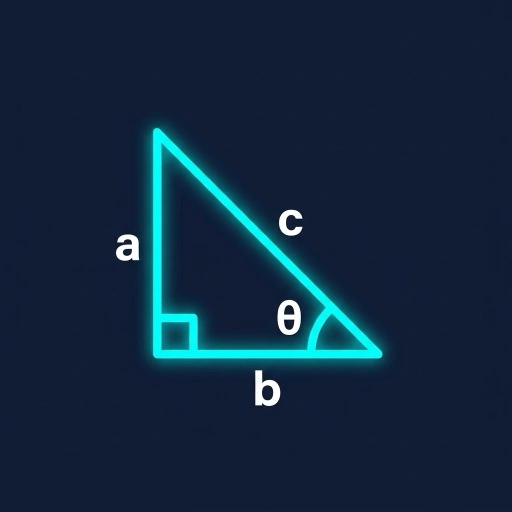
While we take painstaking measures to ensure that every calculation engine faithfully implements standard Euclidean geometry theorems ($a^2 + b^2 = c^2$, SOHCAHTOA trigonometric ratios, area $\frac{1}{2}ab$, and altitude $\frac{ab}{c}$), the site is not intended to serve as certified structural engineering software.
2. Engineering & Construction Boundary Notice
If you are utilizing our calculators for physical construction, architectural rafter cutting, roof pitch layout, land surveying, or load-bearing structural design:
⚠️ Crucial Structural Warning: Always have your dimensional measurements, angle tolerances, and load-bearing calculations independently verified by a qualified, licensed professional engineer or architect prior to executing structural cuts or foundation installations.
3. Floating-Point Precision & Rounding Conventions
Computers represent real numbers using IEEE 754 floating-point arithmetic. While JavaScript provides 64-bit double-precision floating-point numbers (approx. 15-17 significant decimal digits), users should understand:
- Display Rounding: Output values are rounded to 4-6 decimal places for visual clarity.
- Irrational Quantities: Values involving square roots ($\sqrt{2}, \sqrt{3}$) or trigonometric functions ($\sin(30^\circ), \cos(45^\circ)$) are irrational and are displayed with exact simplified radical expressions alongside high-precision rounded approximations.
- Unit Consistency: Inputs must use uniform length units (e.g. all in meters, or all in inches) to obtain accurate area and perimeter results.
4. Warranty Disclaimer
THE SERVICES AND CALCULATOR ENGINES ON THIS WEBSITE ARE PROVIDED ON AN "AS IS" AND "AS AVAILABLE" BASIS WITHOUT WARRANTIES OF ANY KIND, EITHER EXPRESS OR IMPLIED, INCLUDING BUT NOT LIMITED TO WARRANTIES OF MERCHANTABILITY, FITNESS FOR A PARTICULAR PURPOSE, OR ACCURACY.
If you notice a potential discrepancy in a calculation step or formula guide, please notify us immediately via our Contact Page so our editorial team can audit it.