The Pythagorean Theorem Explained
The Pythagorean Theorem is one of geometry's most fundamental rules, establishing the precise mathematical relationship between the side lengths of a right triangle ($a^2 + b^2 = c^2$).
This comprehensive guide explores the Pythagorean formula, geometric meaning, step-by-step derivations, formal proofs, integer triples, triangle classification, distance formula connections, and real-world applications.
Geometric Proof: Square on Leg $a$ ($a^2=9$) + Square on Leg $b$ ($b^2=16$) = Square on Hypotenuse $c$ ($c^2=25$)
📑 Table of Contents
What Is the Pythagorean Theorem?
The Pythagorean Theorem is a fundamental mathematical theorem in geometry that establishes a strict relationship between the three side lengths of a right triangle. Named after the ancient Greek mathematician Pythagoras, the theorem states that in any right-angled triangle, the square of the length of the hypotenuse equals the sum of the squares of the lengths of the two remaining legs.
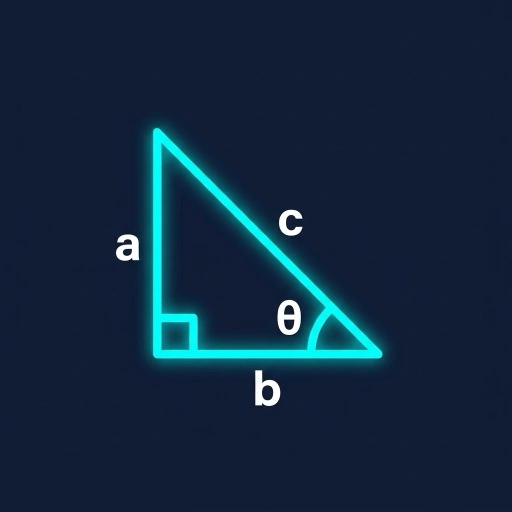
In this equation, $a$ and $b$ represent the perpendicular legs that intersect to form the $90^\circ$ right angle, while $c$ represents the hypotenuse—the longest side lying directly opposite the right angle.
💡 Important Requirement
The Pythagorean Theorem applies strictly and exclusively to right triangles. It does not apply directly to general oblique (acute or obtuse) triangles where no angle measures exactly $90^\circ$.
The Pythagorean Theorem Formula
The algebraic equation $a^2 + b^2 = c^2$ is the primary mathematical expression of the theorem. To understand the formula deeply, let's break down each component:
- $a$: The length of the first perpendicular leg.
- $b$: The length of the second perpendicular leg.
- $c$: The length of the hypotenuse (the side opposite the $90^\circ$ right angle).
- $a^2$: The surface area of a square constructed with side length $a$.
- $b^2$: The surface area of a square constructed with side length $b$.
- $c^2$: The surface area of a square constructed with side length $c$.
Geometrically, the formula means that if you construct physical squares on each of the three sides of a right triangle, the total surface area of the two smaller squares ($a^2$ and $b^2$) will exactly equal the surface area of the largest square ($c^2$).
Interactive Visual Representation of $a^2 + b^2 = c^2$
Observe how the two leg squares ($3^2 = 9$ grid units and $4^2 = 16$ grid units) combine to fill the hypotenuse square ($5^2 = 25$ grid units).
Understanding the Parts of a Right Triangle
To apply the Pythagorean Theorem correctly without errors, you must clearly identify the specific elements of a right triangle:
- Leg $a$ and Leg $b$: The two shorter sides that meet at a perpendicular $90^\circ$ angle. In calculations, legs $a$ and $b$ are interchangeable because $a^2 + b^2 = b^2 + a^2$.
- Hypotenuse $c$: The side positioned directly opposite the $90^\circ$ right angle. It is always the longest side of a right triangle.
- Right Angle ($90^\circ$): The angle formed by the intersection of legs $a$ and $b$, customarily designated with a square corner box symbol ($\llcorner$).
Why Does the Pythagorean Theorem Work?
The Pythagorean Theorem is not an arbitrary rule; it reflects a deep, fundamental geometric truth. To understand why it works:
- Construct a physical square on leg $a$ with area $a^2$.
- Construct a physical square on leg $b$ with area $b^2$.
- Construct a physical square on hypotenuse $c$ with area $c^2$.
- If you slice the two smaller squares ($a^2$ and $b^2$) into geometric pieces, those exact pieces can be rearranged without gaps or overlap to perfectly fill the larger hypotenuse square ($c^2$).
Thus, the equation $a^2 + b^2 = c^2$ expresses an exact equivalence of total surface areas.
Visual Explanation of the Pythagorean Theorem
Consider the classic $3-4-5$ right triangle as a concrete numerical example:
- Let leg $a = 3$ units. The area of the square on side $a$ is $3^2 = 9$.
- Let leg $b = 4$ units. The area of the square on side $b$ is $4^2 = 16$.
- Let hypotenuse $c = 5$ units. The area of the square on side $c$ is $5^2 = 25$.
Adding the smaller areas together yields:
Because $25 = 25$, the areas match perfectly, demonstrating why $a^2 + b^2 = c^2$ holds true visually and numerically.
Pythagorean Theorem Step by Step
Here is the standard step-by-step procedure for solving any Pythagorean problem:
Why is the square root taken at the final stage? Because adding $a^2 + b^2$ gives $c^2$ (the squared hypotenuse). Taking the square root converts the area metric back into linear side length.
Solving for the Hypotenuse
When both legs $a$ and $b$ are known, rearrange the Pythagorean formula to solve directly for hypotenuse $c$:
Example: Solve for Hypotenuse $c$
Given: Leg $a = 5$, Leg $b = 12$
Need an instant automated solver? Use our dedicated Hypotenuse Calculator.
Solving for a Missing Leg
When the hypotenuse $c$ and one leg are known, isolate the missing leg by subtracting the square of the known leg from $c^2$:
Example: Solve for Missing Leg $a$
Given: Hypotenuse $c = 13$, Leg $b = 5$
Need to calculate missing legs for any right triangle? Try our Right Triangle Side Calculator.
Why the Hypotenuse Is Always the Longest Side
We can algebraically prove that hypotenuse $c$ must be strictly longer than either leg $a$ or leg $b$:
Starting with the Pythagorean equation:
$$\begin{aligned} c^2 &= a^2 + b^2 \end{aligned}$$Since side lengths in real geometry must be positive non-zero numbers ($a > 0$ and $b > 0$), their squares are strictly positive ($a^2 > 0$ and $b^2 > 0$). Therefore:
$$\begin{aligned} c^2 > a^2 &\implies c > a \\ c^2 > b^2 &\implies c > b \end{aligned}$$Because $c > a$ and $c > b$, hypotenuse $c$ is guaranteed to be the longest side in every right triangle.
Pythagorean Theorem Worked Examples
Five comprehensive step-by-step solved geometry problems illustrating integer triples, decimal calculations, and real-world applications.
Example 1: Classic 3-4-5 Integer Right Triangle
Given: Leg $a = 3$, Leg $b = 4$. Find hypotenuse $c$.
Result: $c = 5$
Example 2: 5-12-13 Right Triangle
Given: Leg $a = 5$, Leg $b = 12$. Find hypotenuse $c$.
Result: $c = 13$
Example 3: Solve for Missing Leg $a$
Given: Hypotenuse $c = 10$, Leg $b = 6$. Find leg $a$.
Result: $a = 8$
Example 4: Decimal Side Measurements
Given: Leg $a = 4.5\text{ cm}$, Leg $b = 6.0\text{ cm}$. Find hypotenuse $c$.
Result: $c = 7.5\text{ cm}$
Example 5: Real-World Diagonal Distance
Problem: A rectangular room measures $9\text{ meters}$ wide and $12\text{ meters}$ long. What is the diagonal distance across the floor?
Result: The diagonal distance across the room is $15\text{ meters}$.
Pythagorean Triples
A Pythagorean triple consists of three positive integers $(a, b, c)$ that satisfy $a^2 + b^2 = c^2$ perfectly without any fractional or decimal values.
| Triple $(a, b, c)$ | Algebraic Verification ($a^2 + b^2 = c^2$) | Common Multiples |
|---|---|---|
| 3 - 4 - 5 | $9 + 16 = 25 = 5^2$ | 6-8-10, 9-12-15, 12-16-20 |
| 5 - 12 - 13 | $25 + 144 = 169 = 13^2$ | 10-24-26, 15-36-39, 20-48-52 |
| 8 - 15 - 17 | $64 + 225 = 289 = 17^2$ | 16-30-34, 24-45-51 |
| 7 - 24 - 25 | $49 + 576 = 625 = 25^2$ | 14-48-50, 21-72-75 |
| 9 - 40 - 41 | $81 + 1600 = 1681 = 41^2$ | 18-80-82, 27-120-123 |
Primitive vs Non-Primitive Pythagorean Triples
Pythagorean triples are categorized into two structural classes:
-
Primitive Pythagorean Triples: The integers $a$, $b$, and $c$ share no common divisor greater than 1 (they are coprime, i.e., $\gcd(a, b, c) = 1$).
Examples: $(3, 4, 5)$, $(5, 12, 13)$, $(8, 15, 17)$. -
Non-Primitive Pythagorean Triples: Formed by multiplying a primitive triple by a positive integer scaling factor $k > 1$.
Example: Multiplying $(3, 4, 5)$ by $k = 2$ produces $(6, 8, 10)$. Because $6^2 + 8^2 = 36 + 64 = 100 = 10^2$, it forms a valid right triangle, but shares a common factor of 2.
Generating Pythagorean Triples (Euclid's Formula)
Any primitive Pythagorean triple can be systematically generated using Euclid's Formula. Choose any two positive integers $m$ and $n$ such that $m > n > 0$:
Example: Generating Triples with Euclid's Formula
Choose $m = 2$ and $n = 1$ ($m > n$):
This generates the famous primitive triple (3, 4, 5).
The Converse of the Pythagorean Theorem
The Converse of the Pythagorean Theorem works in reverse to test triangle geometry:
🔄 Converse Rule
If a triangle has side lengths $a$, $b$, and $c$ (where $c$ is the longest side) that satisfy $a^2 + b^2 = c^2$, then the triangle is guaranteed to be a right-angled triangle with a $90^\circ$ angle opposite side $c$.
Distinction:
- Pythagorean Theorem: Starts with a known right triangle $\implies$ concludes that $a^2 + b^2 = c^2$.
- Converse Theorem: Starts with known side lengths satisfying $a^2 + b^2 = c^2 \implies$ proves the triangle contains a $90^\circ$ right angle.
Pythagorean Theorem and Triangle Classification
By comparing $a^2 + b^2$ against $c^2$ (where $c$ is the longest side), you can classify any triangle as right, acute, or obtuse:
| Equation Relationship | Triangle Classification | Description |
|---|---|---|
| $a^2 + b^2 = c^2$ | Right Triangle | Contains exactly one $90^\circ$ right angle. |
| $a^2 + b^2 > c^2$ | Acute Triangle | All three interior angles measure less than $90^\circ$. |
| $a^2 + b^2 < c^2$ | Obtuse Triangle | Contains one interior angle greater than $90^\circ$. |
Pythagorean Theorem Proofs
Over 370 distinct proofs of the Pythagorean Theorem exist. Here are three of the most famous and elegant derivations:
1. Visual Area Rearrangement Proof
Construct a large outer square with side length $(a + b)$. Inside this outer square, place four congruent right triangles with sides $a$, $b$, and hypotenuse $c$.
- Total area of the outer square = $(a + b)^2 = a^2 + 2ab + b^2$.
- Combined area of the 4 interior right triangles = $4 \times \left(\frac{1}{2}ab\right) = 2ab$.
- Area of the inner tilted square formed by hypotenuses = $c^2$.
Setting the total area equal to the sum of its internal parts:
$$\begin{aligned} (a + b)^2 &= 2ab + c^2 \\ a^2 + 2ab + b^2 &= 2ab + c^2 \end{aligned}$$Subtracting $2ab$ from both sides yields the theorem:
$$\begin{aligned} a^2 + b^2 = c^2 \end{aligned}$$2. Similar Triangles Proof
In right triangle $ABC$ with right angle at $C$, drop an altitude perpendicular segment $h$ from vertex $C$ to hypotenuse $c$. This splits hypotenuse $c$ into two segments, $d$ and $e$, such that $c = d + e$.
This altitude creates two smaller right triangles that are both geometrically similar to the original large triangle:
$$\begin{aligned} \frac{a}{c} = \frac{d}{a} \implies a^2 = c \cdot d \\ \frac{b}{c} = \frac{e}{b} \implies b^2 = c \cdot e \end{aligned}$$Adding the two equations together:
$$\begin{aligned} a^2 + b^2 = c \cdot d + c \cdot e = c(d + e) \end{aligned}$$Since $d + e = c$, substituting gives:
$$\begin{aligned} a^2 + b^2 = c \cdot c = c^2 \end{aligned}$$3. Direct Square Area Interpretation
By constructing physical square figures directly on each side of the right triangle, direct spatial measurement confirms that the surface space enclosed by $a^2$ added to $b^2$ equals $c^2$.
Connection to Similar Triangles
The altitude to the hypotenuse divides a right triangle into two sub-triangles. Because all three triangles share identical acute angle measures, their corresponding side ratios are strictly proportional:
$$\begin{aligned} \text{Original Triangle} \sim \text{Left Sub-Triangle} \sim \text{Right Sub-Triangle} \end{aligned}$$Geometric Interpretation of a² + b² = c²
Mathematically, $a^2 + b^2 = c^2$ is an area sum equation. Rather than viewing $a$, $b$, and $c$ merely as line segment lengths, envision them as dimensions defining two-dimensional squares. The theorem asserts that two smaller square surfaces combined have the identical surface area of one larger square built on the hypotenuse.
When Can You Use the Pythagorean Theorem?
You can apply the theorem under the following conditions:
- The triangle contains a verified $90^\circ$ right angle.
- You know any two side lengths and need to solve for the third missing side.
- You need to verify whether three known side lengths form a valid right triangle.
- Measurements are expressed in compatible units (e.g., all inches or all meters).
When the Pythagorean Theorem Does Not Apply
The standard formula $a^2 + b^2 = c^2$ fails for arbitrary non-right triangles (acute or obtuse triangles). If no interior angle measures $90^\circ$, applying $a^2 + b^2 = c^2$ produces incorrect results. For general oblique triangles, you must use the Law of Cosines:
$$\begin{aligned} c^2 = a^2 + b^2 - 2ab \cos C \end{aligned}$$Pythagorean Theorem vs Law of Cosines
The Pythagorean Theorem is actually a special case of the broader Law of Cosines:
| Feature | Pythagorean Theorem | Law of Cosines |
|---|---|---|
| Applicable Triangles | Right triangles only ($C = 90^\circ$) | All triangles (Right, Acute, Obtuse) |
| Formula | $a^2 + b^2 = c^2$ | $c^2 = a^2 + b^2 - 2ab \cos C$ |
| Angle Dependency | Assumes fixed $90^\circ$ angle | Requires included angle $C$ |
| Mathematical Scope | Special case | General formula |
When $C = 90^\circ$, $\cos 90^\circ = 0$. Substituting zero into the Law of Cosines eliminates the trailing term:
$$\begin{aligned} c^2 = a^2 + b^2 - 2ab(0) \implies c^2 = a^2 + b^2 \end{aligned}$$This mathematically proves that the Pythagorean Theorem is the $90^\circ$ special case of the Law of Cosines.
Pythagorean Theorem vs SOHCAHTOA
While both tools solve right triangles, they serve different primary purposes:
- Pythagorean Theorem ($a^2 + b^2 = c^2$): Relates three side lengths without requiring acute angle values.
- SOHCAHTOA Trigonometry ($\sin, \cos, \tan$): Relates side lengths to acute angles ($\theta$).
Need to solve angles or trigonometric ratios? Explore our SOHCAHTOA Calculator.
Real-World Applications of the Pythagorean Theorem
Practical industry applications showing how the theorem is used in construction, engineering, navigation, and digital technology.
🏗️ Construction & Carpentry
Carpenters use the 3-4-5 rule to ensure walls, framing, and foundations meet at exact $90^\circ$ square angles.
🪜 Ladder Safety Placement
Safety regulations calculate ladder reach height ($a$) based on wall distance ($b$) and ladder length ($c$).
🛰️ Navigation & GPS
Navigational mapping systems calculate shortest point-to-point distances across 2D grids using leg vectors.
🖥️ Screen Diagonal Size
Television and monitor display sizes (e.g., 55-inch TV) represent hypotenuse $c$ calculated from screen width and height.
📐 Architecture & Roof Pitch
Architects calculate rafter lengths ($c$) from building span width ($b$) and roof rise height ($a$).
🗺️ Land Surveying
Surveyors measure boundary lines, elevation rises, and diagonal field distances accurately.
Pythagorean Theorem in Coordinate Geometry
In Cartesian coordinate geometry, the Distance Formula between two points $(x_1, y_1)$ and $(x_2, y_2)$ is derived directly from the Pythagorean Theorem:
Here, $\Delta x = (x_2 - x_1)$ serves as horizontal leg $a$, $\Delta y = (y_2 - y_1)$ serves as vertical leg $b$, and straight-line distance $d$ acts as hypotenuse $c$.
Example: Calculate Distance Between Points
Find distance between Point 1 $(1, 2)$ and Point 2 $(4, 6)$:
Result: Distance $d = 5\text{ units}$.
Common Pythagorean Theorem Mistakes
Ten common algebraic and geometric mistakes to avoid when solving right triangle problems.
- Assigning the wrong side as $c$: Assuming leg $a$ or $b$ is $c$. Hypotenuse $c$ MUST always be opposite the $90^\circ$ angle.
- Forgetting to square numbers: Adding $a + b = c$ directly instead of squaring ($a^2 + b^2 = c^2$).
- Forgetting the final square root: Stopping at $c^2 = 25$ without taking $\sqrt{25} = 5$.
- Taking square root too early: Writing $\sqrt{a^2 + b^2} = a + b$ (algebraic error: $\sqrt{9+16} \neq 3+4$).
- Applying formula to non-right triangles: Attempting to use $a^2 + b^2 = c^2$ on acute or obtuse triangles.
- Incorrect subtraction when finding a leg: Adding $c^2 + b^2$ instead of subtracting $c^2 - b^2$.
- Mixing measurement units: Adding inches squared to feet squared without converting units first.
- Confusing side length with area: Treating $a^2$ as side length instead of square area.
- Rounding intermediate values: Rounding square roots mid-calculation instead of keeping exact decimals.
- Misidentifying hypotenuse in rotated figures: Failing to recognize the hypotenuse when a right triangle is tilted.
Pythagorean Theorem Formula Quick Reference
Main Pythagorean Theorem
Relates legs $a$ and $b$ to hypotenuse $c$.
Solve for Hypotenuse
Use when both legs $a$ and $b$ are known.
Solve for Leg a
Use when hypotenuse $c$ and leg $b$ are known.
Solve for Leg b
Use when hypotenuse $c$ and leg $a$ are known.
Converse Test
If true, the triangle is a right triangle.
Coordinate Distance
Straight-line distance between two grid points.
Looking for a complete right triangle reference sheet? Visit our Right Triangle Formulas Reference.
Related Right Triangle Calculators & Resources
Explore interactive solvers, trigonometric calculators, and geometric formula references.
Frequently Asked Questions
Clear answers to common questions about the Pythagorean Theorem ($a^2 + b^2 = c^2$).
Q1
What is the Pythagorean Theorem?
The Pythagorean Theorem is a fundamental principle in geometry stating that in any right triangle, the area of the square constructed on the hypotenuse equals the sum of the areas of the squares constructed on the legs ($a^2 + b^2 = c^2$).
Q2
What is the formula for the Pythagorean Theorem?
The standard algebraic formula is $a^2 + b^2 = c^2$, where $a$ and $b$ represent the perpendicular legs and $c$ represents the hypotenuse opposite the $90^\circ$ right angle.
Q3
What do a, b, and c represent?
In the formula $a^2 + b^2 = c^2$, $a$ and $b$ represent the two shorter sides (legs) that form the $90^\circ$ right angle, while $c$ represents the hypotenuse, which is the longest side opposite the right angle.
Q4
Why is the hypotenuse represented by c?
By mathematical convention, capital letter $C$ designates the $90^\circ$ right-angle vertex, and lowercase letter $c$ designates the side opposite that vertex, which is the hypotenuse.
Q5
When can the Pythagorean Theorem be used?
The Pythagorean Theorem can be used whenever a triangle contains a $90^\circ$ right angle and you know two side lengths, or when you need to verify whether three given side lengths form a right triangle.
Q6
Does the Pythagorean Theorem work for every triangle?
No. The standard equation $a^2 + b^2 = c^2$ applies exclusively to right triangles containing a $90^\circ$ angle. For acute or obtuse non-right triangles, the Law of Cosines must be used instead.
Q7
How do you find the hypotenuse using the theorem?
To solve for hypotenuse $c$, square both leg lengths, sum them together, and calculate the principal square root: $c = \sqrt{a^2 + b^2}$.
Q8
How do you find a missing leg?
To solve for missing leg $a$, subtract the square of leg $b$ from the square of hypotenuse $c$ and take the square root: $a = \sqrt{c^2 - b^2}$. Similarly, $b = \sqrt{c^2 - a^2}$.
Q9
What is a Pythagorean triple?
A Pythagorean triple is a set of three positive integers $(a, b, c)$ that satisfy the equation $a^2 + b^2 = c^2$ perfectly, such as $(3, 4, 5)$ or $(5, 12, 13)$.
Q10
What is the most common Pythagorean triple?
The most common and fundamental Pythagorean triple is $(3, 4, 5)$, where $3^2 + 4^2 = 9 + 16 = 25 = 5^2$.
Q11
What is the converse of the Pythagorean Theorem?
The converse states that if a triangle has side lengths $a$, $b$, and $c$ (where $c$ is the longest side) satisfying $a^2 + b^2 = c^2$, then the triangle is guaranteed to be a right-angled triangle.
Q12
How is the theorem related to the distance formula?
The coordinate distance formula $d = \sqrt{(x_2 - x_1)^2 + (y_2 - y_1)^2}$ is a direct application of the Pythagorean Theorem, where $\Delta x$ and $\Delta y$ act as legs $a$ and $b$ and distance $d$ acts as hypotenuse $c$.
Q13
How is the theorem different from SOHCAHTOA?
The Pythagorean Theorem relates all three side lengths of a right triangle together without requiring angles, whereas SOHCAHTOA trigonometric ratios relate side lengths directly to acute angles.
Q14
How is the theorem related to the Law of Cosines?
The Pythagorean Theorem is the special $90^\circ$ case of the Law of Cosines ($c^2 = a^2 + b^2 - 2ab \cos C$). When $C = 90^\circ$, $\cos 90^\circ = 0$, reducing the equation to $a^2 + b^2 = c^2$.
Q15
Why does the Pythagorean Theorem work?
Geometrically, the theorem works because the combined surface area of two squares built on the legs of a right triangle perfectly equals the surface area of a square built on its hypotenuse, as proven through geometric rearrangement and similar triangles.