Right Triangle Angle Calculator
Calculate an unknown acute angle of a right triangle instantly from any two known side lengths using inverse trigonometric functions.
Easily select inverse sine ($\sin^{-1}$), inverse cosine ($\cos^{-1}$), or inverse tangent ($\tan^{-1}$) based on your known side relationship to determine target angle $\theta$ and complementary angle $\phi$ with step-by-step mathematical proofs.
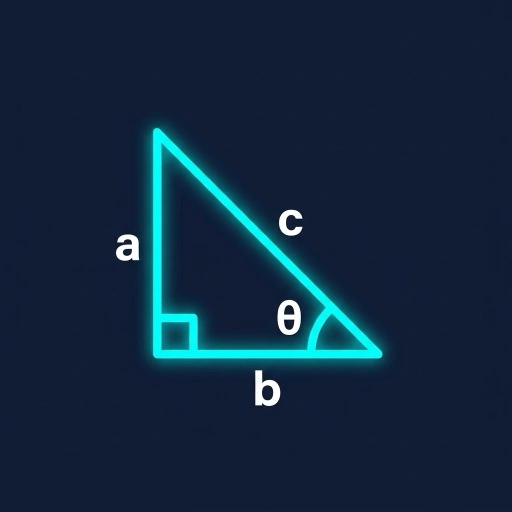
Standard Right Triangle Diagram showing 90° right angle $C$, unknown acute angle $\theta$, complementary angle $\phi$, Hypotenuse $c$, Opposite side $a$, and Adjacent side $b$.
Right Triangle Angle Calculator
Select your known side relationship and enter the side lengths to solve for unknown acute angles $\theta$ and $\phi$.
Angle Calculation Results
Calculated interior angles & step-by-step breakdown
Step-by-Step Formulas & Solution Steps
Detailed Breakdown
What Can the Right Triangle Angle Calculator Calculate?
Our right triangle angle solver evaluates all missing interior angles, complementary angles, and trigonometric ratios simultaneously from any valid known side pair.
How to Use the Right Triangle Angle Calculator
Follow these quick steps to solve any unknown right triangle angle in seconds.
- Identify your target acute angle (θ): Mark the unknown acute angle you wish to calculate relative to your known sides.
- Identify your two known side lengths: Determine whether you know the Opposite leg, Adjacent leg, or Hypotenuse.
- Select the appropriate calculation method: Choose from the tabs at the top of the calculator (e.g. Opposite + Hypotenuse, Adjacent + Hypotenuse, or Opposite + Adjacent).
- Enter the numerical side values: Input positive numbers into the respective side length fields.
- Select your output angle unit: Choose Degrees ($^\circ$) or Radians ($\text{rad}$) from the unit dropdown.
- Click Calculate Angle: Press the button to generate instant calculated angles and step-by-step mathematical proofs.
Valid Known Input Combinations for Angle Calculation
Because every right triangle inherently includes one fixed 90° right angle, you only need any two side lengths to completely calculate both interior acute angles:
- Opposite side and Hypotenuse: Solves target angle $\theta$ using inverse sine ($\theta = \sin^{-1}(O/H)$).
- Adjacent side and Hypotenuse: Solves target angle $\theta$ using inverse cosine ($\theta = \cos^{-1}(A/H)$).
- Opposite side and Adjacent side: Solves target angle $\theta$ using inverse tangent ($\theta = \tan^{-1}(O/A)$).
What Is an Unknown Angle in a Right Triangle?
A right triangle is defined by having one fixed $90^\circ$ right angle. The remaining two interior angles ($\theta$ and $\phi$) are always acute angles, measuring strictly between $0^\circ$ and $90^\circ$.
An unknown angle is an acute interior angle whose degree measure is not directly given, but can be deduced using inverse trigonometry. Because the sum of interior angles in any Euclidean triangle equals $180^\circ$, subtracting the $90^\circ$ right angle leaves exactly $90^\circ$ to be shared between the two acute angles:
This complementary relationship means that finding just one acute angle immediately reveals the second acute angle ($\phi = 90^\circ - \theta$).
Right Triangle Angle Diagram
Visual representation of right angle geometry elements, reference angle $\theta$, opposite leg, adjacent leg, and hypotenuse.
Diagram Key: $C = 90^\circ$ right angle, $\theta$ = primary target angle, $\phi$ = complementary angle, $c$ = hypotenuse, $a$ = opposite leg to $\theta$, $b$ = adjacent leg to $\theta$.
Parts of a Right Triangle for Angle Calculations
Key components, symbols, and side-to-angle relationships.
Right Triangle Angle Formulas
Comprehensive mathematical formula reference for inverse trigonometric angle calculations.
Inverse Sine (&sin;¯¹)
Variables: $O$ = opposite leg, $H$ = hypotenuse.
When used: Solves target angle $\theta$ when opposite side & hypotenuse are known.
Inverse Cosine (&cos;¯¹)
Variables: $A$ = adjacent leg, $H$ = hypotenuse.
When used: Solves target angle $\theta$ when adjacent side & hypotenuse are known.
Inverse Tangent (&tan;¯¹)
Variables: $O$ = opposite leg, $A$ = adjacent leg.
When used: Solves target angle $\theta$ when both perpendicular legs are known.
Complementary Angle
Variables: $\theta$ = target angle, $\phi$ = complementary angle.
When used: Finds second acute angle instantly without additional trig.
Angle Sum Law
Variables: $\theta, \phi$ = acute interior angles.
When used: Verifies interior angle summation in Euclidean space.
Degree <> Radian Conversion
Variables: $\text{deg}$ = sexagesimal degrees, $\text{rad}$ = radians.
When used: Converts degree angle results to mathematical radians.
How to Find a Missing Angle From Two Sides
Select the calculation method corresponding to your two known side lengths.
Scenario 1: Known Opposite & Hypotenuse
When opposite side $O$ and hypotenuse $H$ are given, solve $\theta$ using inverse sine:
Example: $O=5, H=10 \implies \theta = \sin^{-1}(0.5) = 30^\circ$.
Scenario 2: Known Adjacent & Hypotenuse
When adjacent side $A$ and hypotenuse $H$ are given, solve $\theta$ using inverse cosine:
Example: $A=8, H=10 \implies \theta = \cos^{-1}(0.8) \approx 36.87^\circ$.
Scenario 3: Known Opposite & Adjacent
When both legs $O$ and $A$ are given, solve $\theta$ using inverse tangent:
Example: $O=3, A=4 \implies \theta = \tan^{-1}(0.75) \approx 36.87^\circ$.
SOHCAHTOA for Right Triangle Angles
The classic memory aid for remembering right triangle trigonometric ratios and inverse functions.
SOH
$$\theta = \sin^{-1}\left(\frac{\text{Opposite}}{\text{Hypotenuse}}\right)$$
CAH
$$\theta = \cos^{-1}\left(\frac{\text{Adjacent}}{\text{Hypotenuse}}\right)$$
TOA
$$\theta = \tan^{-1}\left(\frac{\text{Opposite}}{\text{Adjacent}}\right)$$
How to Choose the Right Ratio: Identify which two sides are involved in your problem and choose the corresponding ratio from SOHCAHTOA. For interactive practice, visit our SOHCAHTOA Calculator.
Right Triangle Angle Worked Examples
Step-by-step mathematical solutions for standard right-triangle angle problems.
Example 1: Classic 3-4-5 Triangle Angle
Given: Opposite = 3, Adjacent = 4, Hypotenuse = 5
Formula: $\theta = \tan^{-1}(3/4)$
Substitution: $\theta = \tan^{-1}(0.75)$
Calculation: $\theta \approx 36.87^\circ, \phi = 53.13^\circ$
Answer: $\theta = 36.87^\circ, \phi = 53.13^\circ$
Example 2: Inverse Sine Method
Given: Opposite = 5, Hypotenuse = 10
Formula: $\theta = \sin^{-1}(5/10)$
Substitution: $\theta = \sin^{-1}(0.5)$
Calculation: $\theta = 30^\circ, \phi = 60^\circ$
Answer: $\theta = 30^\circ, \phi = 60^\circ$
Example 3: Inverse Cosine Method
Given: Adjacent = 8, Hypotenuse = 10
Formula: $\theta = \cos^{-1}(8/10)$
Substitution: $\theta = \cos^{-1}(0.8)$
Calculation: $\theta \approx 36.87^\circ, \phi = 53.13^\circ$
Answer: $\theta = 36.87^\circ, \phi = 53.13^\circ$
Example 4: Inverse Tangent Method
Given: Opposite = 8, Adjacent = 6
Formula: $\theta = \tan^{-1}(8/6)$
Substitution: $\theta = \tan^{-1}(1.3333)$
Calculation: $\theta \approx 53.13^\circ, \phi = 36.87^\circ$
Answer: $\theta = 53.13^\circ, \phi = 36.87^\circ$
Example 5: Decimal Side Lengths
Given: Opposite = 7.5 cm, Adjacent = 12.2 cm
Formula: $\theta = \tan^{-1}(7.5 / 12.2)$
Substitution: $\theta = \tan^{-1}(0.61475)$
Calculation: $\theta \approx 31.58^\circ, \phi = 58.42^\circ$
Answer: $\theta = 31.58^\circ, \phi = 58.42^\circ$
Example 6: 30-60-90 Angle Solve
Given: Short leg = 1, Hypotenuse = 2
Formula: $\theta = \sin^{-1}(1/2)$
Substitution: $\theta = \sin^{-1}(0.5) = 30^\circ$
Calculation: $\phi = 90^\circ - 30^\circ = 60^\circ$
Answer: $\theta = 30^\circ, \phi = 60^\circ$
Special Right Triangles
Fixed ratio right triangles with exact known angle values.
45-45-90 Triangle
An isosceles right triangle with equal legs and acute angles of $45^\circ$.
Legs = $x$, Hypotenuse = $x\sqrt{2}$.
45-45-90 Calculator →30-60-90 Triangle
A scalene right triangle created by bisecting an equilateral triangle.
Short leg = $x$, Long leg = $x\sqrt{3}$, Hypotenuse = $2x$.
30-60-90 Calculator →Choosing the Correct Inverse Trigonometric Function
Use the decision matrix below to select the exact inverse trigonometric formula for your problem.
- Choose $\sin^{-1}$ when you know the side opposite the angle and the hypotenuse.
- Choose $\cos^{-1}$ when you know the side adjacent to the angle and the hypotenuse.
- Choose $\tan^{-1}$ when you know both perpendicular legs (no hypotenuse required).
Degrees vs Radians for Right Triangle Angles
Understanding standard sexagesimal degrees versus mathematical radians.
Right triangle angles can be expressed in either degrees ($^\circ$) or radians ($\text{rad}$):
- Degrees: Standard unit for elementary geometry, surveying, and engineering (e.g. $30^\circ$, $45^\circ$, $60^\circ$).
- Radians: Standard unit for mathematical calculus and physics (e.g. $\pi/6$, $\pi/4$, $\pi/3$).
Technical note: JavaScript engine functions compute inverse trig in radians. Our calculator converts these outputs into user-selected degrees or radians with zero precision loss.
How to Verify a Calculated Angle
Three independent mathematical verification checks for calculated angle results.
- Complement Check: Ensure $\theta + \phi = 90^\circ$.
- Forward Trig Check: Plug $\theta$ into the standard trig function (e.g. $\sin(\theta)$) and verify it equals your original side ratio $O / H$.
- Pythagorean Check: Verify that your side lengths satisfy $a^2 + b^2 = c^2$.
Common Right Triangle Angle Calculation Mistakes
Critical pitfalls to avoid when calculating right triangle angles.
- Using standard trig instead of inverse trig: Using $\sin$ instead of $\sin^{-1}$ calculates a ratio, not an angle.
- Confusing opposite and adjacent legs: Swapping opposite and adjacent calculates the complement $\phi$ instead of target angle $\theta$.
- Treating hypotenuse as an adjacent leg: The hypotenuse is opposite the 90° corner and cannot be used as a perpendicular leg.
- Entering Hypotenuse ≤ Leg: The hypotenuse must always be strictly longer than either leg.
- Calculator unit mismatch: Expecting degrees while software is set to radians.
- Premature rounding: Rounding intermediate ratio values before taking arcsin/arccos/arctan introduces rounding errors.
- Forgetting complementary relationship: Recalculating the second acute angle with complex trig when $\phi = 90^\circ - \theta$ is faster.
- Using invalid negative side lengths: Geometric side lengths must always be strictly positive.
- Non-right triangle application: Applying basic inverse trig ratios to non-right (oblique) triangles.
- Mixing degree and radian inputs: Combining degree angles with radian formulas.
Real-World Applications of Right Triangle Angle Calculations
Practical engineering, construction, and navigation applications.
- Roof Pitch & Construction: Calculating rafter slope angle from rise and run.
- Ramp Inclination: Determining ADA accessibility slope angle from vertical rise and ramp length.
- Ladder Safety: Calculating safe ground angle for leaning ladders (recommended $75^\circ$).
- Navigation & Surveying: Computing bearings, line-of-sight elevation angles, and terrain gradient.
- Engineering & Physics: Resolving vector force components into angular directions.
Related Right Triangle Calculators
Explore our full suite of free online right triangle calculation tools.
Frequently Asked Questions
Common questions about right triangle angle calculations, formulas, and inverse trigonometry.
Q1
What is a Right Triangle Angle Calculator?
A Right Triangle Angle Calculator is an online geometry tool designed specifically to calculate an unknown acute interior angle of a right triangle from known side lengths using inverse trigonometric functions ($\sin^{-1}, \cos^{-1}, \tan^{-1}$).
Q2
How do I find a missing angle in a right triangle?
Identify which two side lengths are known relative to your target acute angle $\theta$. Divide the appropriate sides to get a trig ratio, then apply inverse sine ($\sin^{-1}$), inverse cosine ($\cos^{-1}$), or inverse tangent ($\tan^{-1}$).
Q3
How do I calculate an angle using inverse sine?
When the opposite side ($O$) and hypotenuse ($H$) are known, use $\theta = \sin^{-1}(O / H)$. For example, $\sin^{-1}(5/10) = 30^\circ$.
Q4
How do I calculate an angle using inverse cosine?
When the adjacent side ($A$) and hypotenuse ($H$) are known, use $\theta = \cos^{-1}(A / H)$. For example, $\cos^{-1}(8/10) \approx 36.87^\circ$.
Q5
How do I calculate an angle using inverse tangent?
When both perpendicular legs (opposite $O$ and adjacent $A$) are known, use $\theta = \tan^{-1}(O / A)$. For example, $\tan^{-1}(3/4) \approx 36.87^\circ$.
Q6
What is inverse sine?
Inverse sine ($\sin^{-1}$ or $\arcsin$) is the mathematical function that inputs a ratio (opposite over hypotenuse) and returns the corresponding acute angle $\theta$.
Q7
What is inverse cosine?
Inverse cosine ($\cos^{-1}$ or $\arccos$) is the function that takes a side ratio (adjacent over hypotenuse) and returns the acute angle $\theta$.
Q8
What is inverse tangent?
Inverse tangent ($\tan^{-1}$ or $\arctan$) is the function that converts the ratio of two legs (opposite over adjacent) back into an angle $\theta$.
Q9
Which two sides do I need to calculate an angle?
Any two side lengths are sufficient: Opposite + Hypotenuse ($\sin^{-1}$), Adjacent + Hypotenuse ($\cos^{-1}$), or Opposite + Adjacent ($\tan^{-1}$).
Q10
How do I identify the opposite side?
The opposite side is the leg positioned directly across from the target acute angle $\theta$.
Q11
How do I identify the adjacent side?
The adjacent side is the leg that touches the target angle $\theta$ and forms one of its rays, excluding the hypotenuse.
Q12
How do I identify the hypotenuse?
The hypotenuse is always the longest side of a right triangle, located directly opposite the 90° right angle.
Q13
How do I find the other acute angle?
Since interior angles sum to 180° and one angle is 90°, the second acute angle $\phi$ is simply $90^\circ - \theta$.
Q14
Why do the two acute angles add to 90°?
Because all triangle interior angles sum to 180°. Subtracting the 90° right angle leaves 90° to be shared between the two remaining acute angles.
Q15
Should I use degrees or radians?
Degrees (°) are standard for everyday geometry, construction, and engineering. Radians are standard for advanced physics and calculus. Our calculator supports both.
Q16
Why is my calculated angle different from another calculator?
Slight differences occur when another calculator is set to radian mode instead of degree mode, or when intermediate values are prematurely rounded.
Q17
Can I calculate angles using decimal side lengths?
Yes. Side lengths can be any positive real decimal numbers (e.g. 7.5 cm, 12.2 cm).
Q18
How do I verify a calculated angle?
Check that $\theta + \phi = 90^\circ$ and verify that taking $\sin(\theta)$, $\cos(\theta)$, or $\tan(\theta)$ reproduces your original side ratio.