Right Triangle Side Calculator
Find an unknown side length of a right triangle instantly when any two sides or one side and an acute angle are known. Calculate missing leg lengths ($a$ or $b$) or hypotenuse ($c$) with high mathematical accuracy.
Our solver applies the Pythagorean theorem ($a^2 + b^2 = c^2$) and fundamental trigonometric ratios ($\sin, \cos, \tan$) to generate exact radical forms, rounded decimal values, complete substitution steps, and verification proofs for any missing side problem.
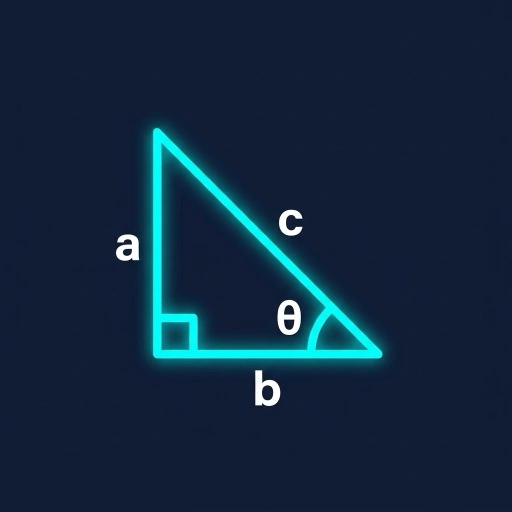
Standard Right Triangle Side Diagram ($a = \text{leg}$, $b = \text{leg}$, $c = \text{hypotenuse}$, $C = 90^\circ$)
Right Triangle Side Calculator
Calculate any unknown side length (leg $a$, leg $b$, or hypotenuse $c$) using the Pythagorean theorem or trigonometric ratios.
Side Calculation Results
Calculated side lengths, exact radical values & step-by-step breakdown
Step-by-Step Formulas & Solution Steps
Detailed Breakdown
What Does the Right Triangle Side Calculator Find?
Our solver is specifically designed to determine unknown side lengths in any right-angled triangle across three fundamental calculation scenarios.
What Is a Missing Side in a Right Triangle?
A right triangle consists of three straight bounding sides: two legs ($a$ and $b$) that form the 90-degree right angle, and one hypotenuse ($c$) that spans across the right angle. A missing side refers to any one of these three linear dimensions whose length is initially unknown.
Because right triangles possess strict geometric constraints governed by the Pythagorean theorem and trigonometry, knowing any two independent pieces of information (such as two side lengths, or one side length and an acute angle) is mathematically sufficient to compute the missing side length with 100% precision.
Identify the Known and Unknown Sides
Follow this step-by-step workflow to identify your given measurements before selecting a calculation method.
- Identify the 90° Right Angle: Locate the square corner where the two perpendicular legs meet.
- Identify the Hypotenuse ($c$): Locate the side directly opposite the 90° right angle. Confirm whether its value is known or unknown.
- Identify Known Side Lengths: Determine if you have two legs ($a, b$) or one leg and the hypotenuse ($a, c$ or $b, c$).
- Identify the Missing Side: Determine which specific side length ($a$, $b$, or $c$) you need to calculate.
- Check for Known Acute Angles: If only one side length is known, check if an acute angle ($\theta = A$ or $B$) is given.
- Select the Calculation Method: Choose the Pythagorean theorem for side-only problems, or trigonometric ratios for side-plus-angle problems.
Labeled Right Triangle showing Leg $a$, Leg $b$, Hypotenuse $c$, 90° corner, and acute angle $\theta$.
Right Triangle Side Calculation Methods
Use this quick decision table to match your known measurements to the correct side-calculation equation.
| Known Information | Unknown Side | Calculation Formula | Method Used |
|---|---|---|---|
| Two Legs ($a, b$) | Hypotenuse ($c$) | $c = \sqrt{a^2 + b^2}$ | Pythagorean Theorem |
| Hypotenuse ($c$) & Leg ($b$) | Missing Leg ($a$) | $a = \sqrt{c^2 - b^2}$ | Pythagorean Subtraction |
| Hypotenuse ($c$) & Leg ($a$) | Missing Leg ($b$) | $b = \sqrt{c^2 - a^2}$ | Pythagorean Subtraction |
| Hypotenuse ($c$) & Angle ($\theta$) | Opposite Leg | $\text{opposite} = c \times \sin(\theta)$ | Sine Ratio ($\text{SOH}$) |
| Hypotenuse ($c$) & Angle ($\theta$) | Adjacent Leg | $\text{adjacent} = c \times \cos(\theta)$ | Cosine Ratio ($\text{CAH}$) |
| Adjacent Leg & Angle ($\theta$) | Opposite Leg | $\text{opposite} = \text{adjacent} \times \tan(\theta)$ | Tangent Ratio ($\text{TOA}$) |
| Opposite Leg & Angle ($\theta$) | Adjacent Leg | $\text{adjacent} = \frac{\text{opposite}}{\tan(\theta)}$ | Tangent Division |
Finding a Missing Side From Two Known Sides
When two side lengths of a right triangle are known, the third missing side can be computed directly using the Pythagorean theorem without requiring any angle measurements.
Case 1: Two Legs Known $\rightarrow$ Find Hypotenuse
Square both leg lengths ($a^2$ and $b^2$), sum them together, and calculate the square root of the sum:
For direct hypotenuse calculations, visit our Right Triangle Hypotenuse Calculator.
Case 2: Hypotenuse & One Leg Known $\rightarrow$ Find Missing Leg
Square the hypotenuse ($c^2$), subtract the square of the known leg, and calculate the square root of the difference:
For dedicated leg calculations, check out our Pythagorean Theorem Calculator or Right Triangle Side Calculator.
Finding a Missing Side From One Side and an Angle
When you know one side length and one acute interior angle ($\theta$), you can solve for any unknown side length using basic trigonometric functions ($\sin, \cos, \tan$).
- Finding Opposite Leg from Hypotenuse & Angle: $\text{opposite} = c \times \sin(\theta)$
- Finding Adjacent Leg from Hypotenuse & Angle: $\text{adjacent} = c \times \cos(\theta)$
- Finding Opposite Leg from Adjacent Leg & Angle: $\text{opposite} = \text{adjacent} \times \tan(\theta)$
- Finding Adjacent Leg from Opposite Leg & Angle: $\text{adjacent} = \frac{\text{opposite}}{\tan(\theta)}$
- Finding Hypotenuse from Opposite Leg & Angle: $c = \frac{\text{opposite}}{\sin(\theta)}$
For complete trigonometric ratios and step-by-step angle derivations, see our SOHCAHTOA Calculator.
How to Identify the Hypotenuse, Opposite and Adjacent Sides
Understanding side labels relative to a chosen reference angle is key to applying trigonometric side formulas correctly:
Hypotenuse ($c$)
The longest side of the right triangle. It is always located directly across from the 90° right angle.
Opposite Side
The leg positioned directly opposite your selected acute reference angle $\theta$. It does not touch the angle vertex.
Adjacent Side
The leg next to your reference angle $\theta$. It forms one side of the angle $\theta$ along with the hypotenuse.
Missing Side Calculation Examples
Review step-by-step solutions for five common missing-side calculation problems.
Example 1: Two Legs Known $\rightarrow$ Find the Hypotenuse
Given leg $a = 6\text{ cm}$ and leg $b = 8\text{ cm}$. Find hypotenuse $c$.
Substitution: $c = \sqrt{6^2 + 8^2} = \sqrt{36 + 64}$
Calculation: $c = \sqrt{100} = 10\text{ cm}$
Example 2: Hypotenuse & Leg Known $\rightarrow$ Find the Missing Leg
Given hypotenuse $c = 13\text{ ft}$ and leg $b = 5\text{ ft}$. Find missing leg $a$.
Substitution: $a = \sqrt{13^2 - 5^2} = \sqrt{169 - 25}$
Calculation: $a = \sqrt{144} = 12\text{ ft}$
Example 3: Hypotenuse & Angle Known $\rightarrow$ Find the Opposite Side
Given hypotenuse $c = 20\text{ m}$ and acute angle $\theta = 30^\circ$. Find opposite leg.
Substitution: $\text{opposite} = 20 \times \sin(30^\circ) = 20 \times 0.5$
Calculation: $\text{opposite} = 10\text{ m}$
Example 4: Adjacent Side & Angle Known $\rightarrow$ Find the Opposite Side
Given adjacent side $= 8\text{ m}$ and acute angle $\theta = 45^\circ$. Find opposite leg.
Substitution: $\text{opposite} = 8 \times \tan(45^\circ) = 8 \times 1.0$
Calculation: $\text{opposite} = 8\text{ m}$
Example 5: Opposite Side & Angle Known $\rightarrow$ Find the Adjacent Side
Given opposite side $= 10\text{ cm}$ and acute angle $\theta = 30^\circ$. Find adjacent leg.
Substitution: $\text{adjacent} = \frac{10}{\tan(30^\circ)} = \frac{10}{1/\sqrt{3}} = 10\sqrt{3}\text{ cm}$
Result: Exact $= 10\sqrt{3}\text{ cm} \approx 17.3205\text{ cm}$
Missing Side Formula Reference
A compact mathematical reference of all side-finding equations for right triangles.
| Target Missing Side | Given Values | Exact Formula |
|---|---|---|
| Hypotenuse ($c$) | Leg $a$ and Leg $b$ | $c = \sqrt{a^2 + b^2}$ |
| Missing Leg ($a$) | Hypotenuse $c$ and Leg $b$ | $a = \sqrt{c^2 - b^2}$ |
| Missing Leg ($b$) | Hypotenuse $c$ and Leg $a$ | $b = \sqrt{c^2 - a^2}$ |
| Opposite Leg | Hypotenuse $c$ and Angle $\theta$ | $\text{opposite} = c \sin(\theta)$ |
| Adjacent Leg | Hypotenuse $c$ and Angle $\theta$ | $\text{adjacent} = c \cos(\theta)$ |
| Opposite Leg | Adjacent Leg and Angle $\theta$ | $\text{opposite} = \text{adjacent} \tan(\theta)$ |
| Adjacent Leg | Opposite Leg and Angle $\theta$ | $\text{adjacent} = \frac{\text{opposite}}{\tan(\theta)}$ |
How to Choose the Correct Formula
Use this simple decision flow to determine which equation applies to your problem.
• If both known sides are legs $\rightarrow$ Use $c = \sqrt{a^2 + b^2}$ to calculate hypotenuse.
• If one known side is hypotenuse $\rightarrow$ Use $a = \sqrt{c^2 - b^2}$ or $b = \sqrt{c^2 - a^2}$ to calculate missing leg.
• If hypotenuse is known $\rightarrow$ Use $\sin(\theta)$ for opposite leg or $\cos(\theta)$ for adjacent leg.
• If adjacent leg is known $\rightarrow$ Use $\tan(\theta)$ for opposite leg.
• If opposite leg is known $\rightarrow$ Use $\frac{\text{opposite}}{\tan(\theta)}$ for adjacent leg.
How to Verify a Calculated Side
Always double-check your calculated side lengths using these four quick verification tests:
- Hypotenuse Inequality Check: A calculated hypotenuse ($c$) must always be strictly greater than both individual legs ($c > a$ and $c > b$).
- Leg Inequality Check: A calculated leg ($a$ or $b$) must be strictly less than the hypotenuse ($a < c$ and $b < c$).
- Pythagorean Substitution Check: Plug all three sides back into $a^2 + b^2 = c^2$. The left-hand sum must match $c^2$ within numerical tolerance.
- Trigonometric Substitution Check: For angle-based calculations, check that $\sin(\theta) = a/c$, $\cos(\theta) = b/c$, and $\tan(\theta) = a/b$.
Right Triangle Side Length Constraints
Geometric side calculations must adhere to strict physical boundary conditions:
- All side lengths ($a, b, c$) must be strictly positive real numbers ($> 0$).
- The hypotenuse ($c$) must be strictly greater than any individual leg ($c > a$ and $c > b$).
- When finding a missing leg, $c^2 - \text{known leg}^2$ must be strictly positive ($c^2 - b^2 > 0$).
- Acute interior reference angles ($\theta$) must satisfy $0^\circ < \theta < 90^\circ$.
- Not all arbitrary sets of three numbers form a valid right triangle—they must satisfy $a^2 + b^2 = c^2$.
Exact and Decimal Missing-Side Results
In geometry and trigonometry, side lengths frequently involve square roots. For instance, in a right triangle with legs $a = 5$ and $b = 5$, the exact hypotenuse length is $5\sqrt{2}\text{ cm}$, while its rounded decimal representation is approximately $7.0711\text{ cm}$.
Our calculator displays both representations whenever possible. Exact radical notation (e.g. $5\sqrt{3}$) preserves mathematical precision for homework and theoretical work, while rounded decimal values provide practical measurements for real-world engineering and construction applications.
Units for Right Triangle Side Calculations
Our calculator supports standard metric and imperial linear measurement units:
Note: All side input values should be in the same unit. For example, when entering $6\text{ cm}$ and $8\text{ cm}$, the calculated hypotenuse will be $10\text{ cm}$.
Common Missing-Side Calculation Mistakes
Avoid these 11 common mistakes when solving for missing right triangle sides:
- Selecting the Wrong Hypotenuse: Mistaking a perpendicular leg for the hypotenuse. (Hypotenuse is always opposite 90°).
- Forgetting that Hypotenuse is Opposite 90°: Failing to verify the side position before setting up equations.
- Using Wrong Known-Side Combination: Adding leg squares when a leg and hypotenuse are known instead of subtracting.
- Subtracting Wrong Squared Value: Subtracting hypotenuse squared from a leg squared ($a^2 - c^2$), causing negative numbers under square roots.
- Forgetting the Square Root: Leaving the answer as $c^2$ or $a^2$ without extracting the principal square root.
- Confusing Opposite and Adjacent: Misidentifying leg positions relative to reference angle $\theta$.
- Choosing Wrong Trig Ratio: Using cosine when opposite leg is needed, or sine when adjacent leg is needed.
- Mixing Units: Entering one side in feet and another in inches without converting first.
- Rounding Intermediate Calculations: Rounding trig values too early, leading to inaccurate final side lengths.
- Applying Right-Triangle Formulas to Non-Right Triangles: Using $a^2 + b^2 = c^2$ on acute or obtuse triangles.
- Assuming Every Right Triangle Has Integer Ratios: Expecting every triangle to be a 3-4-5 or special integer triple.
Right Triangle Side Calculator vs Specialized Calculators
Understand how this versatile side calculator compares to specialized cluster tools.
| Calculator Name | Primary Focus & Purpose | Best Used When |
|---|---|---|
| Right Triangle Side Calculator | Find any missing side ($a, b, c$) from sides or side + angle. | General side-solving problems with flexible inputs. |
| Hypotenuse Calculator | Focuses specifically on solving side $c$. | Goal is strictly finding hypotenuse length. |
| Pythagorean Calculator | Focuses specifically on solving perpendicular leg $a$ or base $b$. | Hypotenuse is given and missing leg is needed. |
| Angle Calculator | Focuses on calculating acute interior angles $A$ and $B$. | Side lengths are given and acute angles are needed. |
| Pythagorean Calculator | Focuses exclusively on $a^2 + b^2 = c^2$ side algebra. | Working strictly with two known side lengths. |
| SOHCAHTOA Calculator | Focuses on trigonometric ratios ($\sin, \cos, \tan$). | Solving trigonometric side/angle relationships. |
When Should You Use a Right Triangle Side Calculator?
This calculator is ideal for use when:
- You know your geometric polygon is a right triangle (contains a 90° angle).
- You have at least two pieces of valid linear or angular information.
- Your primary goal is finding an unknown side length ($a$, $b$, or $c$).
- You need exact radical expressions alongside rounded decimal values.
- You require step-by-step substitution proofs for study or verification.
Related Right Triangle Calculators
Explore dedicated calculators across our right-triangle geometry platform.
Frequently Asked Questions
Common questions about finding missing right triangle side lengths, formulas, and verification.
Q1
What is a Right Triangle Side Calculator?
A Right Triangle Side Calculator is an online geometry tool designed to calculate an unknown or missing side length of a right-angled triangle using known sides or a known side and acute angle.
Q2
How do I find a missing side of a right triangle?
To find a missing side, first identify what information is given. If two sides are known, use the Pythagorean theorem ($a^2 + b^2 = c^2$). If one side and an acute angle are known, use trigonometric ratios ($\sin, \cos, \tan$).
Q3
How do I find the hypotenuse from two sides?
When both perpendicular legs ($a$ and $b$) are known, calculate the hypotenuse ($c$) by taking the square root of the sum of their squares: $c = \sqrt{a^2 + b^2}$.
Q4
How do I find a missing leg?
When the hypotenuse ($c$) and one leg ($b$) are known, calculate the missing leg ($a$) by subtracting the square of the known leg from the square of the hypotenuse and taking the square root: $a = \sqrt{c^2 - b^2}$.
Q5
What formula finds the missing side?
The formula depends on the known values. Use $c = \sqrt{a^2 + b^2}$ for hypotenuse from two legs, $a = \sqrt{c^2 - b^2}$ for a missing leg, $\text{opposite} = c \times \sin(\theta)$ for hypotenuse and angle, or $\text{opposite} = \text{adjacent} \times \tan(\theta)$ for adjacent side and angle.
Q6
Can I find a side using one angle and one side?
Yes. Since a right triangle always contains a 90° angle, knowing any one side length and one acute angle is sufficient to calculate all missing sides using sine, cosine, or tangent ratios.
Q7
How do I identify the hypotenuse?
The hypotenuse is always the side located directly opposite the 90-degree right angle. It is also guaranteed to be the longest of the three sides in any right triangle.
Q8
How do I identify the opposite side?
The opposite side is the leg positioned directly across from your selected acute reference angle $\theta$.
Q9
How do I identify the adjacent side?
The adjacent side is the leg next to your selected acute reference angle $\theta$, forming one of the angle's arms alongside the hypotenuse.
Q10
When should I use the Pythagorean theorem?
Use the Pythagorean theorem ($a^2 + b^2 = c^2$) whenever you know two side lengths of a right triangle and need to calculate the third missing side length without using angles.
Q11
When should I use sine, cosine, or tangent?
Use trigonometric ratios when you know one side length and one acute angle, or when you need to calculate an unknown side relative to a reference angle.
Q12
What if I know the hypotenuse and one leg?
Subtract the square of the known leg from the square of the hypotenuse and calculate the square root of the result: $\text{missing leg} = \sqrt{\text{hypotenuse}^2 - \text{known leg}^2}$.
Q13
Can the calculator handle decimal side lengths?
Yes. Our calculator accepts arbitrary positive decimal inputs (such as 3.5, 7.25, or 12.8) and outputs accurate decimal approximations as well as exact radical forms where applicable.
Q14
Can the calculator show exact radical answers?
Yes. When a calculated side can be expressed as a simplified square root (such as $5\sqrt{3}$ or $\sqrt{13}$), the calculator displays both the exact radical expression and the rounded decimal value.
Q15
What units can I use for side calculations?
You can use any metric or imperial linear length units including mm, cm, m, km, in, ft, and yd. All inputs should use consistent units for accurate calculation.
Q16
How can I verify my calculated side?
For a calculated hypotenuse, ensure $c > a$ and $c > b$. For a calculated leg, ensure $a < c$. You can also substitute all three sides back into $a^2 + b^2 = c^2$ to verify equality.
Q17
Can I use this calculator for any right triangle?
Yes, as long as the triangle contains a 90° right angle and you provide physically valid positive inputs (such as hypotenuse longer than any leg and acute angles between 0° and 90°).
Q18
What is the difference between a side calculator and a hypotenuse calculator?
A side calculator is a versatile tool for finding any unknown side (hypotenuse, leg $a$, or leg $b$) from various input combinations, whereas a hypotenuse calculator focuses specifically on calculating side $c$.