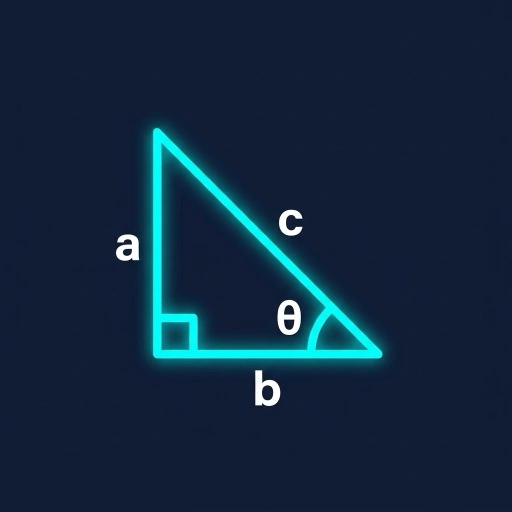
45-45-90 Triangle Calculator
A 45-45-90 triangle is a special right triangle with two complementary $45^\circ$ acute angles and one $90^\circ$ right angle.
Because its two acute angles are equal, its perpendicular legs are identical ($a = b$) and its three side lengths adhere to the fundamental ratio $1 : 1 : \sqrt{2}$. Use this calculator to solve missing side lengths, exact radical forms, hypotenuse, area, and perimeter instantly.
45-45-90 Triangle Calculator
Select your input mode (Leg or Hypotenuse) to calculate missing sides, exact radical expressions ($\sqrt{2}$), area, perimeter, and step-by-step mathematical proofs.
Calculated Results
Exact radical ($\sqrt{2}$) & decimal solution breakdown
Step-by-Step 45-45-90 Mathematical Solution
Detailed Breakdown
What Can the 45-45-90 Triangle Calculator Calculate?
This specialized geometry tool solves all side lengths, radical relationships, and geometric properties of an isosceles right triangle from a single known measurement.
What Is a 45-45-90 Triangle?
A 45-45-90 triangle is a special right triangle possessing interior angles measuring exactly $45^\circ$, $45^\circ$, and $90^\circ$. Because its two non-right acute angles are equal ($45^\circ = 45^\circ$), it is classified in geometry as an isosceles right triangle.
By the Fundamental Isosceles Triangle Theorem, sides opposite equal interior angles must be identical in length. Consequently, the two perpendicular sides forming the $90^\circ$ corner (called the legs, $a$ and $b$) are always equal ($a = b$). The third side, opposite the $90^\circ$ angle (the hypotenuse, $c$), is always $\sqrt{2}$ times longer than either leg.
- Angles: Exactly $45^\circ$, $45^\circ$, and $90^\circ$ (summing to $180^\circ$).
- Triangle Class: Isosceles right triangle.
- Leg Equality: Both legs are equal ($a = b$).
- Hypotenuse Multiplier: Hypotenuse is always $a\sqrt{2} \approx 1.41421356 \times a$.
45-45-90 Triangle Ratio
The side length ratio of any 45-45-90 triangle is fixed and universal regardless of the triangle's physical size:
This ratio represents $\text{Leg } a : \text{Leg } b : \text{Hypotenuse } c$. Written algebraically for any leg length $a$:
$$a : a : a\sqrt{2}$$
| Triangle Side | Opposite Angle | Relative Ratio Unit | Algebraic Expression |
|---|---|---|---|
| Leg a | $45^\circ$ | $1$ | $a$ |
| Leg b | $45^\circ$ | $1$ | $a$ |
| Hypotenuse c | $90^\circ$ | $\sqrt{2} \approx 1.41421356$ | $a\sqrt{2}$ |
45-45-90 Triangle Diagram
Visual representation of an isosceles right triangle showing side ratios, angle labels, and equal-leg tick marks.
Red tick marks signify equal leg lengths ($a = b$). The hypotenuse ($c$) is $\sqrt{2}$ times leg length $a$.
45-45-90 Triangle Formulas
All geometric equations for a 45-45-90 triangle derive directly from its $1 : 1 : \sqrt{2}$ side ratio and the Pythagorean theorem:
Equal Legs
Both perpendicular legs are identical in length.
Hypotenuse from Leg
Multiply leg length by $\sqrt{2}$.
Leg from Hypotenuse
Divide hypotenuse by $\sqrt{2}$.
Area
Half the square of the leg length.
Perimeter
Sum of all three boundary side lengths.
How to Find the Hypotenuse of a 45-45-90 Triangle
To find the hypotenuse ($c$) of a 45-45-90 triangle when a leg length ($a$) is known, multiply the leg length by $\sqrt{2}$:
$$c = a\sqrt{2}$$
Pythagorean Proof:
By the Pythagorean theorem ($a^2 + b^2 = c^2$), substitute $b = a$:
Formula: $c = a\sqrt{2}$
Substitution: $c = 8 \times \sqrt{2}$
Exact Answer: $8\sqrt{2}\text{ cm}$
Decimal Answer: $8 \times 1.41421356 \approx 11.314\text{ cm}$
How to Find a Missing Leg in a 45-45-90 Triangle
To find the missing leg length ($a$ or $b$) when the hypotenuse ($c$) is known, divide the hypotenuse by $\sqrt{2}$ (or multiply by $\frac{\sqrt{2}}{2}$):
$$a = b = \frac{c}{\sqrt{2}} = \frac{c\sqrt{2}}{2}$$
Formula: $a = \frac{c}{\sqrt{2}}$
Substitution: $a = \frac{14}{\sqrt{2}} = \frac{14\sqrt{2}}{2} = 7\sqrt{2}$
Exact Answer: $a = b = 7\sqrt{2}\text{ m}$
Decimal Answer: $7 \times 1.41421356 \approx 9.899\text{ m}$
How to Find the Area of a 45-45-90 Triangle
The general area formula for any right triangle is $\text{Area} = \frac{1}{2} \times \text{base} \times \text{height}$. Because a 45-45-90 triangle's base and height are both equal legs ($a$), the formula simplifies to:
$$\text{Area} = \frac{1}{2} a \times a = \frac{a^2}{2}$$
If only the hypotenuse $c$ is known, substitute $a = \frac{c}{\sqrt{2}}$ into the area formula:
$$\text{Area} = \frac{(c / \sqrt{2})^2}{2} = \frac{c^2 / 2}{2} = \frac{c^2}{4}$$
Formula: $A = \frac{a^2}{2}$
Substitution: $A = \frac{12^2}{2} = \frac{144}{2} = 72\text{ cm}^2$
How to Find the Perimeter of a 45-45-90 Triangle
The perimeter ($P$) is the total distance around all three boundary sides:
$$P = a + b + c = a + a + a\sqrt{2} = 2a + a\sqrt{2} = a(2 + \sqrt{2})$$
Formula: $P = a(2 + \sqrt{2})$
Substitution: $P = 10(2 + \sqrt{2}) = 20 + 10\sqrt{2}\text{ in}$
Decimal Answer: $20 + 14.1421356 \approx 34.142\text{ in}$
Why Are the Two Legs Equal?
The equality of the two legs ($a = b$) is rooted in fundamental Euclidean geometry.
- Angle Complementarity: In any right triangle, interior angles sum to $180^\circ$. Since one angle is $90^\circ$, the remaining two acute angles must sum to $90^\circ$. If one acute angle is $45^\circ$, the other acute angle is $90^\circ - 45^\circ = 45^\circ$.
- Converse of Isosceles Triangle Theorem: If two interior angles of a triangle are equal ($45^\circ = 45^\circ$), the sides opposite those angles must be equal in length.
$$\text{Angle } A = \text{Angle } B = 45^\circ \implies \text{Leg } a = \text{Leg } b$$
Why Is the Hypotenuse √2 Times the Leg?
We derive why $\sqrt{2}$ appears in the hypotenuse formula using step-by-step algebraic substitution:
- Start with the Pythagorean theorem: $a^2 + b^2 = c^2$.
- Because the triangle is isosceles, set $b = a$: $$a^2 + a^2 = c^2$$
- Combine like terms: $$2a^2 = c^2$$
- Take the principal square root of both sides: $$c = \sqrt{2a^2}$$
- Simplify the radical product: $$c = \sqrt{2} \cdot \sqrt{a^2} = a\sqrt{2}$$
Thus, the factor $\sqrt{2} \approx 1.41421356$ is an inescapable mathematical constant of 2D Euclidean geometry whenever two equal perpendicular lengths meet at $90^\circ$.
45-45-90 Triangle and the Pythagorean Theorem
The 45-45-90 ratio is a direct algebraic specialization of the general Pythagorean theorem ($a^2 + b^2 = c^2$). Instead of solving full square root additions for unequal sides, the equal leg property allows instant shortcut calculations:
$$a^2 + b^2 = c^2 \xrightarrow{a=b} 2a^2 = c^2 \implies c = a\sqrt{2}$$
For general right triangles with unequal legs, use our comprehensive Pythagorean Theorem Calculator to solve any arbitrary $a^2 + b^2 = c^2$ combination.
45-45-90 Triangle Worked Examples
Comprehensive step-by-step solved problems covering various initial inputs and side length scenarios.
Example 1: Basic Unit Scale Model ($a = 1$)
Given: Leg $a = 1$
Formula: $b = a$, $c = a\sqrt{2}$, $A = a^2/2$, $P = a(2+\sqrt{2})$
Substitution: $b = 1$, $c = 1\sqrt{2} = \sqrt{2}$
Answer: Leg $b = 1$, Hypotenuse $c = \sqrt{2} \approx 1.4142$, Area $= 0.5$, Perimeter $= 2+\sqrt{2} \approx 3.4142$
Example 2: Leg $a = 5\text{ cm}$
Given: Leg $a = 5\text{ cm}$
Formula: $c = a\sqrt{2}$
Calculation: $c = 5\sqrt{2}\text{ cm} \approx 7.0711\text{ cm}$
Answer: Leg $b = 5\text{ cm}$, Hypotenuse $c = 5\sqrt{2}\text{ cm} \approx 7.071\text{ cm}$
Example 3: Leg $a = 10\text{ in}$
Given: Leg $a = 10\text{ in}$
Calculation: $c = 10\sqrt{2}\text{ in} \approx 14.142\text{ in}$
Answer: Leg $b = 10\text{ in}$, Hypotenuse $c = 10\sqrt{2}\text{ in} \approx 14.142\text{ in}$
Example 4: Hypotenuse $c = 10\text{ m}$
Given: Hypotenuse $c = 10\text{ m}$
Formula: $a = c / \sqrt{2} = 10 / \sqrt{2} = 5\sqrt{2}$
Answer: Both legs $a = b = 5\sqrt{2}\text{ m} \approx 7.071\text{ m}$
Example 5: Finding Area from Leg $a = 12\text{ ft}$
Given: Leg $a = 12\text{ ft}$
Formula: $A = a^2 / 2 = 12^2 / 2 = 144 / 2 = 72\text{ ft}^2$
Answer: Area $= 72\text{ sq ft}$
Example 6: Finding Perimeter from Leg $a = 10\text{ mm}$
Given: Leg $a = 10\text{ mm}$
Formula: $P = a(2 + \sqrt{2}) = 10(2 + \sqrt{2}) = 20 + 10\sqrt{2}\text{ mm}$
Answer: Perimeter $= 20 + 14.142 \approx 34.142\text{ mm}$
Example 7: Decimal Leg $a = 3.5\text{ cm}$
Given: Leg $a = 3.5\text{ cm}$
Calculation: $c = 3.5\sqrt{2} \approx 4.9497\text{ cm}$, $\text{Area} = (3.5)^2 / 2 = 12.25 / 2 = 6.125\text{ cm}^2$
Answer: $c \approx 4.950\text{ cm}$, Area $= 6.125\text{ cm}^2$
Example 8: Complete Triangle Calculation ($a = 6\text{ yd}$)
Given: Leg $a = 6\text{ yd}$
Results: $b = 6\text{ yd}$, $c = 6\sqrt{2} \approx 8.485\text{ yd}$, Area $= 18\text{ yd}^2$, Perimeter $= 6(2+\sqrt{2}) \approx 20.485\text{ yd}$
45-45-90 Triangle Example With Leg = 1
When leg length $a = 1$, the triangle represents the fundamental unit scale model for all isosceles right triangles:
$$a = 1$$
$$b = 1$$
$$c = \sqrt{2} \approx 1.41421356$$
This unit triangle yields the definitive ratio $1 : 1 : \sqrt{2}$. Any larger or smaller 45-45-90 triangle is simply a uniform geometric scaling of this base unit model by scale factor $a$.
45-45-90 Triangle Example With Leg = 5
For a triangle with legs of length $a = 5\text{ units}$:
$$a = 5$$
$$b = 5$$
$$c = 5\sqrt{2} \approx 7.07106781$$
$$\text{Area} = \frac{5^2}{2} = \frac{25}{2} = 12.5\text{ sq units}$$
45-45-90 Triangle Example With Hypotenuse = 10
When given hypotenuse $c = 10\text{ units}$:
$$c = 10$$
$$a = b = \frac{10}{\sqrt{2}} = \frac{10\sqrt{2}}{2} = 5\sqrt{2} \approx 7.07106781$$
$$\text{Area} = \frac{c^2}{4} = \frac{100}{4} = 25\text{ sq units}$$
45-45-90 Triangle vs 30-60-90 Triangle
Both are famous special right triangles in geometry, but they possess distinct angle structures and side ratios:
| Geometric Property | 45-45-90 Triangle | 30-60-90 Triangle |
|---|---|---|
| Interior Angles | $45^\circ, 45^\circ, 90^\circ$ | $30^\circ, 60^\circ, 90^\circ$ |
| Triangle Type | Isosceles Right Triangle | Scalene Special Right Triangle |
| Side Ratio | $1 : 1 : \sqrt{2}$ | $1 : \sqrt{3} : 2$ |
| Leg Relationship | Equal legs ($a = b$) | Long leg $= \text{short leg} \times \sqrt{3}$ |
| Symmetry Source | Half of a square along diagonal | Half of an equilateral triangle |
To calculate 30-60-90 triangles, visit our dedicated 30-60-90 Triangle Calculator.
45-45-90 Triangle vs General Right Triangle
Every 45-45-90 triangle is a right triangle, but not every right triangle is a 45-45-90 triangle.
- General Right Triangle: Only requires one $90^\circ$ angle. Its acute angles can be any complementary pair (e.g. $20^\circ / 70^\circ$ or $35^\circ / 55^\circ$), and its legs are usually unequal ($a \neq b$).
- 45-45-90 Triangle: Requires both acute angles to be strictly $45^\circ$, forcing equal legs ($a = b$) and the fixed ratio $1 : 1 : \sqrt{2}$.
45-45-90 Triangle vs Equilateral Triangle
While both are symmetric triangles, they belong to different geometric classifications:
- 45-45-90 Triangle: Has angles $45^\circ, 45^\circ, 90^\circ$, contains one right angle, and has two equal sides ($a = b < c$).
- Equilateral Triangle: Has angles $60^\circ, 60^\circ, 60^\circ$, contains no right angles, and has three equal sides ($a = b = c$).
45-45-90 Triangle and SOHCAHTOA
The 45-45-90 triangle is fundamental to trigonometry because it defines the exact values of sine, cosine, and tangent for $45^\circ$:
$$\sin(45^\circ) = \frac{\text{Opposite}}{\text{Hypotenuse}} = \frac{a}{a\sqrt{2}} = \frac{1}{\sqrt{2}} = \frac{\sqrt{2}}{2} \approx 0.70710678$$
$$\cos(45^\circ) = \frac{\text{Adjacent}}{\text{Hypotenuse}} = \frac{a}{a\sqrt{2}} = \frac{1}{\sqrt{2}} = \frac{\sqrt{2}}{2} \approx 0.70710678$$
$$\tan(45^\circ) = \frac{\text{Opposite}}{\text{Adjacent}} = \frac{a}{a} = 1$$
Notice that $\sin(45^\circ) = \cos(45^\circ)$ because opposite and adjacent legs are equal. For general right triangle trigonometry, explore our SOHCAHTOA Calculator.
45° Angle and √2
The mathematical constant $\sqrt{2} \approx 1.41421356$ is intrinsically linked to the $45^\circ$ angle. In a unit circle ($r = 1$), an angle of $45^\circ$ forms a right triangle with horizontal and vertical coordinates $x = y = \frac{\sqrt{2}}{2}$. Thus, the diagonal scaling factor between perpendicular legs and the hypotenuse is always $\sqrt{2}$.
45-45-90 Triangle and Square Diagonals
Drawing a diagonal line between opposite corners of any square divides the square into two congruent 45-45-90 triangles.
Example: A square room with side length $s = 10\text{ ft}$ has a diagonal distance of $d = 10\sqrt{2} \approx 14.142\text{ ft}$.
Real-World Applications of 45-45-90 Triangles
Practical fields where 45-45-90 isosceles right triangles are regularly applied:
- Carpentry & Framing: Laying out $45^\circ$ miter cuts, corner bracing, and diagonal roof trusses.
- Construction & Masonry: Verifying square corners by measuring equal legs and checking diagonal $a\sqrt{2}$.
- Tile & Flooring Layout: Calculating diagonal tile runs across square rooms.
- Computer Graphics & Game Development: Computing 2D vector diagonals and isometric grid projections.
- Architecture & Surveying: Measuring setbacks and $45^\circ$ sightlines.
45-45-90 Triangle in Coordinate Geometry
In Cartesian coordinates, a line with slope $m = 1$ (or $m = -1$) makes a $45^\circ$ angle with the x-axis.
Example: Consider points $A(0,0)$, $B(10,0)$, and $C(10,10)$.
- Horizontal leg $AB = 10 - 0 = 10$
- Vertical leg $BC = 10 - 0 = 10$
- Hypotenuse $AC = \sqrt{10^2 + 10^2} = \sqrt{200} = 10\sqrt{2} \approx 14.142$
45-45-90 Triangle and the Distance Formula
The 2D distance formula between two points $(x_1, y_1)$ and $(x_2, y_2)$ is:
When horizontal change $\Delta x$ equals vertical change $\Delta y = a$, distance simplifies directly to $d = \sqrt{a^2 + a^2} = a\sqrt{2}$, matching the 45-45-90 diagonal formula.
How to Use the 45-45-90 Triangle Calculator
- Select Mode: Choose "Leg + 45° Angle" if you know a leg length, or "Hypotenuse + 45° Angle" if you know the hypotenuse.
- Enter Value: Input your known numerical value into the field.
- Select Unit: Choose your preferred length measurement unit (cm, mm, m, in, ft, etc.).
- Click Solve: Press "Solve 45-45-90 Triangle" to generate instant results.
- Review Output: Check exact radical forms ($\sqrt{2}$), high-precision decimals, area, perimeter, and step-by-step mathematical steps.
45-45-90 Triangle Calculator Units
Our calculator supports all standard metric and imperial length units:
- Metric: Millimeters (mm), Centimeters (cm), Meters (m), Kilometers (km).
- Imperial: Inches (in), Feet (ft), Yards (yd).
Length and perimeter output values retain your selected unit (e.g. $\text{cm}$), while area outputs automatically convert to squared units (e.g. $\text{cm}^2$).
Exact vs Decimal Results
Because $\sqrt{2} \approx 1.41421356237...$ is an irrational number, its decimal representation goes on endlessly without repeating.
- Exact Form: Preserves exact mathematical radicals (e.g. $10\sqrt{2}$ or $5\sqrt{2}$). Essential for algebra class and exact geometry proofs.
- Decimal Form: Rounds the calculation to a clean, practical decimal place (e.g. $14.142\text{ cm}$). Essential for real-world construction and measurement.
Rounding and Accuracy
Our calculator maintains double-precision 64-bit floating-point accuracy internally throughout all intermediate operations. Values are rounded only at the final display step to prevent accumulated rounding errors.
Common 45-45-90 Triangle Mistakes
- Assuming every right triangle is 45-45-90: Ratio $1:1:\sqrt{2}$ only applies when acute angles are $45^\circ$.
- Forgetting legs are equal: Assuming $a$ and $b$ could have different lengths.
- Multiplying hypotenuse by $\sqrt{2}$ instead of dividing: Remember leg $= c / \sqrt{2}$, while hypotenuse $= a\sqrt{2}$.
- Using $\sqrt{3}$ instead of $\sqrt{2}$: Confusing 45-45-90 with 30-60-90 ($1:\sqrt{3}:2$).
- Rounding $\sqrt{2}$ too early: Using $1.41$ early causing calculation drift.
- Confusing area and perimeter: Using perimeter formula for enclosed space.
- Forgetting squared units: Writing area as $\text{cm}$ instead of $\text{cm}^2$.
- Mixing units: Inputting leg in inches and hypotenuse in feet without converting.
- Misidentifying hypotenuse: Treating a perpendicular leg as the hypotenuse.
- Applying ratio to non-right triangles: Trying to use $1:1:\sqrt{2}$ on acute isosceles triangles without a $90^\circ$ angle.
When Can You Use the 45-45-90 Formula?
You can strictly use the $1:1:\sqrt{2}$ formula if and only if your triangle satisfies either condition:
- It is a right triangle ($90^\circ$) with at least one acute angle equal to $45^\circ$.
- It is a right triangle ($90^\circ$) with two legs of equal length ($a = b$).
45-45-90 Triangle Formula Quick Reference
Related Right Triangle Calculators
Explore our complete suite of specialized right triangle calculators and geometric solvers:
Frequently Asked Questions
Detailed answers to common questions about 45-45-90 special right triangles, ratios, and formulas.
Q1
What is a 45-45-90 triangle?
A 45-45-90 triangle is a special right triangle with interior angles measuring 45°, 45°, and 90°. Because its two acute angles are equal, it is also an isosceles right triangle with two equal leg lengths.
Q2
Why is it called a 45-45-90 triangle?
It is named directly after its three interior angle measurements: two 45-degree acute angles and one 90-degree right angle, which sum to 180°.
Q3
What is the 45-45-90 triangle ratio?
The side length ratio of a 45-45-90 triangle is 1 : 1 : √2 (Leg 1 : Leg 2 : Hypotenuse). In algebraic terms, if each leg has length a, the hypotenuse length is a√2.
Q4
What is the formula for a 45-45-90 triangle?
The key formulas are: Leg a = Leg b; Hypotenuse c = a√2; Missing Leg a = c / √2; Area = a²/2; Perimeter = a(2 + √2).
Q5
Are the two legs equal in a 45-45-90 triangle?
Yes. By the Isosceles Triangle Theorem, sides opposite to equal angles must be equal in length. Since both acute angles measure 45°, both legs are identical (a = b).
Q6
How do you find the hypotenuse of a 45-45-90 triangle?
To find the hypotenuse c when leg length a is known, multiply the leg length by the square root of 2: c = a√2.
Q7
How do you find a missing leg in a 45-45-90 triangle?
To find a missing leg length a when hypotenuse c is known, divide the hypotenuse length by the square root of 2: a = c / √2 (or c√2 / 2).
Q8
What is the hypotenuse if the leg is 10?
If a leg length is 10 cm, the exact hypotenuse is 10√2 cm, which approximates to 14.142 cm.
Q9
What is the leg if the hypotenuse is 10?
If the hypotenuse is 10 cm, each leg length is 10 / √2 = 5√2 cm, which approximates to 7.071 cm.
Q10
How do you find the area of a 45-45-90 triangle?
The area formula for any right triangle is ½ × base × height. Since base and height are equal legs (a), Area = ½ × a × a = a²/2.
Q11
How do you find the perimeter of a 45-45-90 triangle?
Perimeter is the sum of all three sides: P = a + b + c = a + a + a√2 = 2a + a√2 = a(2 + √2).
Q12
Why does √2 appear in the 45-45-90 triangle formula?
Square root of 2 appears from the Pythagorean theorem (a² + b² = c²). Setting a = b yields a² + a² = c², so 2a² = c² and taking the square root gives c = √(2a²) = a√2.
Q13
Is every right triangle a 45-45-90 triangle?
No. A right triangle is only a 45-45-90 triangle if its acute angles are exactly 45° each and its two legs are equal in length.
Q14
What is the difference between 45-45-90 and 30-60-90 triangles?
A 45-45-90 triangle has angles 45°-45°-90° with ratio 1:1:√2 and equal legs. A 30-60-90 triangle has angles 30°-60°-90° with ratio 1:√3:2 and unequal legs.
Q15
How is a 45-45-90 triangle related to a square?
Drawing a straight diagonal line across any square divides the square into two congruent 45-45-90 right triangles. The square's side is the leg and the diagonal is the hypotenuse.
Q16
What are sin 45°, cos 45°, and tan 45°?
In a 45-45-90 triangle, sin 45° = √2/2 (≈ 0.7071), cos 45° = √2/2 (≈ 0.7071), and tan 45° = 1.
Q17
Can a square diagonal be calculated using a 45-45-90 triangle?
Yes. Since a square diagonal forms the hypotenuse of a 45-45-90 triangle, Diagonal = Side × √2.
Q18
Can the Pythagorean theorem be used for a 45-45-90 triangle?
Yes, the Pythagorean theorem (a² + b² = c²) applies directly. Substituting a = b yields a² + a² = c², which simplifies to c = a√2.
Q19
How do I calculate a 45-45-90 triangle from its hypotenuse?
Divide the hypotenuse c by √2 to find both equal leg lengths: a = b = c / √2.
Q20
Why is the hypotenuse longer than either leg?
In geometry, the largest side always lies opposite the largest angle. Since 90° is larger than 45°, the hypotenuse opposite 90° is always longer than either leg opposite 45°.