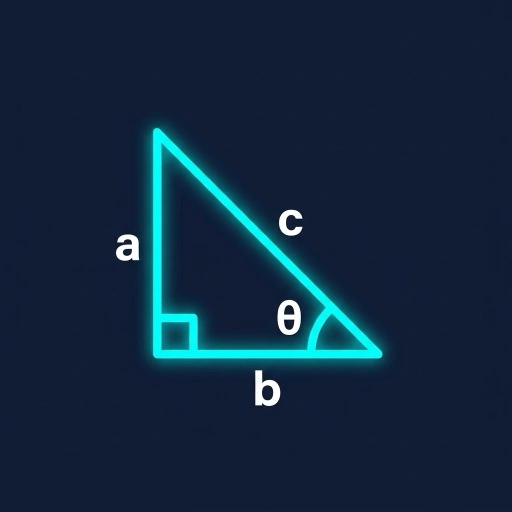
Pythagorean Theorem Calculator
Calculate the unknown hypotenuse or missing leg length of any right triangle in seconds using the fundamental Pythagorean equation $a^2 + b^2 = c^2$.
Whether you need to find hypotenuse length $c$, calculate a missing leg $a$ or $b$, solve right-triangle side lengths, or verify if three side lengths form a valid $90^\circ$ right angle, this tool delivers instant exact radical step-by-step solutions.
Pythagorean Theorem Calculator
Select what side you want to solve ($c$, $b$, or $a$) using $a^2 + b^2 = c^2$ to get instant exact radical steps and scaled visual proofs.
Calculated Results
Exact radical & decimal solution breakdown
Step-by-Step Pythagorean Solution
Detailed Breakdown
What Can the Pythagorean Theorem Calculator Calculate?
The Pythagorean theorem calculator is a specialized geometric tool designed to solve all side length relationships inherent to $90^\circ$ right-angled triangles.
What Is the Pythagorean Theorem?
The Pythagorean theorem (also called Pythagoras' theorem) is one of the most fundamental principles in Euclidean geometry. It establishes that in every right-angled triangle, the area of the square built on the hypotenuse is equal to the sum of the areas of the squares built on the two legs.
Where the variable symbols represent:
- $a$: The length of the first perpendicular leg.
- $b$: The length of the second perpendicular leg.
- $c$: The length of the hypotenuse, which is always opposite the $90^\circ$ right angle.
Because the $90^\circ$ right angle is the largest angle in any right triangle, side $c$ is strictly the longest side of the triangle.
Educational Pythagorean Theorem Visual
This visual diagram demonstrates how the geometric squares constructed on legs $a$ and $b$ sum up to equal the square constructed on hypotenuse $c$ ($a^2 + b^2 = c^2$):
Parts of a Right Triangle
To accurately solve right-triangle problems, it is important to identify each part of the triangle correctly:
| Part | Symbol | Meaning & Geometric Definition |
|---|---|---|
| Right Angle | $90^\circ$ | The fixed square angle defining the right-angled triangle. |
| First Leg | $a$ | One of the two sides forming the $90^\circ$ perpendicular corner. |
| Second Leg | $b$ | The other side forming the $90^\circ$ perpendicular corner. |
| Hypotenuse | $c$ | The diagonal side opposite the $90^\circ$ angle; always the longest side. |
Note: Legs $a$ and $b$ are interchangeable in the Pythagorean equation because addition is commutative ($a^2 + b^2 = b^2 + a^2$). However, hypotenuse $c$ must always represent the longest side opposite the right angle.
How the Pythagorean Theorem Works
The theorem operates by taking advantage of the quadratic relationship between linear side lengths:
Procedure for Finding the Hypotenuse ($c$):
- Identify the two perpendicular leg lengths ($a$ and $b$).
- Square leg $a$ ($a^2$) and leg $b$ ($b^2$).
- Add the two squared values together ($a^2 + b^2$).
- Take the principal square root of the sum ($c = \sqrt{a^2 + b^2}$).
Procedure for Finding a Missing Leg ($a$ or $b$):
- Identify the hypotenuse ($c$) and the known leg ($b$).
- Square the hypotenuse ($c^2$) and the known leg ($b^2$).
- Subtract the leg square from the hypotenuse square ($c^2 - b^2$).
- Take the principal square root of the difference ($a = \sqrt{c^2 - b^2}$).
How to Find the Hypotenuse
When you know the lengths of both perpendicular legs ($a$ and $b$), calculate hypotenuse $c$ using the formula:
Worked Example: Finding Hypotenuse $c$
Given: Leg $a = 3\text{ cm}$, Leg $b = 4\text{ cm}$
Answer: The hypotenuse length is exactly $5\text{ cm}$.
How to Find a Missing Leg
When hypotenuse $c$ and one leg length are known, solve for the unknown leg using algebraic rearrangement:
Worked Example: Finding Missing Leg $a$
Given: Hypotenuse $c = 13\text{ cm}$, Leg $b = 5\text{ cm}$
Answer: The missing leg length $a$ is exactly $12\text{ cm}$.
Pythagorean Theorem Formulas
Use this reference table to select the correct formula for your unknown target side:
| Target Unknown | Pythagorean Formula | Calculation Purpose |
|---|---|---|
| Hypotenuse ($c$) | $c = \sqrt{a^2 + b^2}$ | Find hypotenuse when both leg lengths ($a, b$) are known. |
| Leg $a$ | $a = \sqrt{c^2 - b^2}$ | Find missing leg $a$ when hypotenuse $c$ and leg $b$ are known. |
| Leg $b$ | $b = \sqrt{c^2 - a^2}$ | Find missing leg $b$ when hypotenuse $c$ and leg $a$ are known. |
How to Tell If a Triangle Is a Right Triangle
The Converse of the Pythagorean Theorem states that if the side lengths of a triangle satisfy $a^2 + b^2 = c^2$ (where $c$ is the longest side), then the triangle must contain a $90^\circ$ right angle.
Verification Example: Testing Sides 6, 8, and 10
Longest side: $c = 10$, Shorter sides: $a = 6, b = 8$
Conclusion: The triangle with sides 6, 8, and 10 is a true $90^\circ$ right triangle.
Common Pythagorean Triples
A Pythagorean triple consists of three positive integers $(a, b, c)$ that perfectly satisfy $a^2 + b^2 = c^2$.
| Leg $a$ | Leg $b$ | Hypotenuse $c$ | Verification ($a^2 + b^2 = c^2$) |
|---|---|---|---|
| 3 | 4 | 5 | $9 + 16 = 25$ |
| 5 | 12 | 13 | $25 + 144 = 169$ |
| 6 | 8 | 10 | $36 + 64 = 100$ (Multiple of 3-4-5) |
| 7 | 24 | 25 | $49 + 576 = 625$ |
| 8 | 15 | 17 | $64 + 225 = 289$ |
| 9 | 12 | 15 | $81 + 144 = 225$ (Multiple of 3-4-5) |
| 9 | 40 | 41 | $81 + 1600 = 1681$ |
| 12 | 35 | 37 | $144 + 1225 = 1369$ |
Pythagorean Theorem Worked Examples
Review seven fully worked step-by-step math solutions across diverse right-triangle problem scenarios:
Example 1: Classic 3-4-5 Right Triangle
Given: $a = 3\text{ cm}, b = 4\text{ cm}$
Answer: $c = 5\text{ cm}$.
Example 2: 5-12-13 Right Triangle
Given: $a = 5\text{ m}, b = 12\text{ m}$
Answer: $c = 13\text{ m}$.
Example 3: Find Missing Leg from Hypotenuse 13 and Leg 5
Given: $c = 13\text{ in}, b = 5\text{ in}$
Answer: Leg $a = 12\text{ in}$.
Example 4: Decimal Side Length Calculation
Given: $a = 2.5\text{ m}, b = 6.0\text{ m}$
Answer: $c = 6.5\text{ m}$.
Example 5: Verify Whether Sides 9, 12, 15 Form a Right Triangle
Given: $a = 9, b = 12, c = 15$
Answer: Yes, 9-12-15 forms a valid $90^\circ$ right triangle.
Example 6: Calculate Diagonal of a Rectangle
Given: Width $w = 8\text{ ft}$, Height $h = 15\text{ ft}$
Answer: Rectangle diagonal is $17\text{ ft}$.
Example 7: Coordinate-Plane Straight-Line Distance
Given: Point $A = (1, 2)$, Point $B = (4, 6)$
Answer: Distance $d = 5\text{ units}$.
Pythagorean Theorem and Right Triangles
The Pythagorean theorem forms the bedrock of right-triangle geometry. It establishes that:
- The two shorter perpendicular sides form the $90^\circ$ angle.
- The hypotenuse spans directly opposite the $90^\circ$ corner.
- Knowing any two side lengths enables complete calculation of all remaining side lengths and area.
Return to the main geometry hub for comprehensive multi-input solvers: Right Triangle Calculator.
Pythagorean Theorem vs. Right Triangle Trigonometry
Both the Pythagorean theorem and trigonometry solve right triangles, but they apply to different known input combinations:
| Method | Known Inputs | Typical Geometric Use |
|---|---|---|
| Pythagorean Theorem | Two side lengths ($a, b$ or $a, c$) | Find third side length without needing acute angle measurements. |
| Sine Ratio ($\sin$) | Side & Angle | Relates opposite leg to hypotenuse: $\sin(\theta) = \frac{\text{opposite}}{\text{hypotenuse}}$. |
| Cosine Ratio ($\cos$) | Side & Angle | Relates adjacent leg to hypotenuse: $\cos(\theta) = \frac{\text{adjacent}}{\text{hypotenuse}}$. |
| Tangent Ratio ($\tan$) | Side & Angle | Relates opposite leg to adjacent leg: $\tan(\theta) = \frac{\text{opposite}}{\text{adjacent}}$. |
For angle-based solutions, use our SOHCAHTOA Calculator or Trigonometry Calculator.
Using the Pythagorean Theorem to Find Distance
When movement occurs across two perpendicular axes (horizontal displacement $\Delta x$ and vertical displacement $\Delta y$), the shortest direct path forms the hypotenuse of a right triangle:
For instance, walking 3 blocks east and 4 blocks north creates a direct straight-line displacement of $\sqrt{3^2 + 4^2} = 5$ blocks.
Pythagorean Theorem and Coordinate Distance
In Cartesian coordinate geometry, the distance formula between points $(x_1, y_1)$ and $(x_2, y_2)$ is derived directly from the Pythagorean theorem:
By letting $a = |x_2 - x_1|$ and $b = |y_2 - y_1|$, distance $d$ is simply hypotenuse $c = \sqrt{a^2 + b^2}$.
Applications of the Pythagorean Theorem
Practical applications of the theorem span across numerous everyday disciplines:
- Architecture & Construction: Verifying square $90^\circ$ corners using the 3-4-5 rule.
- Screen Aspect Ratios: Calculating monitor diagonal screen sizes from width and height dimensions.
- Navigation & Mapping: Calculating shortest straight-line distances from grid coordinates.
- Ladder Placement Safety: Finding reach height when placing a ladder base at a safe distance from a wall.
Pythagorean Theorem Units
The Pythagorean theorem is dimensionally homogeneous: all side length inputs must use identical measurement units before calculation.
- Metric: millimeters ($\text{mm}$), centimeters ($\text{cm}$), meters ($\text{m}$), kilometers ($\text{km}$)
- Imperial/US: inches ($\text{in}$), feet ($\text{ft}$), yards ($\text{yd}$)
Example: To combine $2\text{ m}$ and $50\text{ cm}$, convert $50\text{ cm} \to 0.5\text{ m}$ first, yielding $c = \sqrt{2^2 + 0.5^2} = \sqrt{4.25} \approx 2.0615\text{ m}$.
Exact and Decimal Results
When square roots do not evaluate to whole numbers, calculator outputs can be presented in two distinct formats:
- Exact Radical Form: Expresses side length with simplified square roots (e.g., $\sqrt{50} = 5\sqrt{2}$). This preserves exact mathematical precision without rounding errors.
- Decimal Form: Approximates value into standard decimals (e.g., $7.0711\text{ cm}$), ideal for real-world construction and practical measurement.
Common Pythagorean Theorem Mistakes
Avoid These 10 Common Calculation Pitfalls:
- Misidentifying the hypotenuse (forgetting that $c$ is opposite the $90^\circ$ angle).
- Forgetting to square side values before adding or subtracting.
- Forgetting to take the square root at the final step.
- Adding side lengths directly instead of adding their squares ($a+b \neq c$).
- Adding instead of subtracting when solving for a missing leg ($a^2 = c^2 - b^2$).
- Applying the Pythagorean theorem to non-right triangles without a $90^\circ$ angle.
- Mixing measurement units without converting first (e.g., mixing feet and inches).
- Rounding intermediate decimal steps too early, introducing cumulative precision error.
- Entering a leg length greater than or equal to the hypotenuse.
- Miscalculating negative numbers under square root symbols.
When Can You Use the Pythagorean Theorem?
The standard Pythagorean theorem applies strictly to right-angled triangles. For non-right (oblique) triangles, the generalized relationship is given by the Law of Cosines:
Notice that when angle $C = 90^\circ$, $\cos(90^\circ) = 0$, causing $-2ab\cos(C)$ to vanish and reducing the formula back to $a^2 + b^2 = c^2$.
Calculator Accuracy and Rounding
Our online solver calculates floating point arithmetic using 64-bit precision, displaying decimal results rounded to 4 decimal places while simultaneously outputting simplified radical expressions for exact mathematical verification.
Common Pythagorean Theorem Problems
How do I find the hypotenuse?
Square leg $a$ and leg $b$, add the squares together, and take the square root: $c = \sqrt{a^2 + b^2}$.
How do I find a missing leg?
Square hypotenuse $c$, subtract the known leg square, and take the square root: $a = \sqrt{c^2 - b^2}$.
Which side is hypotenuse $c$?
Hypotenuse $c$ is always the longest side, located directly opposite the $90^\circ$ right angle.
Can it find any missing side?
Yes, as long as any two side lengths of a right triangle are known.
Related Right Triangle Calculators
Explore our complete suite of free online right triangle calculation tools:
Frequently Asked Questions
Q1
What is the Pythagorean theorem?
The Pythagorean theorem is a fundamental geometry law establishing that in every right triangle, the square of the hypotenuse length equals the sum of the squares of the two legs: $a^2 + b^2 = c^2$.
Q2
What is the Pythagorean theorem formula?
The standard formula is $a^2 + b^2 = c^2$. Rearranged forms include $c = \sqrt{a^2 + b^2}$, $a = \sqrt{c^2 - b^2}$, and $b = \sqrt{c^2 - a^2}$.
Q3
What is a in the Pythagorean theorem?
The symbol $a$ represents the length of the first leg adjacent to the $90^\circ$ right angle.
Q4
What is b in the Pythagorean theorem?
The symbol $b$ represents the length of the second leg forming the $90^\circ$ right angle.
Q5
What is c in the Pythagorean theorem?
The symbol $c$ represents the hypotenuse, which is the longest side located opposite the $90^\circ$ angle.
Q6
Which side is the hypotenuse?
The hypotenuse is the side lying directly across from the $90^\circ$ right angle. It is always the longest side of a right triangle.
Q7
How do you calculate the hypotenuse?
Square both leg lengths $a$ and $b$, add them together, and take the principal square root: $c = \sqrt{a^2 + b^2}$.
Q8
How do you find a missing leg?
Square hypotenuse $c$, subtract the known leg square, and take the square root: $a = \sqrt{c^2 - b^2}$ or $b = \sqrt{c^2 - a^2}$.
Q9
Can the Pythagorean theorem find a missing side?
Yes, as long as any two side lengths of a right triangle are known, the Pythagorean theorem can solve for the remaining third side.
Q10
Can you use the theorem on any triangle?
No, the standard theorem applies only to right triangles ($90^\circ$ angle). Oblique triangles require the generalized Law of Cosines.
Q11
How do you know if a triangle is right?
Use the converse theorem: test if the sum of squares of the two shorter sides equals the square of the longest side ($a^2 + b^2 = c^2$).
Q12
What are Pythagorean triples?
Pythagorean triples are sets of three positive integer side lengths $(a, b, c)$ that satisfy $a^2 + b^2 = c^2$, such as 3-4-5 and 5-12-13.
Q13
What is a 3-4-5 triangle?
A 3-4-5 triangle is the smallest integer Pythagorean triple right triangle ($3^2 + 4^2 = 9 + 16 = 25 = 5^2$).
Q14
Can the theorem be used with decimals?
Yes, the theorem works with all real numbers, decimals, and fractional side lengths.
Q15
Can the theorem calculate distance?
Yes, by resolving horizontal and vertical displacements as legs $a$ and $b$, the hypotenuse $c$ provides the straight-line distance.
Q16
How is the distance formula related to Pythagorean theorem?
The coordinate distance formula $d = \sqrt{(x_2 - x_1)^2 + (y_2 - y_1)^2}$ is a direct application of $c = \sqrt{a^2 + b^2}$.
Q17
What is the difference between Pythagorean theorem and SOHCAHTOA?
The Pythagorean theorem connects side lengths ($a, b, c$), whereas SOHCAHTOA trigonometric ratios connect side lengths to acute angles.
Q18
What units can be used?
Any unit (mm, cm, m, km, in, ft, yd) can be used, provided all side values are converted to the same unit before calculating.
Q19
Why is the hypotenuse the longest side?
Because $90^\circ$ is the largest interior angle in any right triangle, and the longest side always lies opposite the largest angle.
Q20
What happens if the hypotenuse is smaller than a leg?
A hypotenuse smaller than a leg represents an impossible geometry and produces a negative number under the square root, causing a domain error.