Right Triangle Perimeter Calculator
Calculate the total boundary perimeter $P = a + b + c$ for any right triangle easily by entering any three side lengths, two legs, or a leg and hypotenuse step-by-step.
Our online right triangle perimeter calculator solves missing sides using the Pythagorean theorem ($c = \sqrt{a^2 + b^2}$ or $b = \sqrt{c^2 - a^2}$) and sums all three boundary lengths instantly with full geometric verification.
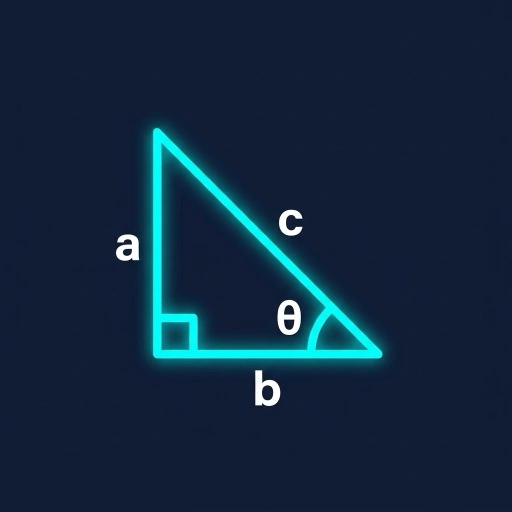
Standard Right Triangle Boundary Diagram ($P = a + b + c$)
Right Triangle Perimeter Calculator
Select your known side measurements to calculate the total outer boundary perimeter and step-by-step mathematical proofs.
Calculation Results
Total outer boundary & step-by-step solution breakdown
Step-by-Step Formulas & Solution Steps
Detailed Breakdown
What Is the Perimeter of a Right Triangle?
Definition, geometric boundaries, and fundamental linear length principles.
The perimeter of a right triangle is the total continuous distance around its three outer boundary edges. Unlike area, which measures the two-dimensional surface space enclosed inside the polygon, perimeter measures the one-dimensional path wrapping completely around the figure.
Every right triangle consists of three distinct sides: two perpendicular legs ($a$ and $b$) that form the $90^\circ$ corner, and one hypotenuse ($c$) positioned directly opposite the right angle. The perimeter equation simply sums these three side lengths:
Because perimeter measures outer linear distance, it is expressed strictly in one-dimensional linear units such as centimeters ($\text{cm}$), meters ($\text{m}$), inches ($\text{in}$), or feet ($\text{ft}$).
Right Triangle Perimeter Formula
Primary formula and derived equations for unknown side combinations.
The fundamental right triangle perimeter formula requires knowing all three side lengths:
Where:
- $a$ = length of the first perpendicular leg
- $b$ = length of the second perpendicular leg (base)
- $c$ = length of the hypotenuse ($c = \sqrt{a^2 + b^2}$)
When Two Legs ($a, b$) Are Known
Solves hypotenuse $c$ first using addition under the square root.
When Hypotenuse ($c$) & Leg ($a$) Are Known
Solves missing leg $b$ first using subtraction under the square root.
How to Calculate the Perimeter of a Right Triangle
Follow these quick step-by-step instructions to solve any boundary length.
- Identify your known side lengths: Determine whether you have three sides ($a, b, c$), two legs ($a, b$), or one leg and the hypotenuse ($a, c$).
- Verify unit consistency: Convert all input dimensions to identical linear units (e.g., convert inches to feet or centimeters to meters).
- Calculate missing side (if required): If only two sides are given, apply $c = \sqrt{a^2 + b^2}$ or $b = \sqrt{c^2 - a^2}$ to solve for the third side.
- Verify right-triangle validity: Confirm that $a^2 + b^2 = c^2$ and the hypotenuse is strictly the longest side.
- Add all three side lengths: Sum $P = a + b + c$.
- Report with linear measurement units: Always state your answer with linear units (e.g., $24\text{ cm}$).
Perimeter When All Three Sides Are Known
Direct addition formula and 6-8-10 worked example.
When all three side lengths ($a, b, c$) are provided, calculating perimeter requires simple addition without square root extractions:
Worked Example: 6-8-10 Right Triangle
Given: Leg $a = 6\text{ units}$, Leg $b = 8\text{ units}$, Hypotenuse $c = 10\text{ units}$
Formula: $P = a + b + c$
Substitution: $P = 6 + 8 + 10$
Result: $P = 24\text{ units}$
Note: The 6-8-10 triangle is a scaled Pythagorean triple derived by doubling the standard 3-4-5 right triangle.
Perimeter From Two Known Legs
Deriving hypotenuse c first using the Pythagorean theorem.
When you know both perpendicular legs $a$ and $b$, calculate hypotenuse $c$ first, then sum all three sides:
Worked Example: Legs $a = 5$, $b = 12$
Step 1 (Hypotenuse): $c = \sqrt{a^2 + b^2} = \sqrt{5^2 + 12^2} = \sqrt{25 + 144} = \sqrt{169} = 13\text{ units}$
Step 2 (Perimeter): $P = a + b + c = 5 + 12 + 13 = 30\text{ units}$
Perimeter From Hypotenuse and One Leg
Calculating missing leg b before summing boundary sides.
When hypotenuse $c$ and one leg $a$ are known, calculate the missing perpendicular leg $b = \sqrt{c^2 - a^2}$ first, then sum all three sides:
Worked Example: Hypotenuse $c = 13$, Known Leg $a = 5$
Step 1 (Missing Leg): $b = \sqrt{c^2 - a^2} = \sqrt{13^2 - 5^2} = \sqrt{169 - 25} = \sqrt{144} = 12\text{ units}$
Step 2 (Perimeter): $P = a + b + c = 5 + 12 + 13 = 30\text{ units}$
Perimeter From a Pythagorean Triple
Integer side combinations and exact perimeter values.
A Pythagorean triple consists of three positive integers $(a, b, c)$ that satisfy $a^2 + b^2 = c^2$. Because all side lengths are exact integers, their perimeters are also exact integers:
3-4-5 Triple
$$P = 3 + 4 + 5 = 12\text{ units}$$
5-12-13 Triple
$$P = 5 + 12 + 13 = 30\text{ units}$$
8-15-17 Triple
$$P = 8 + 15 + 17 = 40\text{ units}$$
7-24-25 Triple
$$P = 7 + 24 + 25 = 56\text{ units}$$
Right Triangle Perimeter With Decimal Side Lengths
Calculating perimeter for fractional and floating-point dimensions.
Not all right triangles have integer side lengths. When working with decimal dimensions, perform calculations without intermediate rounding to prevent error propagation:
Decimal Example: $a = 2.5$, $b = 6$, $c = 6.5$
Verification: $2.5^2 + 6^2 = 6.25 + 36 = 42.25 = 6.5^2 \quad \checkmark$
Perimeter: $P = 2.5 + 6 + 6.5 = 15\text{ units}$
Exact vs Decimal Perimeter Results
Comparing exact radical notation ($12 + \sqrt{74}$) with decimal approximations.
When a leg calculation results in an irrational square root, the perimeter can be written in two distinct ways: exact radical form and decimal approximation.
Example: Legs $a = 5$, $b = 7$
Hypotenuse: $c = \sqrt{5^2 + 7^2} = \sqrt{25 + 49} = \sqrt{74}$
Exact Radical Form: $P = 5 + 7 + \sqrt{74} = 12 + \sqrt{74}\text{ units}$
Decimal Approximation: $P \approx 12 + 8.6023 = 20.602\text{ units}$
Exact radical form preserves full mathematical precision, whereas decimal approximations are preferred for practical real-world measurements.
Right Triangle Perimeter Units
Linear measurement units vs square area units.
Perimeter is a one-dimensional linear measurement. Common metric and imperial units include:
- Millimeters ($\text{mm}$), Centimeters ($\text{cm}$), Meters ($\text{m}$), Kilometers ($\text{km}$)
- Inches ($\text{in}$), Feet ($\text{ft}$), Yards ($\text{yd}$), Miles ($\text{mi}$)
Adding lengths maintains the linear unit: $\text{cm} + \text{cm} + \text{cm} = \text{cm}$. Never use square units ($\text{cm}^2$, $\text{ft}^2$) for perimeter.
Converting Right Triangle Perimeter Units
Standard linear conversion factors for metric and imperial dimensions.
Before adding side lengths, ensure all dimensions use the exact same unit. Common linear conversion factors include:
- $1\text{ m} = 100\text{ cm} = 1,000\text{ mm}$
- $1\text{ ft} = 12\text{ in}$
- $1\text{ yd} = 3\text{ ft} = 36\text{ in}$
Mixing different units directly (e.g., adding $5\text{ m} + 50\text{ cm}$) produces incorrect results. Always convert first!
How the Hypotenuse Affects Right Triangle Perimeter
Why the hypotenuse is always the longest side and dominates the perimeter sum.
In any non-degenerate right triangle, the hypotenuse $c = \sqrt{a^2 + b^2}$ is strictly the longest side ($c > a$ and $c > b$). Consequently, the hypotenuse accounts for more than one-third of the total perimeter.
As the ratio between legs $a$ and $b$ varies, the hypotenuse length and overall perimeter adjust dynamically to satisfy right-angle geometric constraints.
Can You Find the Perimeter From Only One Side?
Single-side constraints vs special right triangle rules.
Knowing only one side length of a general right triangle is insufficient to uniquely determine its perimeter. An infinite number of right triangles can share a single leg length.
However, if additional geometric constraints are provided—such as acute angle measurements in special right triangles—a single side length becomes sufficient to solve the complete perimeter.
Can You Find the Perimeter From Two Sides?
Solving complete perimeter from any two side measurements.
Yes. Knowing any two side lengths of a right triangle is always sufficient to determine its exact perimeter:
- Case 1 (Two Legs $a, b$): Calculate $c = \sqrt{a^2 + b^2}$, then $P = a + b + c$.
- Case 2 (Hypotenuse $c$ & Leg $a$): Calculate $b = \sqrt{c^2 - a^2}$, then $P = a + b + c$.
- Case 3 (Two Arbitrary Sides): Identify which side is the hypotenuse (longest side), solve for the third side, and sum all three.
Perimeter of a 45-45-90 Triangle
Special isosceles right triangle perimeter equation $P = a(2 + \sqrt{2})$.
A 45-45-90 triangle is an isosceles right triangle with equal leg lengths $a = b$. Its hypotenuse is $c = a\sqrt{2}$.
Numerical Example: Leg $a = 10\text{ units}$
Formula: $P = 10(2 + \sqrt{2})$
Decimal Result: $P \approx 10(2 + 1.4142) = 34.142\text{ units}$
Perimeter of a 30-60-90 Triangle
Special scalene right triangle perimeter equation $P = x(3 + \sqrt{3})$.
A 30-60-90 triangle has side lengths in exact proportion $1 : \sqrt{3} : 2$. If the shortest leg is $x$:
- Short Leg = $x$
- Long Leg = $x\sqrt{3}$
- Hypotenuse = $2x$
Numerical Example: Short Leg $x = 5\text{ units}$
Formula: $P = 5(3 + \sqrt{3})$
Decimal Result: $P \approx 5(3 + 1.7320) = 23.660\text{ units}$
Right Triangle Perimeter vs Area
Comparing 1D boundary length with 2D enclosed surface space.
For a detailed calculation of enclosed space, visit our specialized Right Triangle Area Calculator.
How to Verify a Right Triangle Perimeter
Five-point verification checklist for algebraic correctness.
- Positive Values: Verify that $a > 0$, $b > 0$, and $c > 0$.
- Longest Side: Confirm that hypotenuse $c$ is strictly greater than leg $a$ and leg $b$.
- Pythagorean Proof: Check that $a^2 + b^2 = c^2$.
- Perimeter Sum: Confirm that $P = a + b + c$.
- Linear Units: Confirm that all terms use matching linear units.
Common Right Triangle Perimeter Mistakes
Frequent errors and how to avoid them.
1. Confusing Area & Perimeter
Using $A = \frac{1}{2}ab$ instead of adding all three outer sides $P = a + b + c$.
2. Forgetting the Hypotenuse
Adding only the two legs ($a + b$) and forgetting to include hypotenuse $c$.
3. Incorrect Units
Expressing perimeter in square units ($\text{cm}^2$) instead of linear units ($\text{cm}$).
4. Mixed Measurement Units
Adding inches to feet directly without first converting to a uniform unit.
5. Treating Leg as Hypotenuse
Mistaking a leg for hypotenuse $c$ when evaluating $b = \sqrt{c^2 - a^2}$.
6. Early Decimal Rounding
Rounding intermediate hypotenuse roots too early, causing cumulative rounding error.
Right Triangle Perimeter and Semiperimeter
Definition and formula for half-perimeter $s = P / 2$.
The semiperimeter ($s$) of a right triangle is exactly half of its total perimeter:
Semiperimeter is extensively used in advanced geometric formulas, including Heron's formula and calculating inradius ($r = s - c$).
Real-World Right Triangle Perimeter Example
Practical carpentry example framing a 0.9 m × 1.2 m timber ramp brace.
Practical Example: Framing a Triangular Ramp Support
A carpenter is framing a right-triangular timber brace with a vertical rise of $0.9\text{ m}$ and horizontal run of $1.2\text{ m}$. What is the total length of border framing material required?
Given: Leg $a = 0.9\text{ m}$, Leg $b = 1.2\text{ m}$
Step 1 (Hypotenuse): $c = \sqrt{0.9^2 + 1.2^2} = \sqrt{0.81 + 1.44} = \sqrt{2.25} = 1.5\text{ m}$
Step 2 (Perimeter): $P = 0.9 + 1.2 + 1.5 = 3.6\text{ meters}$
Answer: The carpenter requires exactly $3.6\text{ meters}$ of framing material for the border.
Right Triangle Perimeter Calculation Workflow
Visual 4-step flowchart from inputs to final linear boundary result.
Identify Known Sides
Gather input values for legs ($a, b$) or hypotenuse ($c$).
Solve Missing Side
Apply $c = \sqrt{a^2 + b^2}$ or $b = \sqrt{c^2 - a^2}$ if needed.
Verify Right Triangle
Confirm $a^2 + b^2 = c^2$ with valid positive lengths.
Sum Boundary Length
Calculate $P = a + b + c$ in uniform linear units.
Right Triangle Perimeter Worked Examples
Structured problem solutions with step-by-step substitutions.
Example 1: Standard 3-4-5 Right Triangle
Problem: Calculate perimeter of a right triangle with legs 3 cm and 4 cm, hypotenuse 5 cm.
Formula: $P = a + b + c = 3 + 4 + 5 = 12\text{ cm}$
Example 2: 5-12-13 Right Triangle
Problem: Find perimeter when legs are 5 in and 12 in.
Calculation: $c = \sqrt{25 + 144} = 13\text{ in} \implies P = 5 + 12 + 13 = 30\text{ in}$
Example 3: Radical Result ($a = 4$, $b = 5$)
Calculation: $c = \sqrt{16 + 25} = \sqrt{41} \implies P = 4 + 5 + \sqrt{41} = 9 + \sqrt{41} \approx 15.403\text{ units}$
For additional fully worked problems, explore our Right Triangle Worked Examples library.
Right Triangle Perimeter Quick Reference
Summary reference table for all right triangle perimeter formulas.
Related Right Triangle Calculators
Explore our suite of specialized geometry and trigonometry solvers.
Right Triangle Perimeter Calculator FAQ
Frequently asked questions about calculating right triangle boundary lengths.
Q1
What is the perimeter of a right triangle?
The perimeter of a right triangle is the total linear distance around its outer boundary, calculated by adding the lengths of all three sides: $P = a + b + c$.
Q2
What is the formula for the perimeter of a right triangle?
The standard formula is $P = a + b + c$. If hypotenuse $c$ is unknown, it becomes $P = a + b + \sqrt{a^2 + b^2}$. If leg $b$ is unknown, it becomes $P = a + c + \sqrt{c^2 - a^2}$.
Q3
How do you find the perimeter when both legs are known?
First compute the hypotenuse using the Pythagorean theorem ($c = \sqrt{a^2 + b^2}$), then sum all three sides ($P = a + b + c$).
Q4
How do you find the perimeter when the hypotenuse and one leg are known?
First compute the missing leg ($b = \sqrt{c^2 - a^2}$), then sum all three sides ($P = a + b + c$).
Q5
Can I calculate the perimeter from all three sides?
Yes. Simply add $P = a + b + c$ after verifying that $a^2 + b^2 = c^2$ and the side lengths satisfy the triangle inequality.
Q6
What is the perimeter of a 3-4-5 right triangle?
The perimeter of a 3-4-5 right triangle is $P = 3 + 4 + 5 = 12\text{ units}$.
Q7
Can you find the perimeter from only one side?
Generally no, unless additional geometric constraints (such as acute angles in a 45-45-90 or 30-60-90 triangle) are given.
Q8
What units are used for right triangle perimeter?
Perimeter uses linear units such as $\text{mm}, \text{cm}, \text{m}, \text{in}, \text{ft},$ or $\text{yd}$. It never uses square units.
Q9
What is the difference between perimeter and area?
Perimeter measures 1D outer boundary distance ($P = a + b + c$ in linear units), whereas area measures 2D enclosed surface ($A = \frac{1}{2}ab$ in square units).
Q10
What is the perimeter of a 45-45-90 triangle?
For leg length $a$, the perimeter is $P = a + a + a\sqrt{2} = a(2 + \sqrt{2})$.
Q11
What is the perimeter of a 30-60-90 triangle?
For shortest leg $x$, the perimeter is $P = x + x\sqrt{3} + 2x = x(3 + \sqrt{3})$.
Q12
What is the semiperimeter of a right triangle?
The semiperimeter ($s$) is half of the total perimeter: $s = \frac{P}{2} = \frac{a + b + c}{2}$.
Q13
Can the calculator handle decimal side lengths?
Yes, our calculator supports arbitrary positive decimal inputs and provides exact radical and decimal output formats.
Q14
How do I verify that the three sides form a right triangle?
Verify that all sides are positive, hypotenuse $c$ is the longest side, and the side lengths satisfy $a^2 + b^2 = c^2$.