Right Triangle Altitude Calculator
The right triangle altitude calculator finds the exact length of the perpendicular altitude $h$ dropped directly from the $90^\circ$ right-angle vertex to the hypotenuse $c$.
Easily compute the altitude from two legs, three side lengths, or area and hypotenuse with step-by-step mathematical explanations, exact radical forms, and geometric mean theorem breakdowns.
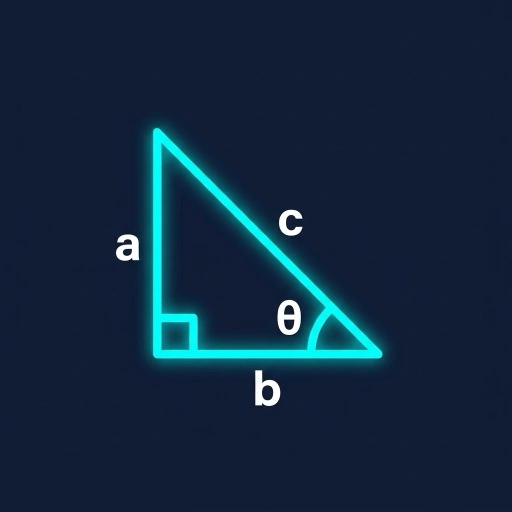
Standard Right Triangle Altitude Diagram ($h = \frac{ab}{c}$)
Right Triangle Altitude Calculator
Select your known parameters to calculate the altitude $h$ and view step-by-step mathematical proofs.
Calculated Right Triangle Altitude
Altitude solution & step-by-step breakdown
Step-by-Step Formulas & Solution Steps
Detailed Breakdown
What Is the Altitude of a Right Triangle?
In geometry, an altitude of a triangle is a perpendicular line segment drawn from a vertex to the opposite side (or line containing the opposite side). Because every triangle has three vertices, every triangle possesses three distinct altitudes.
For a right triangle, two of its three altitudes are identical to its perpendicular legs $a$ and $b$, because each leg is already perpendicular to the other. However, the third altitude—specifically the altitude dropped from the $90^\circ$ right-angle vertex to the hypotenuse $c$—is an interior perpendicular segment denoted by $h$.
This specific altitude $h$ is of primary interest in geometry because it establishes fundamental proportional relationships, divides the original triangle into two smaller similar right triangles, and obeys the famous Geometric Mean Theorem.
Altitude to the Hypotenuse
Geometric positioning, perpendicular intersection, and hypotenuse segment division.
The altitude to the hypotenuse is the perpendicular segment extending from the right-angle vertex $C$ to meet the hypotenuse $c$ at point $D$ at a $90^\circ$ angle.
When altitude $h$ is drawn to hypotenuse $c$, it divides hypotenuse $c$ into two smaller segments: segment $p$ (adjacent to leg $a$) and segment $q$ (adjacent to leg $b$), such that:
Figure: Altitude $h$ intersects hypotenuse $c$ at point $D$, splitting $c$ into segments $p$ and $q$.
Right Triangle Altitude Formula
Core mathematical formula for altitude dropped to the hypotenuse.
The fundamental formula to calculate the altitude $h$ to the hypotenuse from side lengths is:
Where:
- $h$ = altitude to the hypotenuse
- $a$ = length of the first perpendicular leg
- $b$ = length of the second perpendicular leg
- $c$ = length of the hypotenuse ($c = \sqrt{a^2 + b^2}$)
In plain language: The altitude to the hypotenuse equals the product of the two perpendicular legs divided by the hypotenuse.
How the Right Triangle Altitude Formula Is Derived
Proof via equal area representations using legs vs hypotenuse.
The altitude formula $h = \frac{ab}{c}$ is directly derived using the basic formula for the area of a triangle.
The area $A$ of any triangle is given by $A = \frac{1}{2} \times \text{base} \times \text{height}$. A right triangle can be evaluated in two distinct ways:
- Using the legs: Choosing leg $b$ as the base means leg $a$ is the perpendicular height: $$\text{Area} = \frac{1}{2} a b$$
- Using the hypotenuse: Choosing hypotenuse $c$ as the base means altitude $h$ is the corresponding perpendicular height: $$\text{Area} = \frac{1}{2} c h$$
Because both expressions calculate the exact same enclosed area of the same triangle, we set them equal to each other:
$$\frac{1}{2} a b = \frac{1}{2} c h$$Multiply both sides of the equation by $2$:
$$a b = c h$$Dividing both sides by $c$ isolates the altitude $h$:
$$h = \frac{a b}{c}$$This clean, elegant derivation proves that $h = \frac{ab}{c}$ holds true for all right triangles.
How to Find the Altitude From Two Legs
When only the two perpendicular legs $a$ and $b$ are known, first calculate the hypotenuse $c$ using the Pythagorean theorem:
$$c = \sqrt{a^2 + b^2}$$Then substitute $c$ back into the primary altitude formula:
Example (Two Legs Known):
Given $a = 3$ and $b = 4$:
- Calculate hypotenuse $c$: $$c = \sqrt{3^2 + 4^2} = \sqrt{9 + 16} = \sqrt{25} = 5$$
- Calculate altitude $h$: $$h = \frac{3 \times 4}{5} = \frac{12}{5} = 2.4 \text{ units}$$
How to Find the Altitude From Three Side Lengths
When all three sides ($a, b, c$) are known, calculating the altitude is a straightforward single-step process.
Before computing, always verify that the sides form a valid right triangle by checking that $a^2 + b^2 = c^2$.
Example (Three Sides Known):
Given $a = 6$, $b = 8$, and $c = 10$:
- Verify Pythagorean theorem: $$6^2 + 8^2 = 36 + 64 = 100 = 10^2 \quad \checkmark$$
- Calculate altitude $h$: $$h = \frac{6 \times 8}{10} = \frac{48}{10} = 4.8 \text{ units}$$
How to Find the Altitude From Area and Hypotenuse
If you know the total enclosed area $A$ of the right triangle and its hypotenuse $c$, you can solve for altitude $h$ by rearranging the area equation $A = \frac{1}{2} c h$:
Example (Area and Hypotenuse Known):
Given Area $A = 30 \text{ sq units}$ and Hypotenuse $c = 13 \text{ units}$:
$$h = \frac{2 \times 30}{13} = \frac{60}{13} \approx 4.6154 \text{ units}$$Note: Area $A$ is expressed in square units (e.g., $\text{cm}^2$), while altitude $h$ and hypotenuse $c$ are linear distance measurements (e.g., $\text{cm}$).
Relationship Between Altitude and Area
The altitude to the hypotenuse is intrinsically connected to the triangle's area. Because $\text{Area} = \frac{1}{2} c h$, the altitude $h$ represents the exact perpendicular height required when using hypotenuse $c$ as the base.
If you double the area of a right triangle while holding hypotenuse $c$ constant, the altitude $h$ doubles proportionally.
To explore general area calculations, visit our dedicated Right Triangle Area Calculator →.
Relationship Between the Altitude and the Two Legs
Because $h = \frac{ab}{\sqrt{a^2 + b^2}}$, altitude $h$ is sensitive to both leg lengths. If either leg increases while the other remains fixed, the altitude $h$ increases, but it remains strictly less than both legs $a$ and $b$.
In any right triangle, the altitude to the hypotenuse is always strictly shorter than both leg $a$ and leg $b$:
$$h < a \quad \text{and} \quad h < b$$Right Triangle Altitude as a Geometric Mean
One of the most important theorems in geometry is the Right Triangle Altitude Theorem (or Geometric Mean Altitude Theorem).
When the altitude $h$ is drawn to hypotenuse $c$, it splits the hypotenuse into two segments $p$ and $q$. The length of altitude $h$ is the geometric mean of segments $p$ and $q$:
This relationship arises because the altitude creates two smaller right triangles that are geometrically similar to each other and to the original triangle. Comparing proportional side ratios yields $\frac{h}{p} = \frac{q}{h} \implies h^2 = pq$.
Altitude and the Two Hypotenuse Segments
In addition to $h^2 = pq$, drawing altitude $h$ creates two additional leg-segment relationships known as the Leg Theorem:
- Leg $a$ relationship: $a^2 = c \times p \implies a = \sqrt{cp}$
- Leg $b$ relationship: $b^2 = c \times q \implies b = \sqrt{cq}$
- Segment sum: $p + q = c$
- Altitude geometric mean: $h^2 = p \times q$
Altitude in Special Right Triangles
Exact formulas for 45-45-90 and 30-60-90 right triangles.
45-45-90 Isosceles Right Triangle Altitude
In a 45-45-90 triangle → with equal legs $a = b$, hypotenuse $c = a\sqrt{2}$. Substituting into the altitude formula:
$$h = \frac{a \times a}{a\sqrt{2}} = \frac{a}{\sqrt{2}} = \frac{a\sqrt{2}}{2}$$Example: For equal legs $a = 10$, altitude $h = \frac{10\sqrt{2}}{2} = 5\sqrt{2} \approx 7.071 \text{ units}$.
30-60-90 Right Triangle Altitude
In a 30-60-90 triangle → with short leg $x$, long leg $x\sqrt{3}$, and hypotenuse $c = 2x$:
$$h = \frac{x \times (x\sqrt{3})}{2x} = \frac{x\sqrt{3}}{2}$$Example: For short leg $x = 6$, altitude $h = \frac{6\sqrt{3}}{2} = 3\sqrt{3} \approx 5.196 \text{ units}$.
Exact vs Decimal Altitude Results
Altitude calculations often yield rational fractions or radical expressions.
- Exact Fraction / Radical Form: Keeps precision without rounding (e.g., $h = \frac{60}{13}$ or $h = 5\sqrt{2}$).
- Decimal Form: Provides practical decimal approximations (e.g., $h \approx 4.6154$).
To maintain mathematical rigor, avoid rounding intermediate numbers like hypotenuse $c$ before computing altitude $h$.
Right Triangle Altitude Units
Altitude is a 1-dimensional (linear) distance. Always express altitude in linear measurement units:
mm, cm, m, km, in, ft, yd
Correct: $h = 4.8 \text{ cm}$.
Incorrect: $h = 4.8 \text{ cm}^2$ (Square units designate area, not altitude).
How to Calculate the Altitude of a Right Triangle
- Identify known values: Determine if you have two legs, three sides, or area and hypotenuse.
- Check units: Ensure all input measurements share the same unit.
- Compute missing hypotenuse (if needed): Use $c = \sqrt{a^2 + b^2}$.
- Apply the primary formula: Multiply leg $a$ by leg $b$.
- Divide by hypotenuse: Calculate $h = \frac{ab}{c}$.
- Verify results: Optionally double-check using $h = \frac{2A}{c}$ or $h = \sqrt{pq}$.
- Report result with units: Present altitude in exact fraction/radical and decimal forms.
Right Triangle Altitude Worked Examples
Step-by-step altitude solutions for common right triangle configurations.
Example 1: 3-4-5 Right Triangle
Problem: Find the altitude to the hypotenuse for a right triangle with legs $a = 3 \text{ cm}$ and $b = 4 \text{ cm}$.
Given: $a = 3$, $b = 4$
Step 1 (Hypotenuse): $c = \sqrt{3^2 + 4^2} = \sqrt{25} = 5 \text{ cm}$
Step 2 (Altitude): $h = \frac{3 \times 4}{5} = \frac{12}{5} = 2.4 \text{ cm}$
Answer: $h = 2.4 \text{ cm}$
Verification: $\text{Area} = \frac{1}{2}(3)(4) = 6$. Using $h$: $\text{Area} = \frac{1}{2}(5)(2.4) = 6 \quad \checkmark$
Example 2: 5-12-13 Right Triangle
Problem: Calculate the altitude $h$ for a right triangle with legs $a = 5$ and $b = 12$.
Given: $a = 5$, $b = 12$
Step 1 (Hypotenuse): $c = \sqrt{5^2 + 12^2} = \sqrt{25 + 144} = \sqrt{169} = 13$
Step 2 (Altitude): $h = \frac{5 \times 12}{13} = \frac{60}{13} \approx 4.6154 \text{ units}$
Answer: Exact: $\frac{60}{13}$, Decimal: $\approx 4.6154$
Example 3: 6-8-10 Right Triangle
Problem: Find altitude $h$ when $a = 6 \text{ m}$, $b = 8 \text{ m}$, and $c = 10 \text{ m}$.
Given: $a = 6$, $b = 8$, $c = 10$
Calculation: $h = \frac{6 \times 8}{10} = \frac{48}{10} = 4.8 \text{ m}$
Answer: $h = 4.8 \text{ m}$
Example 4: Area & Hypotenuse Method
Problem: Find altitude $h$ if Area $A = 24 \text{ cm}^2$ and hypotenuse $c = 10 \text{ cm}$.
Formula: $h = \frac{2A}{c}$
Calculation: $h = \frac{2 \times 24}{10} = \frac{48}{10} = 4.8 \text{ cm}$
Answer: $h = 4.8 \text{ cm}$
Example 5: 45-45-90 Special Triangle
Problem: An isosceles right triangle has leg $a = 8 \text{ in}$. Find altitude $h$.
Formula: $h = \frac{a\sqrt{2}}{2}$
Calculation: $h = \frac{8\sqrt{2}}{2} = 4\sqrt{2} \approx 5.6569 \text{ in}$
Answer: $h = 4\sqrt{2} \approx 5.6569 \text{ in}$
Example 6: Hypotenuse Segment Method ($h = \sqrt{pq}$)
Problem: The altitude splits the hypotenuse into segments $p = 1.8 \text{ ft}$ and $q = 3.2 \text{ ft}$. Find $h$.
Formula: $h = \sqrt{p \times q}$
Calculation: $h = \sqrt{1.8 \times 3.2} = \sqrt{5.76} = 2.4 \text{ ft}$
Answer: $h = 2.4 \text{ ft}$
For more worked triangle problems, visit our Worked Examples Library →.
How to Verify a Right Triangle Altitude
Verify your altitude calculations using three independent mathematical checks:
- Check 1 (Leg Product): $h = \frac{a \times b}{c}$
- Check 2 (Area Formula): $h = \frac{2A}{c}$ (Verify $\frac{1}{2}ab = \frac{1}{2}ch$)
- Check 3 (Geometric Mean): $h = \sqrt{p \times q}$ (where $p = \frac{a^2}{c}$ and $q = \frac{b^2}{c}$)
All three methods must yield the identical altitude result.
Right Triangle Altitude vs Height
In common language, "altitude" and "height" are often used interchangeably. However, in right triangle geometry:
- Height: Refers generally to any vertical leg relative to a horizontal base leg ($a$ relative to $b$, or $b$ relative to $a$).
- Altitude to Hypotenuse: Refers specifically to the interior perpendicular line segment $h$ drawn from the $90^\circ$ right angle to hypotenuse $c$.
Right Triangle Altitude vs Hypotenuse
It is essential not to confuse hypotenuse $c$ with altitude $h$:
- Hypotenuse ($c$): The longest outer boundary side of the triangle, located directly opposite the $90^\circ$ angle.
- Altitude ($h$): An interior line segment extending from the $90^\circ$ vertex perpendicular to the hypotenuse.
Right Triangle Altitude vs Median
An altitude and a median serve fundamentally different geometric roles:
- Altitude ($h$): Meets the hypotenuse at a strict $90^\circ$ perpendicular angle (Does NOT necessarily bisect the hypotenuse unless $a = b$).
- Median ($m_c$): Connects the $90^\circ$ vertex to the exact midpoint of the hypotenuse (In a right triangle, median to hypotenuse length is always exactly $m_c = \frac{c}{2}$).
Real-World Right Triangle Altitude Example
Suppose an architectural truss frame forms a right triangle with horizontal base leg $b = 12 \text{ ft}$ and vertical leg $a = 5 \text{ ft}$. An interior structural support beam must be installed from the $90^\circ$ corner perpendicular to the diagonal rafter (hypotenuse).
Step 1: Calculate diagonal rafter length $c = \sqrt{5^2 + 12^2} = 13 \text{ ft}$.
Step 2: Calculate exact beam length $h = \frac{5 \times 12}{13} = \frac{60}{13} \approx 4.615 \text{ ft}$ (approx $4 \text{ ft } 7.38 \text{ in}$).
Right Triangle Altitude Formula Quick Reference
Summary of altitude formulas across different geometric scenarios.
Common Right Triangle Altitude Mistakes
- Confusing altitude with hypotenuse: Assuming $h$ is an outer side rather than an interior perpendicular line segment.
- Using addition instead of multiplication: Incorrectly calculating $h = \frac{a + b}{c}$ instead of $h = \frac{a \times b}{c}$.
- Forgetting perpendicularity: Assuming the altitude can intersect the hypotenuse at non-90° angles.
- Using square units for altitude: Reporting altitude in $\text{cm}^2$ or $\text{m}^2$ instead of linear $\text{cm}$ or $\text{m}$.
- Misidentifying hypotenuse $c$: Using a leg length in the denominator instead of the hypotenuse.
- Omitting hypotenuse calculation: Trying to compute $h = \frac{ab}{c}$ without calculating $c = \sqrt{a^2+b^2}$ first when only legs are given.
- Early decimal rounding: Rounding $c$ to few decimal places before dividing, causing compounding rounding error.
- Misapplying $h = \sqrt{pq}$: Using arbitrary side lengths instead of the exact two segments into which $h$ divides hypotenuse $c$.
- Confusing altitude with median: Assuming altitude bisects hypotenuse $c$ when legs $a$ and $b$ are unequal.
- Confusing altitude to hypotenuse with leg height: Mixing up leg height relative to base leg with interior altitude to hypotenuse.
Related Right Triangle Calculators
Explore our full suite of free online right triangle tools.
Right Triangle Altitude Calculator FAQ
Frequently asked questions about altitude to hypotenuse calculations.
Q1
What is the altitude of a right triangle?
The altitude of a right triangle dropped to the hypotenuse is the perpendicular line segment drawn from the 90-degree right-angle vertex to the hypotenuse.
Q2
What is the formula for the altitude of a right triangle?
The primary formula for the altitude to the hypotenuse is $h = \frac{a \times b}{c}$, where $a$ and $b$ are the perpendicular leg lengths and $c$ is the hypotenuse.
Q3
How do you find the altitude from two legs?
First calculate the hypotenuse using the Pythagorean theorem $c = \sqrt{a^2 + b^2}$, then apply the altitude formula $h = \frac{a \times b}{\sqrt{a^2 + b^2}}$.
Q4
How do you find the altitude from three sides?
Multiply the two leg lengths $a$ and $b$, then divide the product by the hypotenuse $c$: $h = \frac{a \times b}{c}$ after verifying that $a^2 + b^2 = c^2$.
Q5
How do you find the altitude from area and hypotenuse?
Rearrange the area formula $\text{Area} = \frac{1}{2} c h$ to solve for altitude: $h = \frac{2A}{c}$.
Q6
What is the altitude to the hypotenuse?
It is the interior height segment of a right triangle that connects the right-angle vertex to the hypotenuse at a perpendicular (90-degree) angle, dividing the triangle into two smaller similar right triangles.
Q7
Is the altitude of a right triangle the same as its height?
Not necessarily. While either perpendicular leg can serve as the height when the other leg is chosen as the base, the specific "altitude to the hypotenuse" refers strictly to the perpendicular segment from the right angle to the hypotenuse.
Q8
What is the geometric mean relationship for a right triangle altitude?
According to the Geometric Mean Theorem, the altitude $h$ dropped to hypotenuse $c$ is the geometric mean of the two hypotenuse segments $p$ and $q$: $h^2 = p \times q$, or $h = \sqrt{p \times q}$.
Q9
What does h² = pq mean in a right triangle?
It means that the square of the altitude to the hypotenuse equals the product of the two segments into which the altitude splits the hypotenuse.
Q10
What is the altitude of a 3-4-5 triangle?
For a 3-4-5 right triangle with legs $a=3$, $b=4$, and hypotenuse $c=5$, the altitude is $h = \frac{3 \times 4}{5} = \frac{12}{5} = 2.4 \text{ units}$.
Q11
What is the altitude of a 45-45-90 triangle?
For an isosceles right triangle with leg length $a$, the altitude to the hypotenuse is $h = \frac{a\sqrt{2}}{2}$ (or $\frac{a}{\sqrt{2}}$).
Q12
What is the altitude of a 30-60-90 triangle?
For a 30-60-90 right triangle with short leg $x$, long leg $x\sqrt{3}$, and hypotenuse $2x$, the altitude to the hypotenuse is $h = \frac{x\sqrt{3}}{2}$.
Q13
Can the calculator handle decimal side lengths?
Yes. The calculator accepts any positive decimal inputs (such as $a=3.5$, $b=4.2$) and computes the exact altitude and step-by-step breakdown instantly.
Q14
What units are used for right triangle altitude?
Altitude is measured in linear units such as centimeters (cm), meters (m), inches (in), or feet (ft). Square units belong to area, not altitude.
Q15
How can I verify my altitude calculation?
You can verify your result using multiple independent methods: $h = \frac{ab}{c}$, $h = \frac{2A}{c}$, or $h = \sqrt{pq}$ when hypotenuse segments $p$ and $q$ are known.