Right Triangle Calculator
Solve any right triangle easily by entering any two known side lengths or acute angles. Calculate missing leg lengths, hypotenuse, angles, area, perimeter, and altitude step-by-step for any right-angle geometry problem.
Our online right triangle solver applies the Pythagorean theorem ($a^2 + b^2 = c^2$) and fundamental trigonometric ratios ($\sin, \cos, \tan$) to determine exact hypotenuse, missing legs, acute angles, area, perimeter, and altitude instantly.
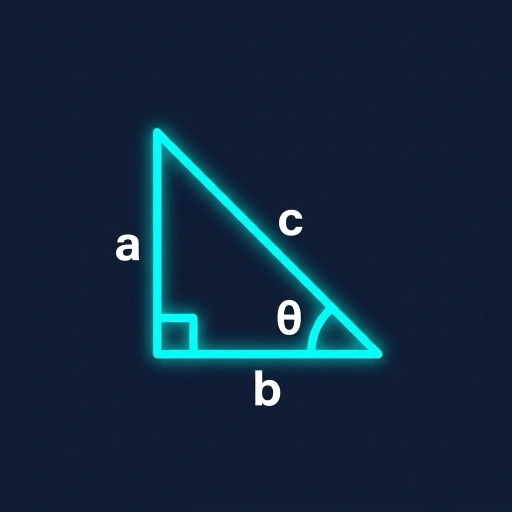
Standard Right Triangle Diagram ($a = \text{leg}$, $b = \text{leg}$, $c = \text{hypotenuse}$, $C = 90^\circ$)
Right Triangle Calculator
Enter any two known values (sides or acute angles) to instantly calculate all missing sides, angles, area, perimeter, and step-by-step mathematical proofs.
Calculation Results
Complete geometric solution & step-by-step breakdown
Step-by-Step Formulas & Solution Steps
Detailed Breakdown
Take the Right Triangle Calculator Anywhere
Solve sides, angles, area and perimeter on the go with our Android app — the same accurate results and step-by-step solutions, right on your phone.
- Fast & lightweight
- Step-by-step solutions
- Free to use
Solve Right Triangles on Any Web Page
Add the Right Triangle Calculator to Chrome and solve sides, angles, area and perimeter from your toolbar. Highlight a triangle problem on any page, right-click “Solve right triangle” (or press Alt+Shift+S) and get the answer with step-by-step working.
- Highlight-to-solve
- Exact answers & steps
- No data collected
What Can the Right Triangle Calculator Calculate?
Our right triangle solver evaluates all core geometric and trigonometric properties simultaneously from any valid input combination.
How to Use the Right Triangle Calculator
Follow these quick steps to solve any right triangle in seconds.
- Enter the known measurements: Look at your triangle problem and note which values are already provided.
- Select the appropriate calculation mode: Choose from the tabs at the top of the calculator (e.g. Two Legs, Leg + Hypotenuse, or Leg + Acute Angle).
- Choose the measurement unit: Select your preferred unit of length (cm, mm, m, km, in, ft, yd) or angle unit (degrees or radians).
- Enter the side lengths or angle: Input the values into the respective numerical fields.
- Click Calculate: Press the Calculate Right Triangle button to trigger instant calculation.
- Review the missing values and geometry results: View calculated side lengths, acute angles, area, perimeter, and altitude organized in distinct result cards.
- View the calculation steps when available: Expand the step-by-step breakdown panel to review the exact mathematical formulas and algebraic substitutions used.
Valid Known Input Combinations
Because every right triangle inherently includes one fixed 90° right angle, you only need any two independent measurements (at least one of which must be a side length) to completely solve the triangle:
- Two legs ($a$ and $b$): Solves hypotenuse $c$ via Pythagorean theorem and acute angles via arctan.
- One leg and hypotenuse ($a$ and $c$ or $b$ and $c$): Solves missing leg via subtraction of squares and angles via arcsin/arccos.
- One leg and an acute angle: Solves remaining sides using tangent, sine, or cosine.
- Hypotenuse and an acute angle: Solves both legs using sine ($a = c \sin A$) and cosine ($b = c \cos A$).
What Is a Right Triangle?
A right triangle (also referred to as a right-angled triangle) is a fundamental polygon in Euclidean geometry that contains exactly one 90-degree ($90^\circ$) right angle. This perpendicular corner forms the cornerstone of trigonometry, architecture, navigation, and engineering.
The two sides that intersect to form the $90^\circ$ right angle are called the legs (traditionally denoted as leg $a$ and leg $b$). The third side, situated directly across from the right angle, is the hypotenuse (denoted as $c$). Because the hypotenuse stretches across the widest opening of the triangle, it is mathematically guaranteed to always be the longest side.
Since the sum of interior angles in any Euclidean triangle must equal $180^\circ$, and the right angle accounts for $90^\circ$, the two remaining interior angles ($A$ and $B$) must be acute angles (less than $90^\circ$) that together sum to exactly $90^\circ$ ($A + B = 90^\circ$). This complementary angle relationship allows missing angles to be calculated effortlessly once one acute angle is identified.
Right Triangle Anatomy Diagram
Visual representation of right angle geometry elements and side relationships.
Diagram Key: $a$ = opposite leg, $b$ = adjacent leg, $c$ = hypotenuse, $C = 90^\circ$ right angle, $A, B$ = complementary acute angles.
Parts of a Right Triangle
Key components, symbols, and geometric definitions.
Understanding Reference Angles: While the hypotenuse $c$ is permanently fixed as the side opposite the $90^\circ$ corner, the designations of opposite and adjacent depend strictly on which acute angle is chosen as the reference point. If you select Angle $A$, leg $a$ is opposite and leg $b$ is adjacent. If you select Angle $B$, leg $b$ becomes opposite and leg $a$ becomes adjacent.
Right Triangle Formulas
Comprehensive mathematical formula reference for right-angle geometry.
Pythagorean Theorem
Variables: $a, b$ = legs, $c$ = hypotenuse.
When used: Finds any missing side length when two sides are known.
Hypotenuse Formula
Variables: $a, b$ = perpendicular legs.
When used: Solves longest side $c$ directly from two legs.
Missing Leg Formulas
Variables: $c$ = hypotenuse, $a, b$ = legs.
When used: Finds unknown leg when hypotenuse & leg are given.
Area Formula
Variables: $a$ = base leg, $b$ = height leg.
When used: Calculates surface area using perpendicular legs.
Perimeter Formula
Variables: $a, b$ = legs, $c$ = hypotenuse.
When used: Sums all outer side lengths for perimeter.
Altitude to Hypotenuse
Variables: $a, b$ = legs, $c$ = hypotenuse, $h$ = altitude.
When used: Finds perpendicular height dropped to hypotenuse.
Pythagorean Theorem for Right Triangles
The Pythagorean theorem is one of the most famous equations in geometry, establishing that in any right triangle, the square of the hypotenuse length equals the sum of the squares of the two leg lengths:
This theorem allows us to easily find the hypotenuse, calculate a missing leg, check if a triangle is a true right triangle, and explore integer combinations called Pythagorean triples.
Simple Pythagorean Worked Example
Given: Leg $a = 3$, Leg $b = 4$
Formula: $c = \sqrt{a^2 + b^2}$
Substitution: $c = \sqrt{3^2 + 4^2} = \sqrt{9 + 16} = \sqrt{25}$
Answer: $c = 5$
Need a dedicated tool focused solely on radical simplifications and exact square roots? Visit our specialized Pythagorean Theorem Calculator.
How to Find the Hypotenuse
To find the hypotenuse of a right triangle when both legs are known, follow these steps:
- Identify the two perpendicular leg lengths ($a$ and $b$).
- Square both values ($a^2$ and $b^2$).
- Add the two squared numbers together ($a^2 + b^2$).
- Take the square root of the sum to find the hypotenuse ($c = \sqrt{a^2 + b^2}$).
How to Find a Missing Side of a Right Triangle
Finding a missing side of a right triangle depends on which two sides are already known:
Scenario 1: Known Two Legs
When legs $a$ and $b$ are given, solve hypotenuse $c$ using addition:
Example: $a=6, b=8 \implies c = \sqrt{36+64} = 10$.
Scenario 2: Known Hypotenuse + One Leg
When hypotenuse $c$ and leg $b$ are given, solve missing leg $a$ using subtraction:
Example: $c=13, b=12 \implies a = \sqrt{169-144} = 5$.
For focused side-only calculations, check out our dedicated Right Triangle Side Calculator and Pythagorean Theorem Calculator.
Right Triangle Angles
Every right triangle has three interior angles: one fixed $90^\circ$ right angle and two acute angles ($A$ and $B$).
- Right Angle ($C$): Always exactly $90^\circ$ (or $\pi/2$ radians).
- Acute Angles ($A$ and $B$): Always strictly between $0^\circ$ and $90^\circ$.
- Complementary Relationship: $A + B = 90^\circ$. Therefore, if Angle $A = 30^\circ$, then Angle $B = 60^\circ$.
If no acute angles are given, you can solve an unknown angle using inverse trigonometric functions from any two side lengths:
Explore more angle properties with our dedicated Right Triangle Angle Calculator.
Right Triangle Trigonometry
Understanding fundamental trigonometric functions and inverse ratios.
Inverse Trigonometric Functions: When side lengths are known but angles are unknown, inverse trigonometric functions ($\sin^{-1}, \cos^{-1}, \tan^{-1}$) reverse the operation to output the angle magnitude in degrees or radians.
Try our dedicated SOHCAHTOA Calculator or Right Triangle Ratios Guide for complete ratio tables.
SOHCAHTOA for Right Triangles
The classic memory aid for remembering right triangle trigonometric ratios.
SOH
$$\sin \theta = \frac{\text{Opposite}}{\text{Hypotenuse}}$$
CAH
$$\cos \theta = \frac{\text{Adjacent}}{\text{Hypotenuse}}$$
TOA
$$\tan \theta = \frac{\text{Opposite}}{\text{Adjacent}}$$
How to Choose the Right Ratio: Identify which two sides are involved in your problem (e.g., opposite and hypotenuse) and choose the corresponding ratio from SOHCAHTOA. For interactive practice, visit our SOHCAHTOA Calculator.
Area of a Right Triangle
Because the two legs ($a$ and $b$) of a right triangle are mutually perpendicular ($90^\circ$ angle), one leg serves perfectly as the geometric base and the other as the height.
Area Worked Example
Given: Leg $a = 6\text{ cm}$, Leg $b = 8\text{ cm}$
Calculation: $\text{Area} = \frac{1}{2} \times 6 \times 8 = 24\text{ cm}^2$
Note: Area measurement units are always squared ($\text{cm}^2, \text{m}^2, \text{in}^2$).
Calculate surface area directly with our Right Triangle Area Calculator.
Perimeter of a Right Triangle
The perimeter of a right triangle is the total continuous distance around its outer boundary, calculated by adding all three side lengths:
Area vs. Perimeter: Area measures the 2D space inside the boundary (in square units), while perimeter measures the total length around the outside (in linear units).
Need to solve perimeter from angles or single sides? Try our Right Triangle Perimeter Calculator.
Right Triangle Height and Altitude
In right triangle geometry, it is crucial to distinguish between the perpendicular legs and the altitude to the hypotenuse ($h$).
The altitude to the hypotenuse is the perpendicular line segment drawn from the $90^\circ$ right-angle vertex directly to hypotenuse $c$. It splits the main right triangle into two smaller, similar right triangles.
Explore altitude geometric mean theorems on our Right Triangle Altitude Calculator page.
Special Right Triangles
Explore famous right triangles with fixed angle-side ratios.
45-45-90 Triangle
An isosceles right triangle with equal legs and acute angles of $45^\circ$.
Legs = $x$, Hypotenuse = $x\sqrt{2}$.
45-45-90 Calculator →30-60-90 Triangle
A scalene right triangle created by bisecting an equilateral triangle.
Short leg = $x$, Long leg = $x\sqrt{3}$, Hypotenuse = $2x$.
30-60-90 Calculator →How to Solve a Right Triangle
"Solving" a right triangle means finding the lengths of all three sides and the measures of all three angles. Depending on what is known, use the following methods:
Case 1: Two sides are known
Use the Pythagorean theorem ($a^2 + b^2 = c^2$) to find the third side. Then use inverse trig functions ($\arctan$ or $\arcsin$) to find acute angles.
Case 2: One leg and one acute angle are known
Subtract the acute angle from $90^\circ$ to find the other angle. Use tangent to find the missing leg and sine or cosine to find the hypotenuse.
Case 3: Hypotenuse and one acute angle are known
Subtract the acute angle from $90^\circ$ to get the second angle. Solve leg $a = c \sin A$ and leg $b = c \cos A$.
Right Triangle Worked Examples
Step-by-step mathematical solutions for standard right-triangle problems.
Example 1: Classic 3-4-5 Triangle
Given: $a = 3$, $b = 4$
Formula: $c = \sqrt{a^2 + b^2}$
Substitution: $c = \sqrt{3^2 + 4^2} = \sqrt{25}$
Calculation: $c = 5$, $\text{Area} = 6$, $P = 12$
Answer: $c = 5, \text{Area} = 6, P = 12$
Example 2: 5-12-13 Triangle
Given: $a = 5$, $b = 12$
Formula: $c = \sqrt{a^2 + b^2}$
Substitution: $c = \sqrt{5^2 + 12^2} = \sqrt{169}$
Calculation: $c = 13$, $\text{Area} = 30$, $P = 30$
Answer: $c = 13, \text{Area} = 30, P = 30$
Example 3: Find Missing Leg
Given: $c = 10\text{ cm}$, $b = 8\text{ cm}$
Formula: $a = \sqrt{c^2 - b^2}$
Substitution: $a = \sqrt{10^2 - 8^2} = \sqrt{36}$
Calculation: $a = 6\text{ cm}$
Answer: Leg $a = 6\text{ cm}$
Example 4: Find Acute Angle
Given: $a = 3$, $b = 4$
Formula: $A = \arctan(a/b)$
Substitution: $A = \arctan(0.75)$
Calculation: $A \approx 36.87^\circ, B = 53.13^\circ$
Answer: $A = 36.87^\circ, B = 53.13^\circ$
Example 5: Solve Area & Perimeter
Given: $a = 5\text{ m}$, $b = 12\text{ m}$, $c = 13\text{ m}$
Formula: $\text{Area} = \frac{1}{2}ab, \quad P = a+b+c$
Substitution: $\text{Area} = \frac{1}{2}(5)(12) = 30\text{ m}^2$
Calculation: $P = 5 + 12 + 13 = 30\text{ m}$
Answer: Area = $30\text{ m}^2$, $P = 30\text{ m}$
Example 6: Known Side & Angle
Given: $c = 10\text{ in}$, $A = 30^\circ$
Formula: $a = c \sin A, \quad b = c \cos A$
Substitution: $a = 10 \sin(30^\circ) = 5\text{ in}$
Calculation: $b = 10 \cos(30^\circ) = 8.66\text{ in}$
Answer: $a = 5\text{ in}, b = 8.66\text{ in}$
Common Pythagorean Triples
Integer side length combinations that satisfy $a^2 + b^2 = c^2$.
Multiplying any primitive triple by a constant factor $k$ yields another valid right triangle triple (e.g. $k=2 \implies (3,4,5) \to (6,8,10)$).
Right Triangle Measurements and Units
Our right triangle calculator supports both metric ($\text{mm}, \text{cm}, \text{m}, \text{km}$) and imperial ($\text{in}, \text{ft}, \text{yd}$) units.
Linear vs. Area Conversions: Remember that while linear side conversions multiply by a scale factor $k$, surface area conversions multiply by $k^2$:
Always ensure all inputs are entered in consistent length units before performing manual calculations to avoid conversion errors.
How to Tell If a Triangle Is a Right Triangle
To verify whether any triangle is a true right triangle, test its three side lengths against the converse of the Pythagorean theorem:
If the lengths of the two shorter sides ($a$ and $b$) and the longest side ($c$) satisfy:
then the triangle is guaranteed to be a right triangle with a $90^\circ$ angle opposite side $c$.
$6^2 + 8^2 = 36 + 64 = 100$.
$10^2 = 100$. Since $100 = 100$, 6-8-10 forms a valid right triangle.
Right Triangle Side and Angle Relationships
- Longest Side: The hypotenuse $c$ is always the longest side in any right triangle.
- Angle Opposition: The larger acute angle is always directly opposite the longer leg, while the smaller acute angle is opposite the shorter leg.
- Complementary Acute Angles: The two acute interior angles always add up to $90^\circ$ ($A + B = 90^\circ$).
- Pythagorean Constraint: Side lengths are linked quadratically via $a^2 + b^2 = c^2$.
- Trigonometric Ratios: The ratios of side lengths depend solely on the acute angle measures.
Common Right Triangle Calculation Mistakes
- Identifying the wrong hypotenuse: Always verify that $c$ is opposite the $90^\circ$ corner before squaring.
- Using the wrong reference angle: Re-check whether your target leg is opposite or adjacent to angle $\theta$.
- Confusing opposite and adjacent: Remember that opposite is across the triangle, adjacent is next to the angle.
- Forgetting to square values: Adding $a + b$ instead of $a^2 + b^2$ is a frequent algebra mistake.
- Forgetting the square root: Failing to take $\sqrt{c^2}$ at the final step yields $c^2$ instead of $c$.
- Using degrees vs. radians incorrectly: Ensure your calculator or function matches the expected unit.
- Mixing measurement units: Mixing inches with feet or centimeters with meters leads to wrong answers.
- Using linear units for area: Writing $\text{cm}$ instead of $\text{cm}^2$ for area measurements.
- Rounding too early: Truncating intermediate values during multi-step calculations causes accuracy drift.
- Entering impossible dimensions: Attempting to set leg $a \ge c$ violates right triangle existence.
Right Triangle Calculator Accuracy
Our right triangle calculator maintains 64-bit double-precision floating-point accuracy internally throughout all intermediate operations.
Calculated results display up to 4 decimal places for general clarity, while exact radical forms (such as $\sqrt{2}$ or $3\sqrt{5}$) are presented alongside decimal outputs whenever applicable.
Common Right Triangle Problems
How do I find the hypotenuse?
Square both leg lengths, add them together, and take the square root: $c = \sqrt{a^2 + b^2}$.
How do I find a missing side?
If a leg is missing, subtract the square of the known leg from the square of the hypotenuse: $a = \sqrt{c^2 - b^2}$.
How do I find a missing angle?
Use inverse trig functions: $A = \arctan(\text{opposite}/\text{adjacent})$ or $A = \arcsin(\text{opposite}/\text{hypotenuse})$.
When should I use SOHCAHTOA vs. Pythagorean Theorem?
Use the Pythagorean theorem when working exclusively with side lengths. Use SOHCAHTOA when angles are involved or requested.
Related Triangle Calculators
Explore specialized tools in our right triangle calculator cluster.
Frequently Asked Questions
Common questions about right triangle calculations, formulas, and geometry rules.
Q1
What is a right triangle?
A right triangle (or right-angled triangle) is a geometric polygon that contains exactly one 90-degree right angle. The side opposite the right angle is called the hypotenuse, while the other two sides forming the 90-degree corner are called legs.
Q2
What is the formula for a right triangle?
The fundamental formula for right triangles is the Pythagorean theorem: $a^2 + b^2 = c^2$, where $a$ and $b$ are the perpendicular leg lengths and $c$ is the hypotenuse length.
Q3
What is the Pythagorean theorem?
The Pythagorean theorem states that in any right-angled triangle, the square of the length of the hypotenuse equals the sum of the squares of the lengths of the two legs ($a^2 + b^2 = c^2$).
Q4
How do you find the hypotenuse?
To find the hypotenuse ($c$) when two legs ($a$ and $b$) are known, square both leg lengths, add them together, and take the square root of the sum: $c = \sqrt{a^2 + b^2}$.
Q5
How do you find a missing leg?
To find a missing leg when the hypotenuse ($c$) and one leg ($b$) are known, subtract the square of the known leg from the square of the hypotenuse and take the square root: $a = \sqrt{c^2 - b^2}$.
Q6
How do you find an angle in a right triangle?
You can calculate an acute angle using inverse trigonometric functions. For example, Angle $A = \sin^{-1}(\text{opposite}/\text{hypotenuse}) = \cos^{-1}(\text{adjacent}/\text{hypotenuse}) = \tan^{-1}(\text{opposite}/\text{adjacent})$.
Q7
Can two sides determine a right triangle?
Yes. Knowing any two side lengths (either both legs, or one leg and the hypotenuse) is sufficient to solve for all remaining sides, acute angles, area, perimeter, and altitude.
Q8
Can one side and one angle determine a right triangle?
Yes. Since a right triangle always includes a $90^\circ$ angle, knowing any one side length and one acute angle is sufficient to solve the complete triangle using trigonometry.
Q9
What is SOHCAHTOA?
SOHCAHTOA is a helpful mnemonic for remembering the basic trigonometric ratios: SOH stands for Sine = Opposite / Hypotenuse, CAH stands for Cosine = Adjacent / Hypotenuse, and TOA stands for Tangent = Opposite / Adjacent.
Q10
What are the three basic trigonometric ratios?
The three basic trigonometric ratios are sine ($\sin \theta = \text{opp}/\text{hyp}$), cosine ($\cos \theta = \text{adj}/\text{hyp}$), and tangent ($\tan \theta = \text{opp}/\text{adj}$).
Q11
What is the area formula for a right triangle?
The area formula for a right triangle is $\text{Area} = \frac{1}{2} \times \text{base} \times \text{height} = \frac{1}{2}ab$, where $a$ and $b$ are the lengths of the two perpendicular legs.
Q12
What is the perimeter formula?
The perimeter formula for a right triangle is $\text{Perimeter} = a + b + c$, representing the total length around all three outer edges.
Q13
What is the altitude of a right triangle?
The altitude ($h$) to the hypotenuse is the perpendicular line segment drawn from the $90^\circ$ right-angle vertex to the hypotenuse $c$. It is calculated as $h = ab/c$.
Q14
What is a 30-60-90 triangle?
A 30-60-90 triangle is a special right triangle with angles of $30^\circ$, $60^\circ$, and $90^\circ$. Its side lengths follow the exact ratio $1 : \sqrt{3} : 2$.
Q15
What is a 45-45-90 triangle?
A 45-45-90 triangle is an isosceles right triangle with acute angles of $45^\circ$ and $45^\circ$. Its side lengths follow the exact ratio $1 : 1 : \sqrt{2}$.
Q16
Which side is the hypotenuse?
The hypotenuse is always the side directly opposite the 90-degree right angle. It is also guaranteed to be the longest of the three sides in any right triangle.
Q17
Do the two acute angles always add to 90°?
Yes. Because all interior angles of a triangle total $180^\circ$ and the right angle takes up $90^\circ$, the remaining two acute angles are complementary and always sum to $90^\circ$ ($A + B = 90^\circ$).
Q18
How can I tell if three sides form a right triangle?
Check if the side lengths satisfy the converse of the Pythagorean theorem: $a^2 + b^2 = c^2$ (where $c$ is the longest side). If $a^2 + b^2$ equals $c^2$, the triangle is a right triangle.
Q19
What are Pythagorean triples?
Pythagorean triples are sets of three positive integers ($a, b, c$) that perfectly satisfy $a^2 + b^2 = c^2$. Famous examples include (3, 4, 5), (5, 12, 13), and (7, 24, 25).
Q20
Can this calculator solve a triangle with decimals?
Yes, our right triangle calculator supports arbitrary positive decimal inputs (e.g. 3.14, 0.75, 12.8) and provides both high-precision rounded values and exact radical expressions.